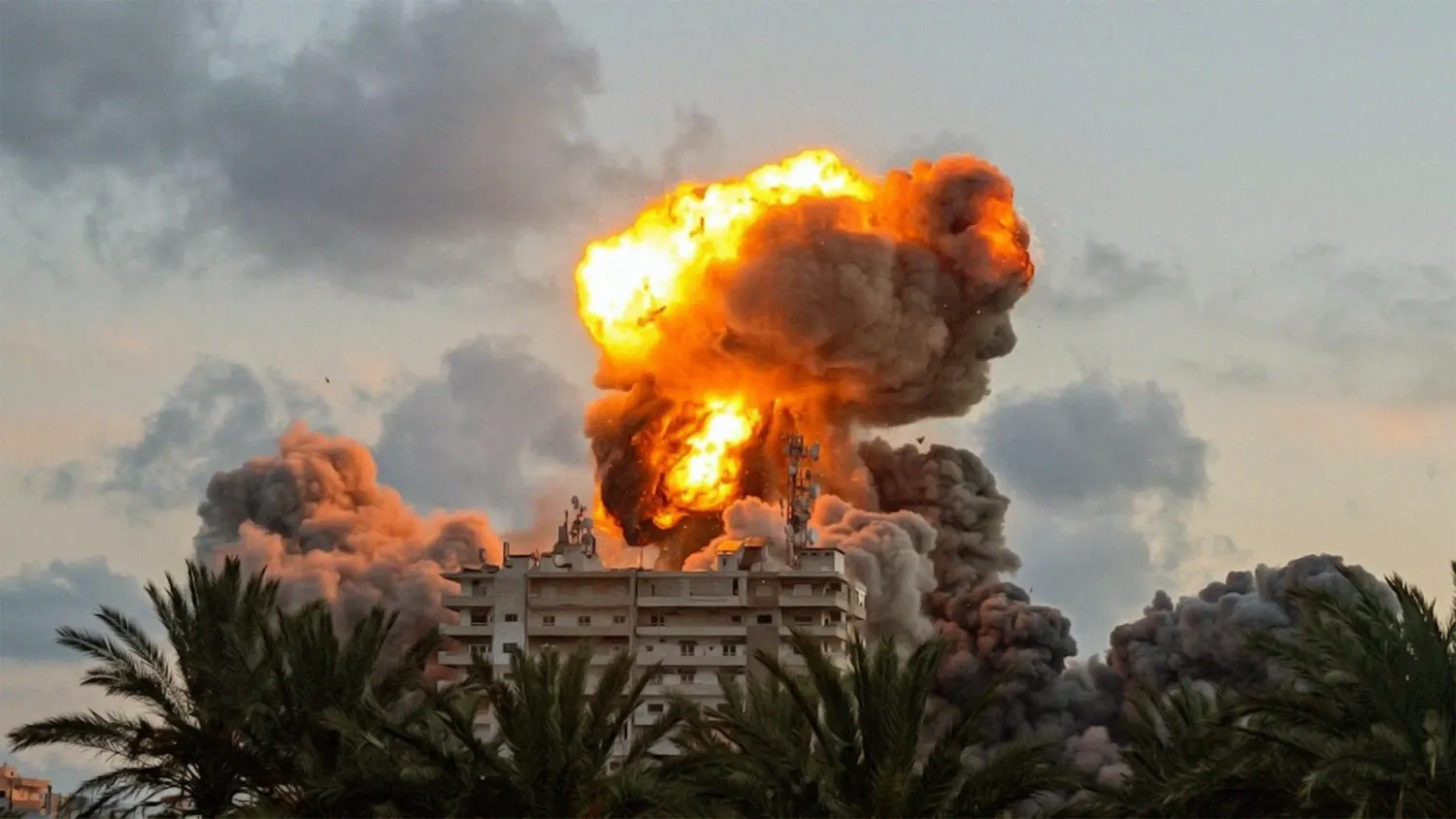
The smoke hadn’t cleared over Tyre when the delegations began boarding their flights to Washington.
In a single 24-hour window, Israeli forces launched nearly 100 distinct bombardment operations across Lebanon striking southern suburbs of Beirut, devastating the ancient port city of Tyre, pounding Nabatieh, and killing at least 28 people while wounding 42 more. The timing was not a coincidence. Military delegations from both Lebanon and Israel were scheduled to meet at the Pentagon that same day for U.S.-sponsored security talks making Thursday’s wave of strikes the most politically loaded in weeks.
This was not a skirmish. It was a statement delivered in explosives.
Beirut’s Southern Suburbs Break Their Silence
For weeks, the Lebanese capital’s southern outskirts had been spared the worst of the bombardment. That changed Thursday.
An Israeli airstrike hit a residential apartment building in the Choueifat neighborhood, the first major strike near Beirut since a temporary ceasefire extension was agreed upon in mid-May. For residents who had stayed put believing the capital’s suburbs offered some safety, the strike shattered that assumption completely. The informal boundary that had kept the war’s worst violence south of the city no longer holds.
The psychological impact reaches far beyond Choueifat. When strikes begin creeping toward the capital, the entire population recalibrates what “safe” means and recalibrates it downward.
Tyre and Nabatieh: Cities, Not Villages
The scale of destruction in Tyre and Nabatieh forces a reckoning with language. These are not border outposts. They are Lebanon’s fourth-largest city and its primary southern economic hub and both were reduced to craters overnight.
Nearly 100 strikes hit the two cities within 24 hours, collapsing residential blocks and commercial districts into rubble. The Israeli military simultaneously issued forced evacuation orders pushing thousands of civilians further north, past the Zahrani River, a boundary that had previously marked the outer edge of the war’s displacement wave.
Tyre carries a weight that goes beyond its population size. As a UNESCO World Heritage site, it holds millennia of Phoenician, Roman, and Crusader history. Overnight airstrikes have placed that irreplaceable heritage in direct danger, with massive blasts striking close enough to ancient ruins that structural damage is no longer a hypothetical.
Nabatieh’s destruction carries a different but equally serious consequence. As the administrative and commercial capital of the south, its paralysis cuts off supply lines, markets, and basic services for an entire region affecting not just those who stayed, but the hundreds of thousands already displaced who depended on its economy.
The Adloun Highway and the Myth of Safe Evacuation
Among Thursday’s most devastating strikes was one that targeted a family fleeing on the Adloun coastal highway. A drone strike wiped out the entire group of six including two children and their parents while they were doing exactly what the evacuation orders told them to do: leave.
That detail matters enormously. When evacuation routes become targets, the entire logic of civilian protection collapses. Families are no longer choosing between staying in danger or reaching safety. They are choosing between two different kinds of danger, with no good option available.
The coastal highway, like most of southern Lebanon’s road network, offers very few alternatives. Evacuating families are funneled onto a handful of arterial roads making them predictable and, as Thursday proved, vulnerable. The Lebanese Health Ministry confirmed that the volume of wounded from that single day completely overwhelmed remaining clinics in the south, forcing ambulances to make dangerous northward journeys toward Sidon just to find open trauma beds.
Also Among the Dead: Lebanese State Soldiers
Two Lebanese Army soldiers were killed in a strike on the Zefta-Deir al-Zahrani road. Their deaths add a dimension that will carry weight at the Pentagon table. Lebanon’s national army, the very institution that any peace framework would rely on to fill the security vacuum in the south is now taking direct fire.
The Lebanese delegation’s stated objective entering the Washington talks is an immediate, binding ceasefire before any broader security arrangements are discussed. The killing of state soldiers makes that demand harder to deprioritize.
Why Netanyahu Ordered the Escalation
Prime Minister Benjamin Netanyahu has directed the military to “deepen” operations and expand the security zone inside Lebanese territory. The trigger, according to Israeli military officials, is Hezbollah’s increasingly effective use of fiber-optic guided exploding drones against Israeli ground forces.
Unlike conventional radio-controlled drones, fiber-optic systems are extremely difficult to jam electronically. They have been striking armored Israeli columns attempting to advance toward Nabatieh, and they have already cost Israeli soldiers their lives. For a military built around air dominance and technological superiority, a weapon it cannot reliably counter is an urgent problem and Thursday’s mass strikes reflect the pressure that creates at the command level.
The logic is straightforward, if brutal: push Hezbollah’s launch zones further back before sitting down at a table where those zones might become protected by a new agreement.
A Humanitarian System Running on Empty
The displacement flowing northward from Tyre and Nabatieh is not abstract. Tens of thousands of families are converging on Sidon and the outer districts of Beirut, overwhelming schools, community centers, and half-built structures that were never designed for this purpose.
Aid organizations are now flagging a secondary humanitarian crisis taking shape inside the displacement itself: clean water running critically short, infant formula disappearing from makeshift shelter supplies, medical care inaccessible to people with wounds and chronic conditions who fled without medication or documentation.
The Zahrani River, now the de facto new boundary of Israel’s evacuation zone, is functioning as a human bottleneck, thousands of people pressing northward with nowhere sufficient to receive them.
The Pentagon Table, Set Amid the Ruins
Since the current phase of the conflict erupted on March 2, Lebanon’s Health Ministry has counted more than 3,200 dead and over a million people displaced. Those numbers frame every conversation happening in Washington.
The military coordination meeting at the Pentagon covering IDF withdrawal mechanics, Lebanese army deployment in the south, and ceasefire enforcement was always going to be difficult. Thursday’s nearly 100 strikes made it more so. Israel has arrived at the table having spent the previous 24 hours demonstrating, emphatically, how much military ground it can cover before any agreement constrains it.
For Lebanon, the core ask remains unchanged: stop the killing before negotiating the architecture of what comes next. Whether Washington can bridge that demand with Israel’s insistence on locking in military gains before ceding leverage is the question that will define whether Friday’s meeting produces anything more than a photo and a press release.
Outside, the smoke over Tyre and the rubble of Choueifat will be waiting regardless of the answer.