The European Union is facing one of its deepest foreign policy divides in years and the stakes go far beyond trade.
As pressure mounts over Israel’s actions in Gaza, the West Bank, and Lebanon, EU leaders are locked in a prolonged internal battle over whether to suspend a major trade agreement.
At the heart of the dispute is a simple but explosive question: Can the EU continue “business as usual” with Israel while claiming to uphold human rights?
The answer, so far, is paralysis.
The Root of the Conflict: A Clause Put to the Test
The controversy centers on the EU–Israel Association Agreement, a trade pact that governs political and economic relations.
Crucially, Article 2 of the agreement requires that cooperation be based on “respect for human rights and democratic principles.”
That clause once largely symbolic has now become the focal point of a legal and moral dispute.
By mid 2025, the EU’s own diplomatic service had reportedly concluded that Israel was in breach of these conditions.
Yet nearly a year later, the EU has still failed to act.
What Just Happened: April 2026 and the Failed Vote
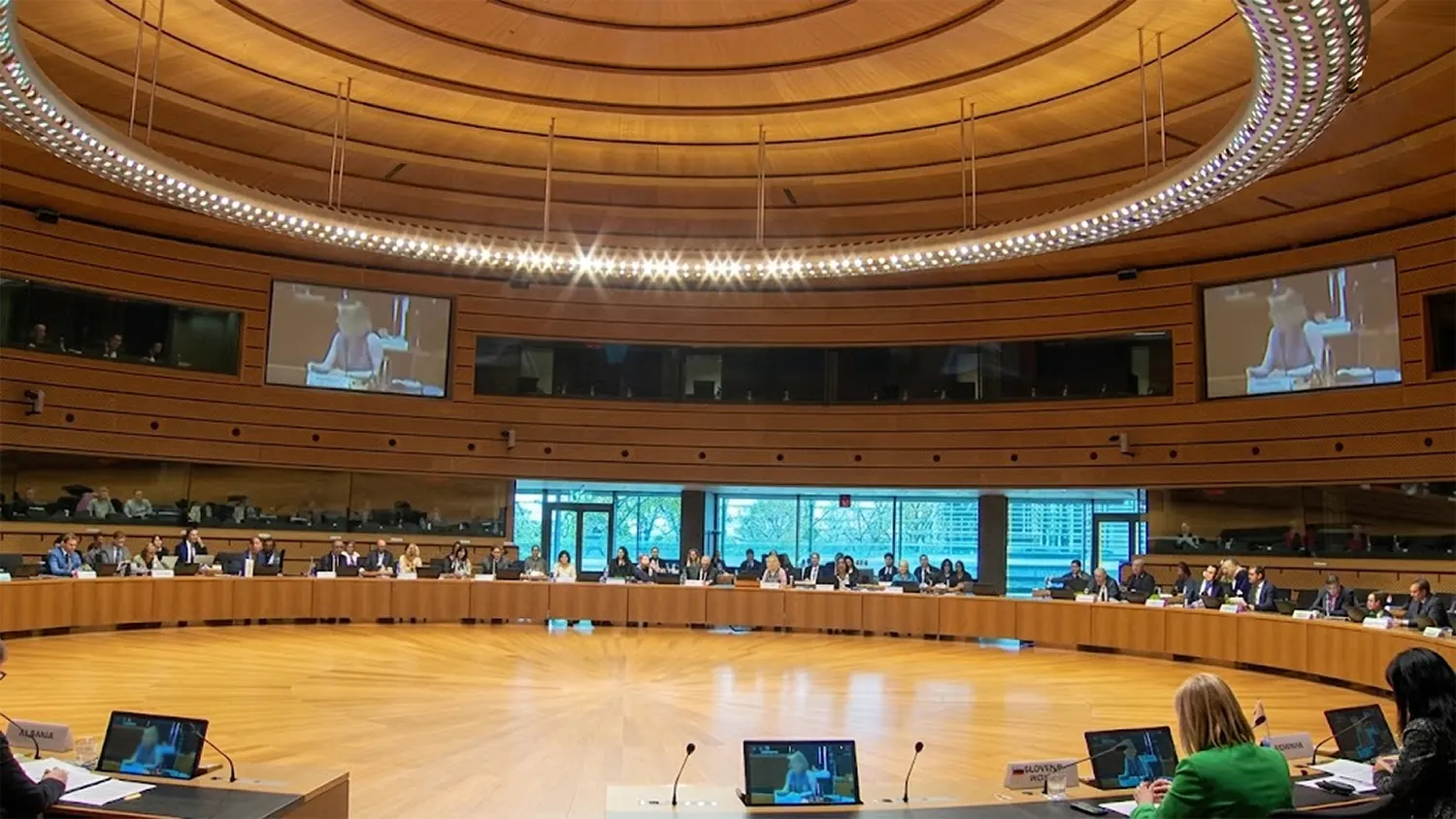
The latest turning point came on April 21, 2026, during a meeting of EU foreign ministers in Luxembourg.
A proposal to suspend the agreement either fully or partially failed to gain enough support.
The divide is clear:
- Ireland, Spain, and Slovenia pushed for suspension, arguing that continued trade makes the EU complicit in human rights violations.
- Germany, Italy, and Austria blocked the move, insisting that engagement is more effective than isolation.
Even attempts at a compromise fell short.
Neither the unanimity required for a full suspension nor the “qualified majority” needed for a partial suspension could be reached.
Mounting Pressure: UN, NGOs, and Public Opinion
As EU governments argue, outside pressure has intensified dramatically.
On April 20, 2026, a UN expert panel called suspension a “legal imperative” rather than a political choice.
More than 70 NGOs including major human rights organizations have demanded an end to what they describe as “business as usual.”
Public pressure is also growing.
A European Citizens’ Initiative titled “Justice for Palestine” gathered over 1.1 million signatures, forcing the European Commission to formally respond.
Meanwhile, critics point to:
- A 2024 advisory opinion from the International Court of Justice
- 2025 arrest warrants issued by the International Criminal Court
Together, these developments are being used to argue that the EU is legally obligated to act under its own rules.
Why the EU Acted Fast on Russia but Not on Israel
The EU’s hesitation stands in stark contrast to its response to Russia’s invasion of Ukraine in 2022.
Back then, the bloc moved from warning to sweeping sanctions in less than 48 hours.
Within days, the EU had:
- Frozen assets of Russian leadership
- Cut major banks from SWIFT
- Locked Russia’s central bank reserves
- Closed European airspace
So why the difference?
First, there was immediate unity. Russia’s invasion was seen as a clear violation of international law and a direct threat to Europe itself.
Second, the situation with Israel is far more politically contested. EU states disagree on whether Israel’s actions constitute human rights violations or legitimate self defense.
Third, the relationship is more complex. Unlike Russia, Israel is deeply integrated into European technology, security, and intelligence networks.
In short: Russia became a pariah overnight. Israel remains a partner under debate.
The Push for Suspension: A Growing Internal Revolt
The strongest challenge to the status quo is coming from Ireland, Spain, Slovenia and increasingly Belgium.
They argue that continuing trade preferences is no longer neutral, it is a form of indirect support.
Their case rests on three main points:
- Gaza: Ongoing humanitarian conditions make preferential trade morally untenable.
- West Bank settlements: Existing rules excluding settlement goods are seen as weak and poorly enforced.
- Lebanon escalation: Expanding military operations have widened concerns beyond Gaza.
As a result, some countries are no longer waiting for Brussels.
Spain and Slovenia have already passed domestic laws restricting trade with settlement-linked goods.
Ireland has revived legislation that could criminalize such trade at the national level.
Why the EU Is Paralyzed
Despite growing pressure, the EU remains stuck due to both legal rules and political realities.
The biggest barrier is unanimity. Any full suspension requires all 27 member states to agree giving countries like Germany an effective veto.
Even a partial suspension requires a complex weighted majority that has not materialized.
But the deeper issue is political.
The EU is split into two camps with fundamentally different worldviews.
- One sees suspension as a moral and legal obligation.
- The other sees it as a strategic mistake that would weaken Europe’s influence.
Germany’s Role: The Decisive Blocker
At the center of the stalemate is Germany.
Foreign Minister Johann Wadephul has made Berlin’s position clear:
“Critical, constructive dialogue” is more effective than cutting ties.
Germany argues that:
- The trade agreement is a key channel of influence. Ending it would remove the EU’s ability to shape Israeli policy.
- Maintaining engagement helps preserve the possibility of a two state solution.
- A rupture could strengthen hardliners within Israel rather than moderate them.
This stance is reinforced by historical and strategic considerations.
For Germany, relations with Israel are tied to its national identity and foreign policy doctrine.
Italy and Austria largely align with this view, providing the votes needed to block action.
The Backlash: “Dialogue or Inaction?”
Opponents of this approach are increasingly vocal.
Critics argue that “dialogue” has become a substitute for action.
They point out that:
- Legal bodies like the ICJ and ICC have already taken significant steps
- Humanitarian conditions continue to worsen
- EU leverage has not produced meaningful change
From this perspective, continuing trade is not neutral, it is complicity.
Where EU Policy Goes From Here
For now, the proposal to suspend the agreement remains officially “on the table.”
But without a shift from key countries like Germany or Italy, a bloc-wide decision appears unlikely in the near term.
Instead, the EU may drift toward a fragmented approach:
- Some countries imposing national restrictions
- Others maintaining full trade ties
- Brussels continuing to pursue dialogue without enforcement
This could mark a turning point in how EU foreign policy operates less unified, more decentralized.
A Test of Europe’s Credibility
The EU’s internal divide over Israel is no longer just a policy disagreement, it is a test of its credibility as a global actor.
On paper, the bloc champions human rights as a core principle. In practice, it is struggling to enforce them when member states disagree.
As the gap between rhetoric and action widens, the real question is not just what the EU will do but whether it can still act as one at all.