Would you change what you eat if you knew your genes were quietly shaping your brain’s future?
For decades, the advice has been simple: eat less red meat, protect your heart and your brain will follow. But a provocative new study is now challenging that idea in a very
specific and deeply personal way.
A genetic twist that flips dietary advice on its head
In research published in JAMA Network Open, scientists tracked more than 2,100 older adults over 15 years. What they found wasn’t just surprising, it was almost paradoxical.
For people carrying a high risk Alzheimer’s gene variant called APOE4, higher meat consumption was linked to slower cognitive decline.
Even more striking: among those who ate the most meat about 870 grams per week,
the usual cognitive disadvantage associated with this gene virtually disappeared.
In plain terms:
The very gene that raises your risk for Alzheimer’s might also come with a hidden dietary workaround.
But the flip side was just as stark. APOE4 carriers who ate the least meat had twice the risk of developing dementia compared to people without the gene.
Why this matters: the end of “one size fits all” nutrition
For years, diets like the Mediterranean and MIND diets have been considered gold standards for brain health. They emphasize plants, fish, and minimal red meat.
This study doesn’t exactly overturn that advice but it complicates it in a big way.
Because it suggests something scientists are increasingly coming to terms with:
“Healthy” isn’t universal, it’s personal.
Your body isn’t just responding to food. It’s interpreting it through your genetic wiring.
A throwback to our ancestors? The evolutionary clue
To understand this, researchers looked backward way backward.
The APOE4 variant is considered the oldest version of the gene, dating back to early human ancestors who lived as “hypercarnivores,” relying heavily on animal protein.
Newer variants APOE2 and APOE3 emerged later, as humans adapted to more varied,
plant rich diets.
That leads to a fascinating hypothesis:
APOE4 brains may still be biologically “tuned” for a meat heavy diet.
Think of it like running modern software on older hardware. Some systems perform best when you match them with what they were originally designed for.
Inside the brain: why protein and fat might matter more here
The APOE gene plays a crucial role in the brain. It helps transport fats and clear away amyloid beta, the sticky protein linked to Alzheimer’s.
But APOE4 isn’t very efficient at this job.
So researchers suspect that diet may help compensate.
Here’s how:
- Nutrient supply for repair:
The brain is about 60% fat, and it needs constant maintenance. Nutrients like vitamin B12, iron, and amino acids abundant in unprocessed meat may provide essential building blocks. - Fuel switching:
APOE4 brains often struggle to use glucose efficiently, a phenomenon sometimes nicknamed “Type 3 diabetes.”
A higher protein, lower carb diet may push the brain toward alternative fuel sources like ketones, which burn more cleanly.
In essence: the right diet might help an APOE4 brain work around its own inefficiencies.
Not all meat is created equal
Before this turns into a free pass for bacon and sausages, there’s a crucial distinction.
The benefits only appeared with unprocessed meat.
Processed meats like deli slices, hot dogs, and bacon were still associated with worse outcomes across the board.
Why? Likely due to:
- Nitrates and preservatives
- Excess sodium
- Inflammation triggering compounds
For a brain already prone to inflammation, that’s like adding fuel to a slow burning fire.
The quiet hero: fish steps into the spotlight
Interestingly, meat wasn’t the only player.
Fish showed similar protective effects for APOE4 carriers.
That’s a major clue.
It suggests the benefit may not come from red meat specifically, but from high quality, bioavailable combinations of protein and fat especially omega 3 fatty acids like DHA and EPA.
This opens a middle path:
You might not need steak, you might just need the right kind of nutrients.
How scientists pieced this together (without a lab coat lecture)
This wasn’t a controlled experiment where people were told exactly what to eat.
Instead, researchers observed real people over time, tracking their diets and cognitive health across 15 years.
They compared:
- Genetic profiles (who had APOE4)
- Dietary habits (how much meat or fish people ate)
- Cognitive performance over time
This kind of study reveals patterns and associations, not direct cause and effect.
Which brings us to an important caveat.
What this study doesn’t prove (yet)
As compelling as the findings are, they come with unanswered questions.
- Is it really the meat or something else?
People who eat more high quality meat might also exercise more or have better access to healthcare. - Is it about carbs, not protein?
A meat heavy diet often means fewer refined carbohydrates. That alone could benefit brain metabolism. - Do nutrients cross into the brain differently?
Scientists still don’t fully understand how diet interacts with the blood brain barrier in APOE4 carriers.
Bottom line:
This study shows a strong link but not definitive proof.
Clinical trials, where diets are carefully controlled, are the next step.
A future where your doctor prescribes a “genetic grocery list”
If these findings hold up, we could be heading toward a radically different model of nutrition.
Instead of general advice, you might get something like this:
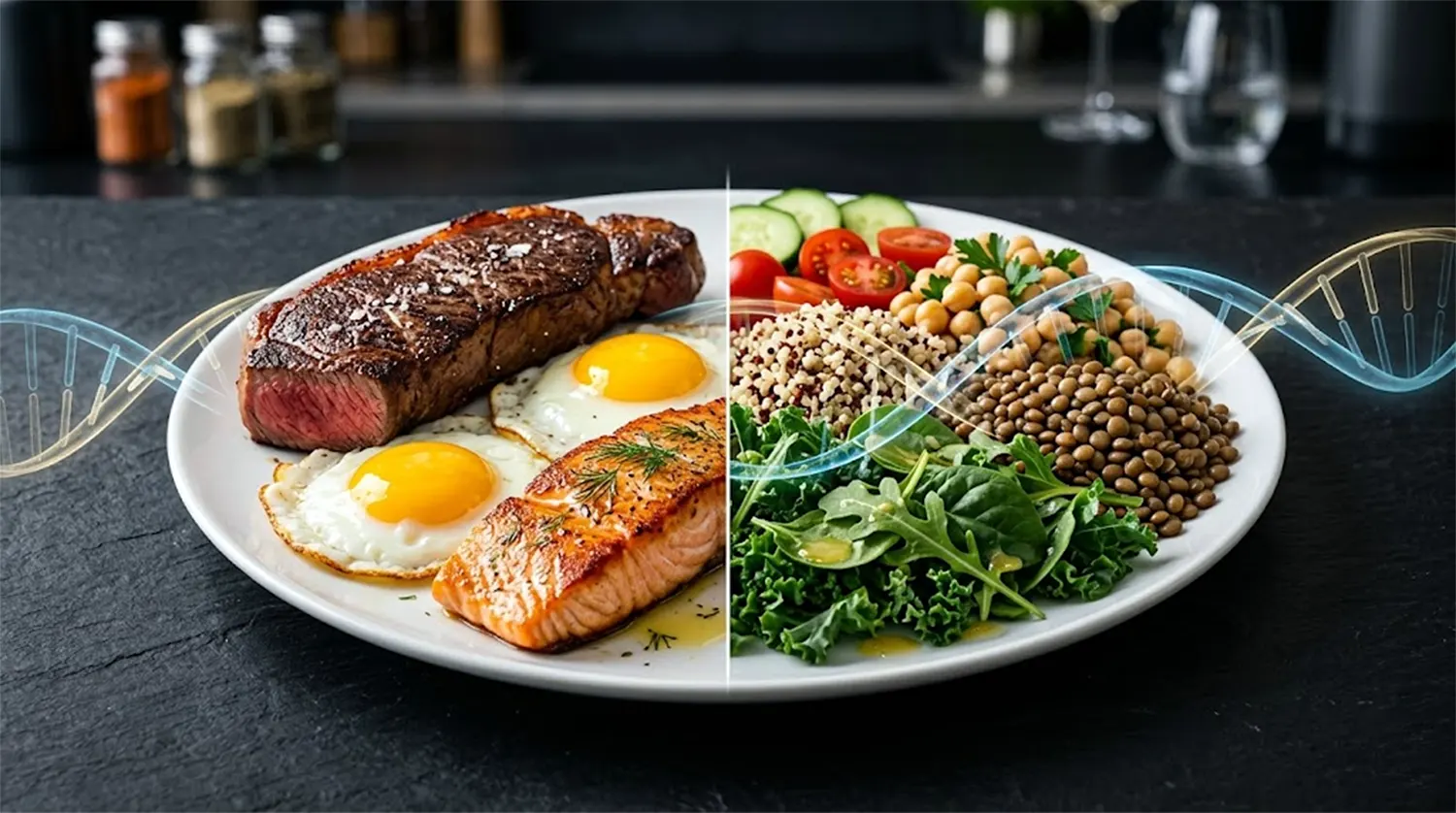
- APOE4 carriers:
A diet richer in unprocessed meats, fish, and healthy fats, with fewer refined carbs. - Non carriers:
A more plant forward, Mediterranean style approach.
It’s the difference between one diet for everyone and a diet tailored to your DNA.
The uncomfortable question: do you even want to know your risk?
There’s a deeper layer to all of this.
To follow the “right” diet, you first need to know whether you carry the APOE4 gene.
But many people avoid genetic testing for a reason:
What if you find out you’re at higher risk for Alzheimer’s and there’s no guaranteed
cure?
This study adds a new wrinkle. It suggests that knowledge might not just bring anxiety,
it might also bring agency.
Where this leaves us
This research doesn’t give us a simple answer. Instead, it offers something more valuable:
A shift in perspective.
It tells us that nutrition isn’t just about food, it’s about fit. The alignment between what you eat and how your body is built.
And in that sense, the future of brain health may look less like a universal diet and more
like a personalized strategy written in your DNA.
The big question now isn’t just “What should we eat?”
It’s becoming:
“What should you eat?”