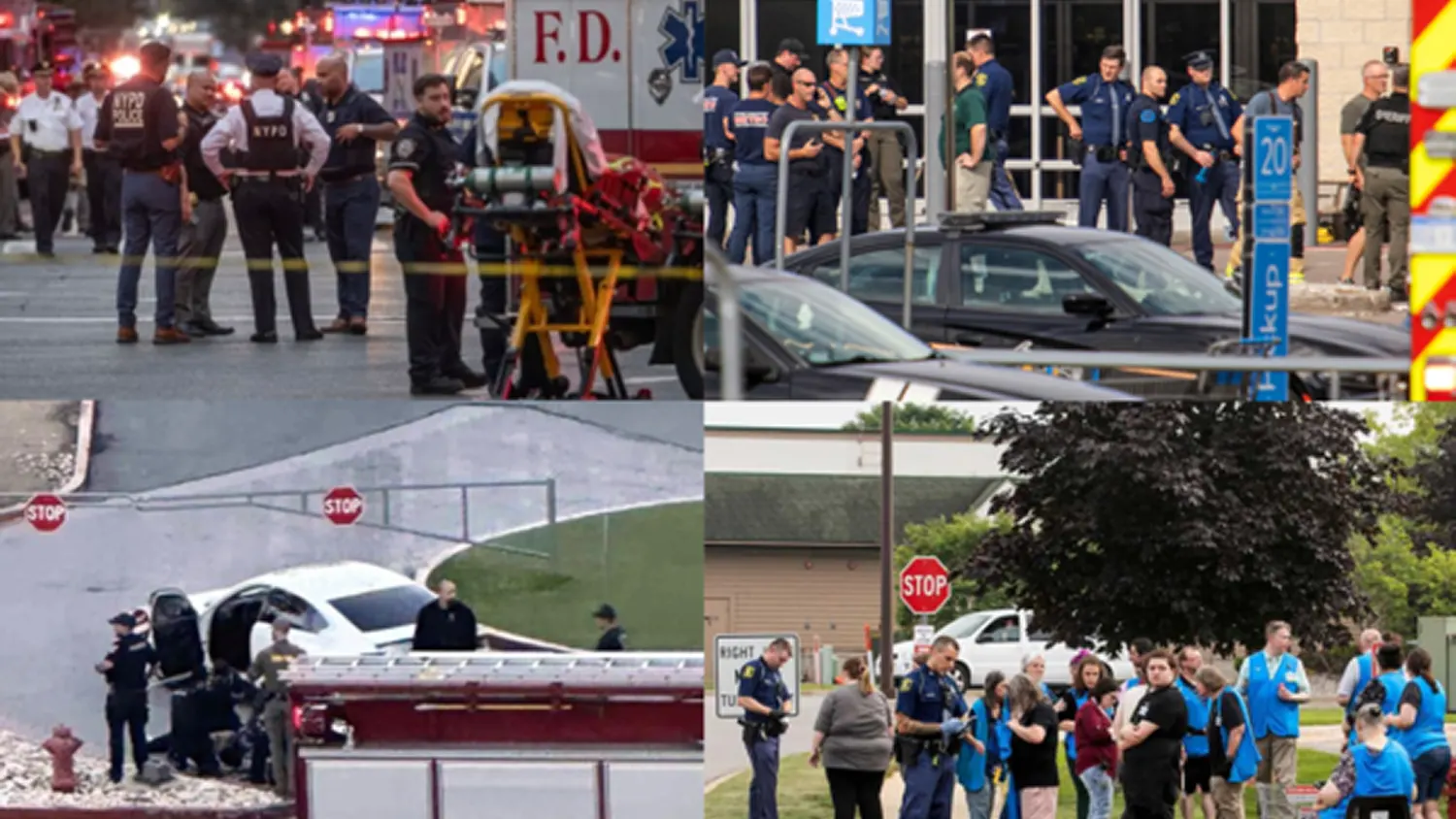
In a single week, the United States has been shaken by a series of violent incidents from a shooting in a Midtown Manhattan office building, to gunfire near a Nevada casino, to a stabbing inside a Michigan Walmart.
These events are not just isolated tragedies, they reflect a deeper emotional rupture in how safe people feel in everyday public spaces.
Even as official data suggests crime is declining in many U.S. cities, the psychological impact of high profile violence tells a very different story.
A Shocking Pattern in Familiar Places
What makes these incidents especially disturbing is not only their severity, but their locations.
Offices, retail stores, and entertainment venues are places people associate with normal life not danger.
When violence erupts in these settings, it disrupts more than just physical safety. It breaks the unspoken trust people have in public spaces.
A workplace is supposed to be routine. A shopping trip should be ordinary. A night out should feel predictable.
But each new attack reinforces a growing uncertainty: that nowhere feels fully protected anymore.
The Numbers Tell a Different Story
At the same time, official statistics offer a more reassuring perspective.
Many U.S. cities have reported declines in violent crime in early 2025, including drops in homicides and gun related assaults.
On paper, this suggests progress. It suggests that long term safety trends may be improving.
But statistics struggle to capture emotional reality.
Because even if overall crime is falling, a single violent event can reshape public perception instantly.
When Fear Outpaces Data
This gap between data and perception is where the real tension lies.
A city can be statistically safer, yet still feel more dangerous.
High profile acts of violence create a ripple effect that extends far beyond the immediate victims.
People begin to question routine actions going to work, shopping, traveling, or attending public events.
That quiet psychological shift is difficult to measure, but deeply felt.
Safety becomes less about numbers and more about instinct.
The Human and Economic Fallout
The impact of these incidents does not end with fear. It spreads into daily life and local economies.
After mass violence, public spaces often see reduced foot traffic, lower spending, and disrupted community activity.
Businesses lose customers. Workers lose income stability. Cities invest more in security infrastructure.
But those costs come with trade offs.
Money that could support education, healthcare, or social programs is increasingly redirected toward safety and prevention measures.
In this way, violence reshapes not only emotions but economic priorities as well.
A Difficult National Conversation
These recurring incidents continue to fuel complex debates in American society.
Questions around gun access, mental health care, and prevention systems remain unresolved and often deeply divided.
Each new tragedy reignites the same national conversation, yet lasting solutions remain difficult to reach.
At the center of it all is a shared concern: how to protect public safety without eroding civil liberties or ignoring deeper social issues.
The Erosion of Everyday Trust
Perhaps the most lasting impact is not visible in statistics or policy reports. It is emotional.
Violence in everyday spaces slowly erodes the sense of normalcy that people rely on to live their lives.
Over time, this creates a subtle but powerful shift in behavior how people move, where they go, and what they consider safe.
It is not just fear of becoming a victim. It is something broader.
It is the loss of confidence in the predictability of public life.
The Core Reality
Even as crime rates fluctuate and long-term data shows improvement, the emotional weight of mass violence continues to shape public perception in the United States.
These incidents highlight a critical truth:
Safety is not only a statistical measure, it is a lived experience shaped by trust, routine, and perception.
And when that trust is repeatedly shaken, rebuilding it becomes just as important as addressing the violence itself.