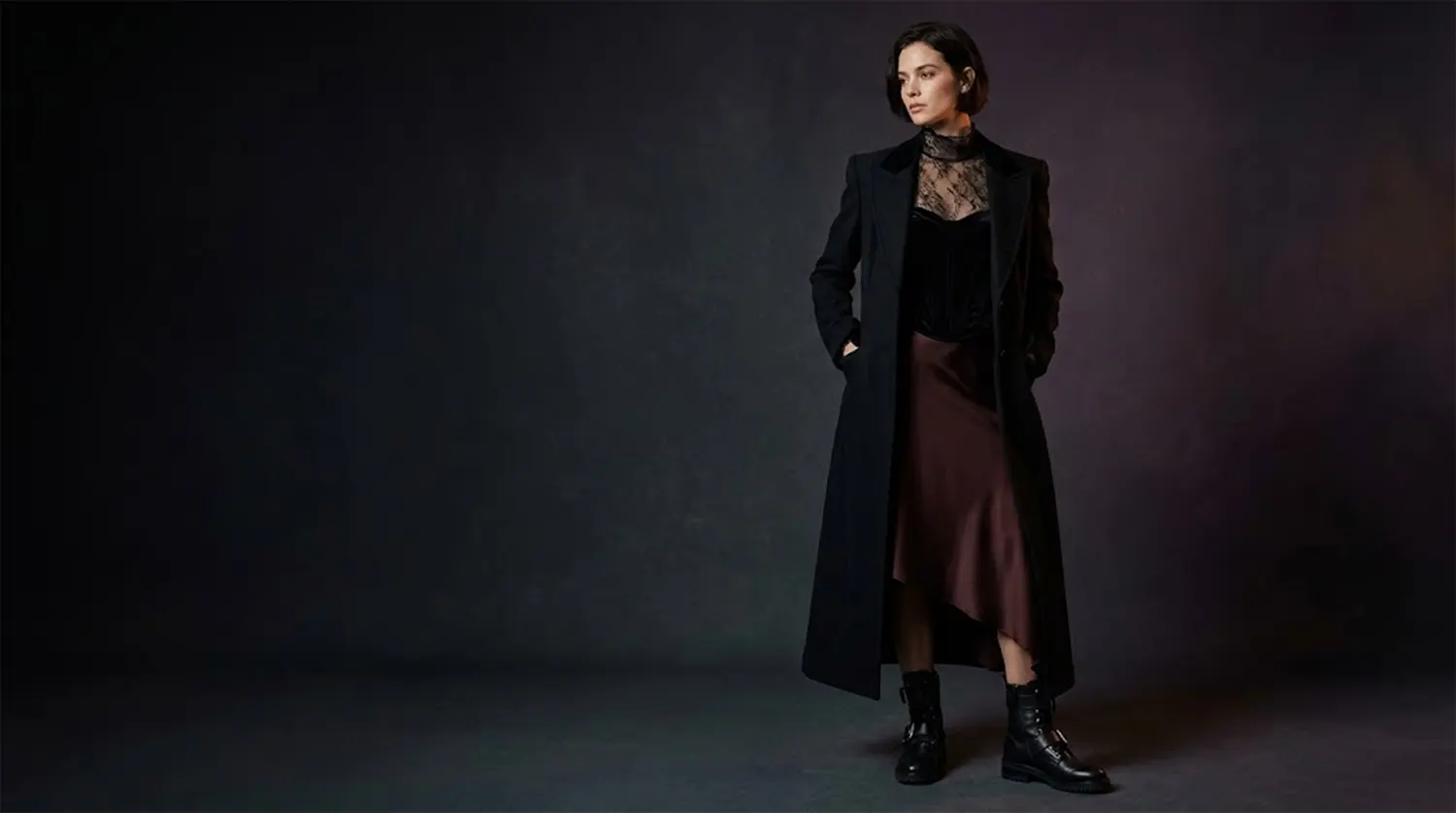
Fashion has grown tired of flat, clean minimalism. In its place, a moodier, richer aesthetic is taking over closets: Dark Romance and Tactile Layering. Think brooding color palettes, fabrics you actually want to touch, and silhouettes that mix soft and hard in the same outfit. It’s not about going full gothic, it’s about texture, contrast, and a little bit of drama, done in a way that still works for the school run, the office, or a night out.
The Formula: Heavy Meets Sheer
At its core, this trend is about texture contrast. Substantial materials, think butter-soft suede, distressed leather, shearling, or chunky bouclé knits get paired directly against something delicate, like sheer black lace, tulle, or fluid silk chiffon. That push and pull between heavy and diaphanous is what gives the look its depth.
Even monochrome outfits avoid looking flat because of surface variety: ribbed knits, crushed velvet, and beadwork all catch the light differently, so an all-black look still reads as rich rather than plain.
Silhouettes lean on gothic tailoring sharp, structured blazers and corsetry that anchor looser, fluid pieces like asymmetrical skirts or dramatic capelets. A dash of Victorian influence shows up too, in high ruffle necks, delicate lace trims, and dropped-waist cuts, giving everything a moody, historical undertone without tipping into cosplay territory.
As for color, the palette stays deliberately restrained: jet black, deep plum, midnight navy, espresso brown, and faded oxblood. Metallic hardware, heavy leather boots, or sun-bleached denim are then layered in to keep the romantic drapery from feeling too precious.
Building a Capsule Wardrobe Around the Trend
The easiest way to make this aesthetic wearable long-term is to build a small, flexible capsule instead of chasing individual “trend” pieces. Because everything shares the same tonal palette, nearly every item mixes and matches.
A solid 12-piece capsule looks something like this:
- Tailored floor-length coat — wool or heavy crepe, jet black or espresso, structured shoulders
- Distressed leather jacket — oversized, subtle sun-bleached wash, heavy hardware
- Sheer high-neck blouse — black or plum lace/chiffon with ruffle cuffs
- Fine-gauge fitted knit — charcoal or burgundy, ribbed, thumbholes or asymmetrical cut
- Structured corset top — dark velvet or satin, worn alone or layered
- Asymmetric slip skirt — black silk or satin, uneven hemline
- Wide-leg tailored trousers — high-waisted, midnight or charcoal
- Washed black denim — straight or wide-leg with raw hems
- Tiered maxi dress — sheer sleeves, deep oxblood chiffon
- Heavy combat or moto boots — black leather, silver buckles
- Pointed-toe ankle boots — sleek leather or suede
- Statement hardware belt — black leather with pewter or silver buckle detail
From there, a handful of go-to combinations cover most of the week:
The daily contrast (casual): sheer blouse over a black cami, washed black denim, moto boots, leather jacket on top. Gothic tailoring (work or evening): a velvet corset layered over a thin knit, wide-leg trousers, pointed boots. Fluid romanticism (weekend): an oversized knit half-tucked into a satin slip skirt, grounded by combat boots. Dramatic layers (cold weather): a tiered maxi dress under a floor-length coat, cinched at the waist with the hardware belt.
The 70/30 Rule for Everyday Wear
The biggest risk with any dramatic aesthetic is looking like you’re in costume rather than getting dressed. The fix is a simple ratio: keep 70% of the outfit grounded in relaxed streetwear or casual tailoring, and let the romantic, dramatic elements make up the remaining 30%.
Four formulas make this easy to apply:
Rough and delicate split: an oversized leather or denim jacket over a sheer or lace top, finished with plain jeans. The worn-in denim balances out the delicate chiffon.
Tailored corsetry layering: a corset worn over a basic tee or thin knit, paired with wide-leg trousers and sneakers or flat boots. The plain tee instantly softens the drama of the corset.
Slouchy knit over fluid silk: a chunky sweater thrown over a satin slip skirt, finished with lug-sole boots. The sweater hides the dressiness of the satin, so the whole look feels cozy instead of formal.
Moody monochrome anchor: an all-black base of tee and jeans, topped with one dramatic outerwear piece, a duster coat or sheer cardigan plus silver hardware. Keeping the base simple lets one statement piece do all the work.
A few extra rules help on busy days: swap heels for flat, heavy soles like combat boots or lug-sole loafers so sheer fabrics stay practical for walking; keep makeup minimal with dewy skin and a simple lip rather than heavy dark makeup; and mix matte and shine pairing flat cotton or wool with satin or leather accents to keep even an all-black outfit visually interesting.
Taking the Look Into the Office
Dark Romance can absolutely work in a business-casual or corporate setting, but it needs a few adjustments. The goal shifts from “moody and dramatic” to mysterious and polished, without any sheer skin or unfinished edges showing through.
A few rules make the transition smooth. Layer sheer fabrics rather than wearing them exposed, a lace or chiffon blouse works best underneath a structured wool vest or sharp blazer, so only the collar and sleeves peek through. Lean on Victorian details instead of sheerness, like high collars, pussybow ties, pleated cuffs, and oxidized silver hardware buttons. Stick to heavy, tactile office fabrics such as worsted wool, cotton poplin, tailored leather, and ribbed cashmere. And widen the color palette beyond black, bringing in deep plum, midnight navy, espresso, and oxblood for a softer, more office-appropriate feel.
Three outfit blueprints translate well from desk to evening: a high-neck lace blouse under a charcoal wool suit, finished with pointed pumps; a fitted turtleneck with a satin midi skirt under an oversized blazer; or a ruffle-cuff blouse with a structured leather midi skirt and a longline wool coat. For shoes and jewelry, swap bright gold for burnished silver, gunmetal, or oxidized pewter, and choose structural cuffs or dark gemstone pieces over anything flashy.
A Trend Built for Every Wardrobe
One of the more overlooked things about this aesthetic is that it’s inherently gender-neutral. Its roots trace back to 19th-century Victorian dandyism, gothic romanticism, and 1980s post-punk, all subcultures where lace, velvet, long coats, and heavy hardware were never assigned to one gender in the first place.
The staples that carry across every wardrobe include floor-length duster coats, high-neck Victorian shirts, chunky knits, wide-leg trousers, and lug-sole boots. For a more masculine or androgynous take, corsets can be swapped for structured waistcoats or harness detailing, silhouettes can lean into volume with sweeping coats and dropped shoulders rather than fitted shapes, and lace can be used sparingly as a sleeve peeking from under a blazer cuff, rather than as the main event.
Why This Aesthetic Is Back Right Now
Old aesthetics rarely resurface as exact copies, they get remixed. While the references here are old (Victorian mourning attire, 19th-century literature, 1980s post-punk, 1990s mall goth), the current execution feels distinctly modern.
Traditional goth style leaned maximalist, with layered chains, fishnets, and heavy hardware. The current version favors “gothic minimalism” instead sharp tailoring, long clean coats, and quiet monochrome styling. Rather than dressing head-to-toe in subculture gear, today’s version mixes one or two historical, romantic pieces with everyday basics like relaxed jeans or clean leather sneakers, which is exactly what keeps it wearable rather than costume-like. The revival is also being pushed along by pop culture, gothic film adaptations, moody period dramas, and public figures embracing darker, more dramatic styling are all putting the aesthetic back in view.
Does It Actually Have to Be Expensive?
This look naturally reads as expensive, even before you check the price tag. That’s because it depends on texture, weight, and structure rather than flat, trend-driven prints and those are things cheap fabric struggles to fake. Suede, shearling, distressed leather, and lace catch and reflect light in a way that flat polyester simply doesn’t. Structured pieces like duster coats and corsetry also need denser fabric and careful tailoring to drape properly, and the palette itself black, oxblood, plum, espresso reads as richer than anything neon or trend-chasing.
At the luxury level, it genuinely is expensive: houses like Alexander McQueen, Khaite, Saint Laurent, Ann Demeulemeester, and Bottega Veneta build entire collections around this mood using real shearling, silk lace, and hand-finished leather, with single pieces easily running into the thousands.
But the everyday version doesn’t require that budget. Two habits get you most of the way there. Thrift and shop secondhand because the trend borrows so heavily from Victorian, post-punk, and 90s goth references, real leather jackets, wool coats, and lace blouses show up constantly on resale apps for a fraction of retail. And anchor the outfit with just one or two heavily textured pieces, a leather jacket or a satin asymmetric skirt, paired with plain basics like black jeans or a simple tee. That contrast alone is usually enough to make the whole outfit read as high-end.