The ink on the U.S.-Iran Memorandum of Understanding had barely dried when the first crisis hit. Signed on June 17, the MoU set off a brief wave of global optimism, a deal was finally in motion. But within 48 hours of the signing, the peace process slammed headfirst into the very conflict it was designed to end.
What’s unfolding right now at the Bürgenstock resort above Lake Lucerne, Switzerland, is not a smooth diplomatic summit. It’s a high-wire act where the rope is fraying at both ends.
The Single Clause That’s Breaking Everything
The fight comes down to Clause 1 of the MoU, which requires both the U.S. and Iran along with their respective allies to declare an immediate and permanent halt to military operations on all fronts, including Lebanon.
The problem? Israel, which was not a party to the negotiations, has continued launching heavy airstrikes across southern Lebanon in the 48 hours since the agreement was signed. At least 16 people were killed in those strikes yesterday alone.
Tehran’s response was swift and furious. Iran declared this a “clear breach of faith” on Washington’s part arguing that the U.S. cannot sign an agreement requiring a ceasefire and then fail to deliver one from its closest regional ally. Washington’s counter-argument is equally straightforward: the U.S. cannot entirely dictate Israel’s independent military decisions.
That structural gap where the U.S. is being held responsible for actions it didn’t take and may not be able to stop is now the central obstacle threatening to derail talks before they even get off the ground.
Iran Closes the Strait. Or Did It?
Escalating the pressure further, Iran’s Khatam al-Anbiya Central Headquarters and the Islamic Revolutionary Guard Corps (IRGC) announced that the Strait of Hormuz is closed to maritime traffic warning all vessels to stay clear as their security can no longer be guaranteed. They framed it as their “first response” to the U.S.’s failure to restrain Israel.
The announcement immediately rattled energy markets. Except the U.S. military says there’s no actual blockade.
CENTCOM reported that 55 merchant ships safely transited the strait on Saturday alone, carrying over 17 million barrels of oil. Vice President J.D. Vance, leading the American delegation in Switzerland, publicly downplayed the closure, noting that millions of barrels successfully moved through Omani waters over the weekend.
President Trump, however, took a markedly sharper tone warning Iranian officials directly that if the Strait remains closed, “You won’t even make it back to your country,” and floating the idea that the U.S. could physically take control of the waterway and impose a 20% oil toll on passing shipments.
Because this standoff is playing out over the weekend while global markets remain closed, energy analysts are bracing for a violent oil price surge when trading reopens Monday morning, a stark reminder of how quickly diplomatic friction translates into economic pain for the rest of the world.
Inside the Room: Who’s Sitting Across the Table
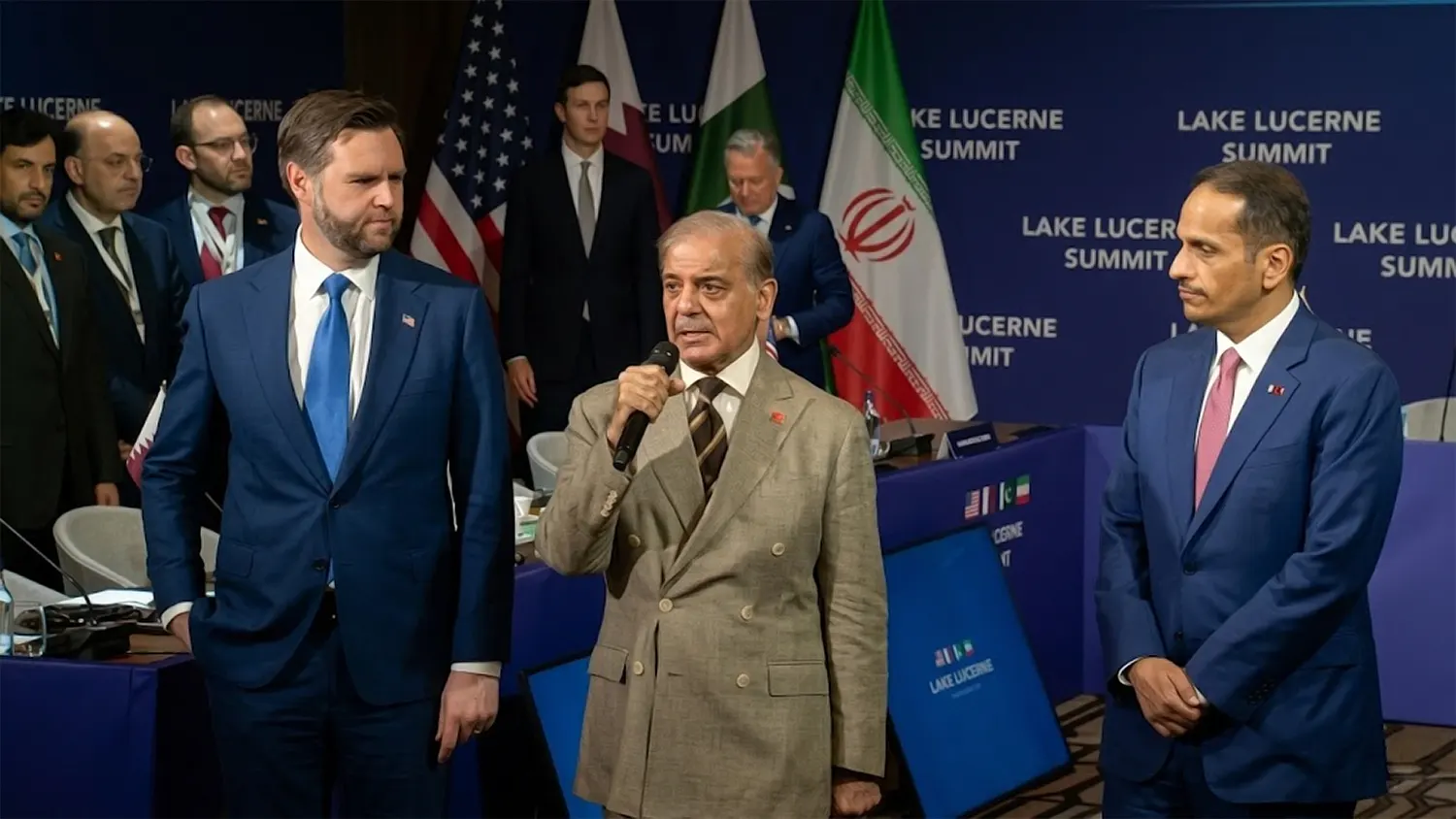
Despite the tensions, delegations from both sides are physically present in Bürgenstock and the composition of those teams reveals exactly how seriously both governments are taking these talks.
The U.S. delegation is led by Vice President J.D. Vance, with Special Envoy Steve Witkoff and Jared Kushner also at the table. Their focus is split between managing the significant backlash the deal is drawing from traditional regional allies, and keeping a close eye on global energy market stability.
The Iranian delegation is led by Parliament Speaker Mohammad Bagher Ghalibaf, alongside Foreign Minister Abbas Araghchi. Ghalibaf is operating under strict directives from Tehran’s Supreme National Security Council walking a careful line between projecting military strength and securing the oil sanctions relief his country desperately needs.
The mediating delegations arguably the most crucial figures in the room are led by Pakistani Prime Minister Shehbaz Sharif and Pakistani Army Chief Asim Munir, alongside Qatari Prime Minister Sheikh Mohammed bin Abdulrahman Al Thani. It was Pakistan and Qatar who brokered the original “Islamabad MoU” that made these face-to-face sessions possible, and they’re now quite literally shuttling between rooms to keep the conversation alive.
The Handshake That Never Happened
Organizers had planned a moment designed for the cameras, a formal handshake and joint photo between Vance and Ghalibaf that would signal progress to a watching world.
The Iranian delegation refused.
Qatari and Swiss organizers were forced to quickly clear the media out of the room. The photo session went ahead with only the Western and mediating teams present. The Iranian delegation only entered after the cameras were gone, demanding a five-minute delay specifically so they wouldn’t appear on screen alongside the Americans.
On-the-ground diplomats are describing the atmosphere as “profoundly frosty.” That phrase doesn’t quite capture the severity what’s actually happening is two delegations operating in the same building while maintaining near-total hostile distance.
Two Tracks, One Very Short Window
To prevent the whole process from collapsing over the immediate military flashpoints, technical groups have split the agenda into two parallel tracks:
Track 1 — Immediate Crisis Management: Lebanon de-escalation, Hormuz shipping re-entry, and blockade disentanglement. This is what has to be resolved now, before anything else can move forward.
Track 2 — Long-Term Framework: Iran’s nuclear down-blending, a proposed $300 billion reconstruction plan, and phased sanctions removal. These were always the bigger items but they’re currently frozen.
Iranian Foreign Ministry spokesperson Esmail Baqaei made it explicit: because the U.S. failed to guarantee the Lebanon ceasefire, Iran will only discuss the immediate enforcement of the signed MoU until the military situation is resolved. The nuclear program discussions and the asset-unfreezing talks are effectively paused.
This Is Not a Two-Day Meeting
The media spotlight is fixed on today’s dramatic standoff, but the diplomats themselves are unpacking for a much longer stay.
The MoU explicitly locks both countries into a 60-day negotiation window. The structure, assuming the current friction doesn’t collapse everything, is designed to evolve in distinct phases:
Right now emergency crisis management focused entirely on Lebanon and the Strait of Hormuz.
Over the coming weeks, a rolling, multi-week diplomatic cycle where the high-profile political figures step back and working-group diplomats and nuclear experts take the lead.
By August the hard deadline. Both sides must have fleshed out all 14 clauses of the tentative framework and produced a fully binding, permanent international treaty.
That’s two months. For context, the Iran nuclear deal negotiations in 2015, the JCPOA took nearly two years.
The core tension right now is a structural paradox neither side can easily escape: Iran views the MoU as a finalized mechanism demanding immediate action in Lebanon. Washington views it as a preliminary roadmap that was never designed to override Israel’s sovereign military decisions. Until that disagreement is resolved, every other item on the agenda stays locked behind it.
The 60-day clock is already ticking. And the first weekend hasn’t gone well.