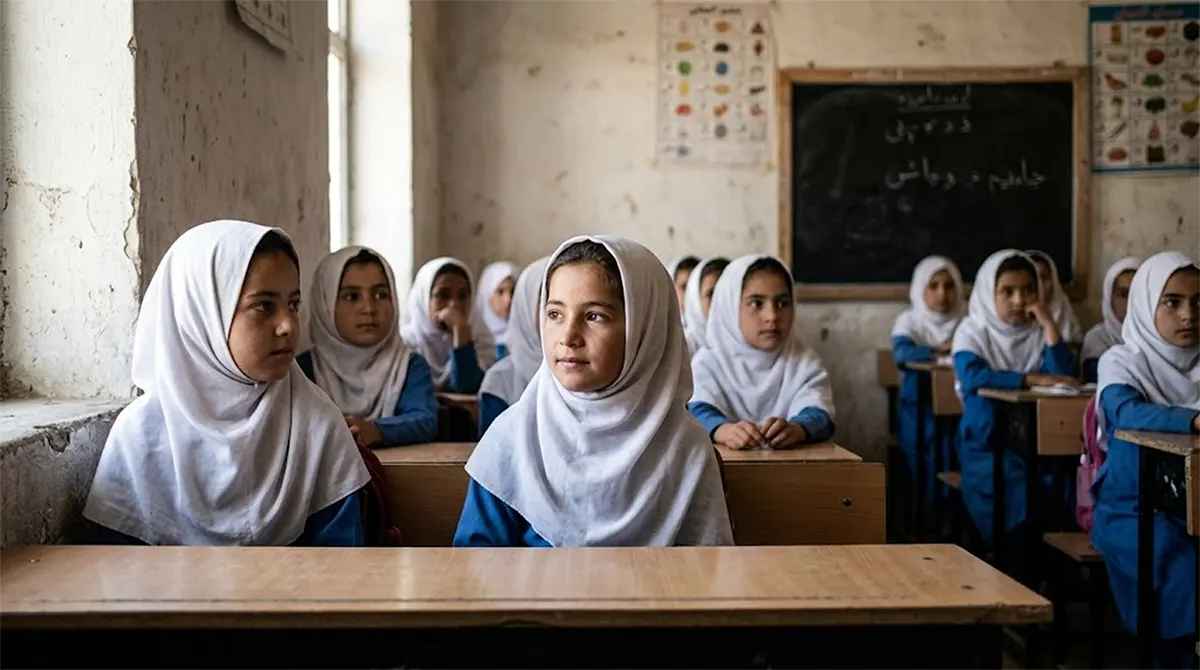
The Taliban’s de facto Ministry of Justice officially published Decree No. 18, a 31-article framework quietly authorized by Supreme Leader Hibatullah Akhundzada that has since drawn near-universal condemnation from the international community. Formally titled the Code on Judicial Separation of Spouses, the decree does far more than govern divorce proceedings. It dismantles the last remaining legal protections for Afghan women and girls and in doing so, has effectively legalized child marriage in one of the world’s most vulnerable countries.
Afghanistan Had a Minimum Marriage Age, The Taliban Just Erased It
Under Afghanistan’s previous civil code, the minimum legal age for marriage was 16 for girls. That number is now gone. Decree No. 18 replaces any numerical age threshold with a single biological marker: puberty.
The moment a girl’s body begins to change, she is legally considered an adult capable of being married under Taliban law. And given that medical science recognizes puberty can begin as early as ages 7 or 8 in some girls with the average onset between 9 and 13, this means children as young as 9 or 10 are now legally eligible for marriage in Afghanistan the moment they show physical signs of maturation.
That alone would be alarming enough. But the decree goes further.
“She Didn’t Say No” Is Now a Legal Marriage Contract
Articles 5 and 6 of Decree No. 18 contain what human rights organizations have called one of the most dangerous legal clauses in modern statutory law: the “silence as consent” rule.
The text explicitly states that if a girl who has reached puberty remains silent when presented with a marriage proposal, that silence is legally recognized as her binding consent to be wed.
To understand why this is so calculated, consider the environment in which it operates. Under the Taliban, a 9 or 10 year old girl has been raised, from birth, in a deeply patriarchal household where obedience to male authority figures her father, her uncles, her older brothers is not just expected but enforced. If she is told she is being married off, staying quiet out of sheer terror, confusion, or helplessness is the most natural possible childhood response. Decree No. 18 takes that trauma-induced silence and converts it into a legally binding “yes.”
There is no interview. No independent assessment. No minimum age. A groom or a father needs only to tell a Taliban judge: “She has reached puberty, and when we asked her, she did not say no.” The judge rules it legal and any outside attempt to intervene is now treated as a violation of statutory law.
UNICEF Executive Director Catherine Russell stated plainly that any framework treating a child’s silence as legal consent is “wholly unacceptable.” The UN Committee on the Rights of the Child, a panel of 18 independent international experts went further, releasing a formal challenge to the decree that stated directly: “Puberty cannot be considered a basis for adulthood or legal capacity to marry.”
Even Toddlers Aren’t Protected, There’s a Loophole for That Too
Legal analysts and Afghan activists have flagged an even more disturbing dimension of the decree. The law effectively sanctions the betrothal of girls as young as 6 or 7, operating under a legal fiction that the child can “theoretically” petition a Taliban judge for an annulment once she turns 9 but only if she can prove she is still a virgin and has the courage to stand alone before adult judges and an adult husband to make her case.
In practice, this is not a protection. It is a paper escape route designed to be unreachable.
Divorce Is a Right for Men, For Women, It’s an Obstacle Course
Beyond child marriage, the core architecture of Decree No. 18 creates an extreme and deliberate asymmetry in divorce rights.
A husband retains an absolute, unilateral right to instantly divorce his wife at any time, for any reason, with no conditions.
A woman seeking separation faces an entirely different system:
- She must present multiple male witness testimonies to a Taliban-run religious court to even file a claim.
- If her husband has gone missing, a tragically common situation in a country scarred by decades of conflict she cannot legally separate or remarry until his death is confirmed and his entire generation of living contemporaries has also died. Women whose husbands disappeared during the war are now legally trapped for the rest of their lives.
- A husband can unilaterally override his wife’s entire separation petition simply by submitting a counter-statement or refusing to consent.
Domestic Violence Is Now Legally Protected by the State
Decree No. 18 builds on its predecessor, Decree No. 12, passed in January 2026, which had already gutted state intervention in domestic abuse cases. Under the combined framework now in place, if a husband is convicted of severely beating his wife to the point of causing fractures or open wounds, the maximum penalty he faces is 15 days in prison.
The law also explicitly forbids the wife from fleeing to her own family’s home while the case is being resolved.
This is not a gap in the law. It is the law, written exactly as intended.
This Is “Gender Apartheid” and It’s Driving Economic Collapse
Decree No. 18 does not exist in isolation. Since seizing power in 2021, the Taliban have issued a relentless sequence of edicts: a total ban on girls’ secondary and higher education, prohibitions on women entering public parks or beauty salons, and mandates requiring male guardians for any travel.
UN experts have begun using the term “gender apartheid” to describe what is happening, a systematic, state-enforced exclusion of an entire demographic from education, employment, legal autonomy, and public life.
The economic consequences are catastrophic and self-reinforcing. The UN estimates that locking women out of the workforce costs Afghanistan billions in lost GDP annually in a country where more than 80% of the population already lives below the poverty line. As families sink deeper into extreme poverty driven by international sanctions and a collapsing local economy, daughters are increasingly viewed through a lens of survival. With girls banned from school, early marriage becomes an economic coping mechanism, a way to secure a bride price or simply reduce the number of mouths to feed.
Decree No. 18 then legally codifies this cycle, trapping young girls in early pregnancy, high maternal mortality rates, and total financial dependency ensuring that the next generation inherits the same poverty.
The Taliban’s Diplomatic Deadlock
Taliban Supreme Leader Hibatullah Akhundzada has been unambiguous: internal decrees take absolute precedence over external approval. Spokesperson Zabihullah Mujahid has defended Decree No. 18 as fully aligned with the Taliban’s interpretation of Sharia law and dismissed all international backlash.
But this legal trajectory has created a severe and self-defeating diplomatic paradox. The Taliban want international recognition, sanctions relief, unfrozen assets, and foreign investment. Every decree they issue moves those goals further out of reach.
No foreign government has formally recognized the Taliban regime. The United States froze roughly $7 billion in Afghan central bank assets held in American banks the moment the Taliban took power in 2021; another $2 billion was frozen by European allies. These funds remain locked in a Swiss-based trust fund. The UN Security Council’s dedicated “1988 Sanctions Regime” which includes asset freezes, a global travel ban on Taliban officials, and a strict arms embargo remains fully in force.
The ICC has issued international arrest warrants for top Taliban leadership, including Akhundzada himself and Supreme Court head Abdul Hakim Haqqani, legally designating them as international fugitives and eliminating any path to them being treated as legitimate global statesmen.
The UN’s strategy, as one analyst summarized it, is a slow, grinding siege: deny the regime money, recognition, and freedom of movement while keeping the most vulnerable population alive through the cracks via aid distributed directly through local NGOs, bypassing Taliban ministries entirely. UNAMA teams operate inside the country to secretly document forced child marriages and abuses for future international legal prosecutions. UNESCO quietly funds digital learning platforms and radio-based education programs to keep girls connected to learning despite being banned from school.
The grim reality, however, is that the Taliban leadership has demonstrated it is willing to keep Afghanistan in deep poverty indefinitely in order to maintain absolute control. They survive through black-market cash smuggling, opium and mineral trade, customs duties at border crossings, and economic lifelines from countries like China, Russia, and Iran, none of which formally recognize the regime, but all of which maintain functional economic ties with it.
The sanctions have successfully stopped the Taliban from accumulating wealth, buying advanced weapons, or gaining global legitimacy. What they have not done is change the Taliban’s behavior because the regime has made clear that enforcing fundamentalist law matters more to its leadership than lifting its people out of poverty.
The World Is Watching. Afghan Girls Are Running Out of Time.
The UN Committee on the Rights of the Child has been direct: child marriage, where at least one party is under 18, is a harmful practice and a form of forced marriage, because children inherently lack the capacity to give full, free, and informed consent. A legal system that weaponizes a child’s fear as consent is not a religious ruling with which outsiders merely disagree, it is, as UN Women and UNICEF have argued, a calculated statutory architecture designed to strip Afghan women of every remaining legal avenue of escape, while formally legalizing the sexual exploitation of children under the cover of marriage law.
Decree No. 18 is the latest and most explicit expression of that architecture. For the millions of Afghan girls growing up inside it, it is not a policy debate. It is the law of the land.
For an in-depth look at Child Marriage in 2026:
One Girl Every 3 Seconds: The Brutal Reality of Child Marriage in 2026