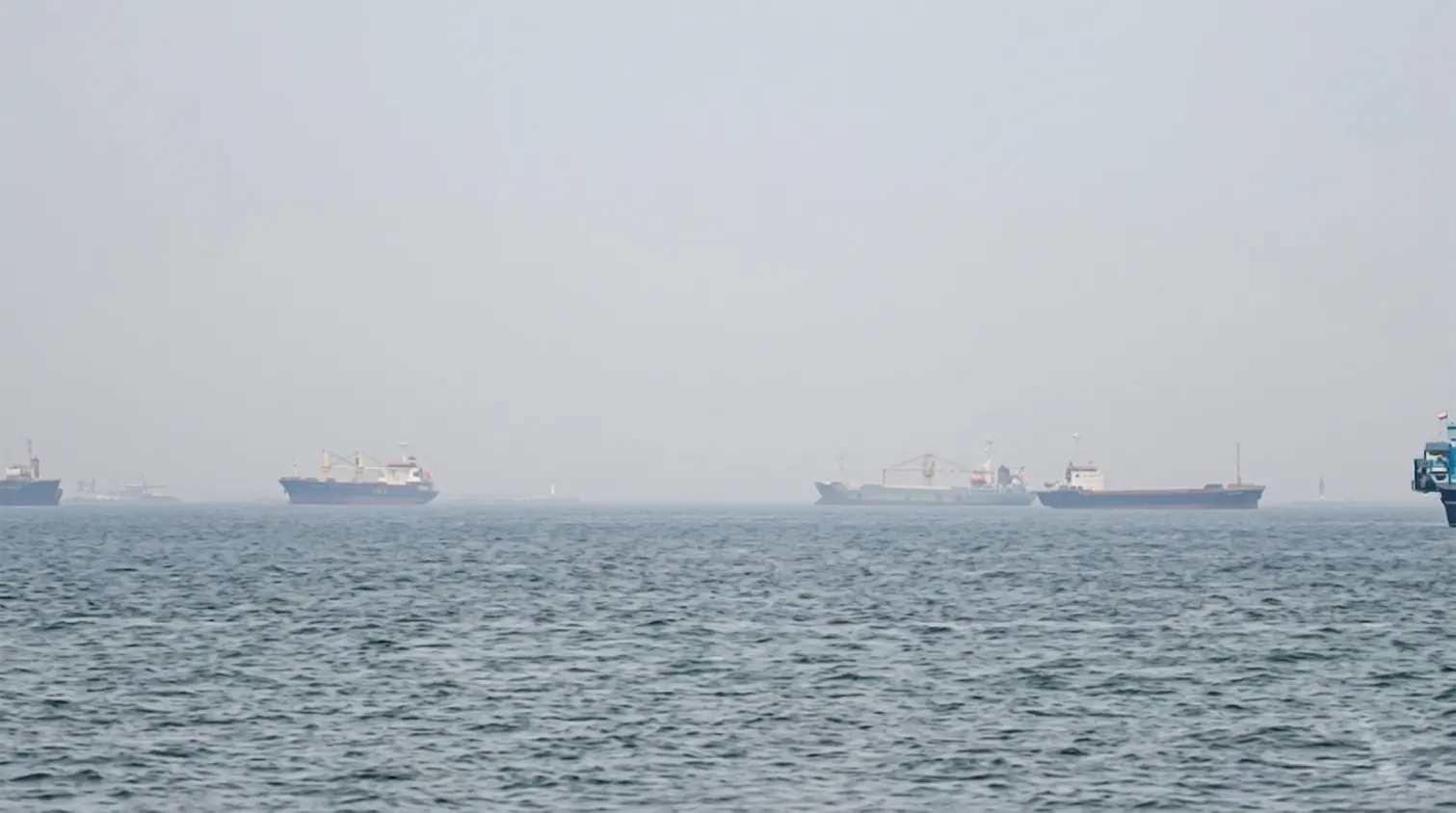
Somewhere in the Persian Gulf right now, a Filipino sailor is sitting in a cramped cabin on an oil tanker that has not moved in weeks. He is one of roughly 22,500 mariners from the Philippines, India, Ukraine, China, Indonesia anchored in the open sea, unable to leave, unable to dock, caught between two superpowers who cannot agree on who controls 21 miles of water.
The Strait of Hormuz, the narrow chokepoint through which roughly a fifth of the world’s oil normally flows, is currently operating at just 5% of its pre war traffic levels. More than 1,550 commercial ships oil tankers, LNG carriers, container ships sit at anchor in designated waiting zones, their cargo going nowhere, their crews running out of options.
Ten of those mariners have already died. Secretary of State Marco Rubio confirmed the figure on May 8, attributing the deaths to medical emergencies and stress-related incidents sustained during weeks of confinement in high-risk waters. These were not combat casualties. They were people who simply could not get the care they needed in time.
Ships stranded
1,550+
Confirmed by Joint Chiefs, May 6
Crew trapped
22,500
IMO estimate, May 8
Strait traffic
5%
Of pre-war average
Deaths confirmed
10
Medical & stress-related
The trap that built itself
To understand why 1,550 ships are simply sitting there and why the obvious solutions are not actually solutions you have to understand the three-way bind that has formed around the Strait.
Iran, through its newly created Persian Gulf Strait Authority, is demanding that all passing vessels apply for permits and pay transit taxes to the Revolutionary Guard. Most international shipping companies have refused on legal grounds. The U.S., meanwhile, has classified the IRGC as a terrorist organization, meaning that any company paying Iran’s transit fee would be violating U.S. sanctions and potentially exposing itself to the seizure of its vessel. The result is a diplomatic catch-22 with a very physical consequence: ships that pay Iran risk punishment from the U.S.; ships that do not pay cannot get through.
“Project Freedom,” the U.S. military escort program designed to guide commercial vessels safely through the Strait, was suspended on May 6 to allow ceasefire negotiations to proceed. On May 8, U.S. forces disabled two Iranian tankers, the M/T Sea Star III and M/T Sevda enforcing the U.S. naval blockade against Iranian linked vessels. The window for safe transit has effectively closed while diplomats talk.
The legal catch-22
Pay Iran’s transit fee → violate U.S. sanctions, risk vessel seizure. Refuse to pay → Iran blocks passage. Wait for Project Freedom → program currently suspended. The ships are not anchored by choice. They are anchored because every exit carries a legal or physical penalty.
Why the ships cannot simply dock and wait it out
The natural question is: why not pull into a nearby port Dubai, Abu Dhabi, Muscat and ride out the crisis on land? The answer is that the ports themselves are part of the problem.
Every major facility in the region is at full capacity. Because no vessels have been able to leave the Gulf for weeks, no berths have opened up. The ports that would normally absorb overflow traffic are already operating at their limits, handling only essential food and medical supply shipments. There is no room.
Even if a berth were available, docking creates its own cascade of complications. Most of these ships are carrying cargo oil, gas, containers destined for Europe or Asia. Unloading in Dubai means finding warehouse space that does not exist, or arranging land routes for commodities that have no viable overland path. The cargo cannot simply be parked indefinitely. And the war risk insurance that would cover a vessel in transit has, for most ships, either been canceled outright or become so prohibitively expensive as to be effectively unavailable. A ship that docks may find itself legally “arrested” by its own insurers or creditors before it can leave again.
The ports nearby, and their current status, tell the story clearly.
| Port Name | Location | Current Status | Notes |
| Jebel Ali | UAE | Full | Limited to essential food and medical supplies only. |
| Fujairah | UAE | Hazardous | Subject to drone strikes; limited to anchorage. |
| Sohar | Oman | Full | Massive backlog of vessels waiting to enter/exit. |
| Khalifa Port | Abu Dhabi, UAE | Full | Extremely limited access for commercial traffic. |
| Bandar Abbas | Iran | Restricted | Open to Iranian-flagged or approved vessels only. |
| Dammam | Saudi Arabia | Full | Diverting to overland transport routes only. |
Who owns the ships and who is sailing them
The 1,550 stranded vessels represent a genuinely global cross-section of maritime commerce. The UAE, with local shipping firms caught inside their own waters, has the most ships at stake roughly 120 vessels. Greece, the world’s largest ship owning nation, has approximately 75 ships stranded, including more than 30 tankers. China has around 74 vessels involved, a mix of state owned oil carriers and private container ships. Japan and India follow, with their ships carrying energy supplies that are critical to both countries’ domestic grids.
Stranded Vessels by Ownership & Type (May 9, 2026)
| Country | Estimated Ships Stranded | Status/Key Impact | Primary Vessel Types |
| UAE | ~120 | Trapped in own waters | Regional feeder ships & tankers |
| Greece | ~75 | World’s largest ship owner | VLCCs & Suezmax tankers |
| China | ~74 | State & private mix | Oil tankers & large container ships |
| Japan | ~39 | Critical dependency | LNG & Crude oil carriers |
| India | ~37 | 13 Indian-flagged | Product tankers & bulk carriers |
But the people on board those ships are an entirely different demographic from the companies that own them. The crew manning a Greek owned tanker is almost certainly not Greek. Maritime labor is overwhelmingly drawn from a handful of lower income nations, and the Strait of Hormuz crisis has effectively put the citizens of those countries in the most direct physical danger.
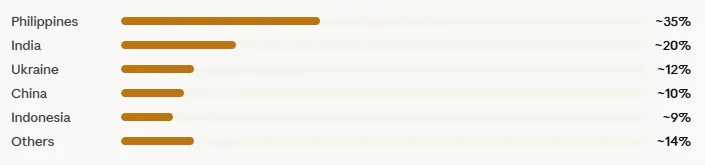
The Philippines alone accounts for an estimated 35–40% of all trapped mariners. India provides roughly another fifth. These are not the nations whose geopolitical decisions created this crisis. They are the ones absorbing its human cost most directly, thousands of their citizens anchored in waters where drone strikes have already hit nearby infrastructure, on vessels that cannot maneuver quickly if something goes wrong.
A selective passage list that reveals the politics
Iran has not blockaded every ship equally. The IRGC has reportedly granted safe passage or priority consideration to vessels from eight specific countries China, Russia, India, Pakistan, Egypt, South Korea, Malaysia, and Thailand provided those ships are not carrying cargo bound for the U.S. or Israel. The list is a near perfect map of Iran’s current geopolitical relationships, and it underscores that what looks like a maritime dispute is functioning as something more deliberate: a pressure campaign expressed through who gets to move and who does not.
What is at stake beyond the ships themselves
The immediate economic impact is already being felt. South Korea and Singapore, both heavily dependent on Gulf energy imports, have dozens of vessels carrying fuel and electronics sitting idle. European countries particularly Italy, France, and Germany are waiting on LNG tankers from Qatar that cannot exit the Gulf. The major shipping lines, Maersk, MSC, and Hapag-Lloyd, have all advised their vessels to hold position or seek alternative multimodal routes, such as overland transit through Saudi Arabia, rather than attempt a crossing.
Those alternatives are slow, expensive, and limited in capacity. They are stopgaps, not solutions. Every week that traffic through the Strait remains at 5% of normal is another week of pressure building on global energy markets, supply chains, and the governments whose citizens depend on both.
The IMO Secretary-General raised the alarm formally at a maritime convention in Panama on May 8, citing the 20,000–22,500 trapped mariners and calling for urgent resolution. The human dimension of this crisis, the sailors who have already died waiting, the thousands more living in uncertainty on vessels that are both their workplace and their cage has not yet received the same attention as the geopolitical maneuvering happening above them. It should.