Israel’s most intense bombing campaign in weeks has killed dozens, displaced over a million people, and pushed the ceasefire to the edge of collapse days before a critical Pentagon meeting and peace talks that may be the last chance to stop a full scale war.
There is a phrase diplomats use when they want to sound calm about something that isn’t: “the situation remains fluid.” What is happening in Lebanon right now has moved past fluid. In the space of 48 hours, Israel launched its heaviest bombing campaign since the April ceasefire, ground forces pushed deeper into Lebanese territory past an informal boundary that had held for weeks, and the UN’s peacekeeping mission recorded the single highest number of Israeli airspace violations since the truce began, all while delegations from both countries are preparing to sit across from each other in Washington.
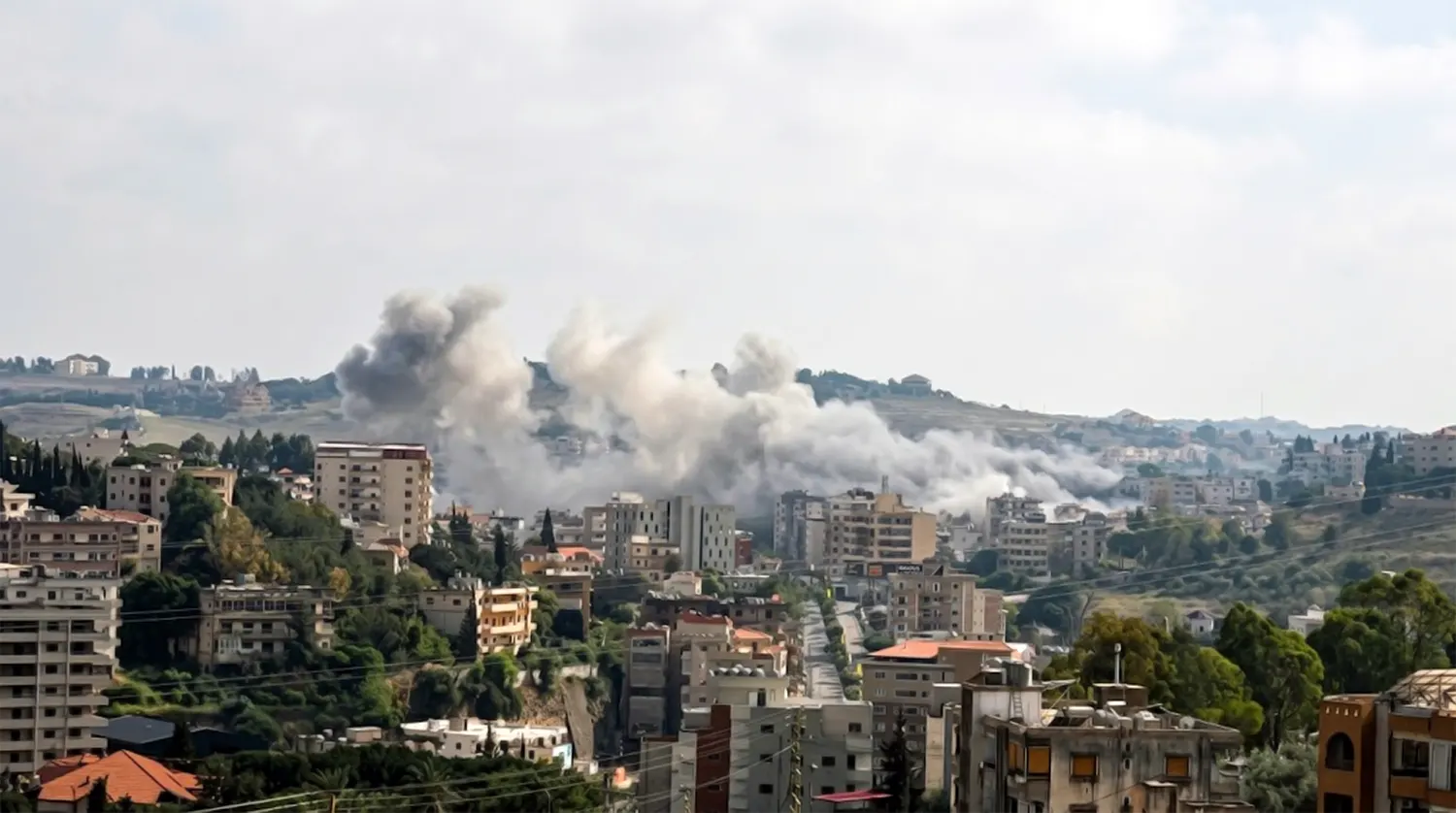
The Israeli Air Force struck over 100 targets in a single night across southern Lebanon and the Bekaa Valley. UN peacekeepers recorded 91 airspace violations in one day, the highest since the ceasefire took effect alongside 399 separate IDF firing incidents.
The stated military rationale is familiar: weapons storage facilities, command centers, observation points. But the scale of the operation and the timing, with Washington talks days away signals something more deliberate. Israel is pressing its military advantage to the maximum before the diplomatic table resets the terms.
What the Strikes Actually Hit
Two strikes defined the human toll of the overnight campaign.
Mashghara — Bekaa Valley
A single airstrike killed 12 people from the same family.
The Bekaa Valley has increasingly become a focus of Israeli operations targeting Hezbollah’s logistics corridors running east toward Syria.
12 killed — one family
Burj al-Shamali — Southern Lebanon
At least 14 people were killed in a strike on this southern town near Tyre, including two children and three women.
The town sits in the dense civilian belt north of the Litani River that Israel has increasingly targeted.
14 killed — incl. 2 children, 3 women
For the first time since the escalation began, Israel also issued an absolute evacuation order for Nabatiyeh, a major city north of the Litani, not a border village. The order tells residents to leave immediately. Combined with prior displacement orders across dozens of southern villages, this marks a significant expansion of the zone Israel considers off-limits to civilians.
Over 3,200 Dead, a War by Any Other Name
The Lebanese Health Ministry’s updated figures put the cumulative toll in stark relief. What was declared a ceasefire on April 17 has, by its own numbers, continued killing at a pace that would qualify as an active conflict anywhere else.
| Lebanon — since March | Israel — since March | ||
| Total killed | 3,213+ | IDF soldiers killed | 23 |
| Total wounded | 9,700+ | Killed since ceasefire | 10 |
| Single worst day (recent) | 31 killed | Killed by suicide drones | 6 |
| Displaced | 1 million+ | Israeli civilians killed | 2 |
The asymmetry in those numbers is stark, but the Israeli figures carry their own strategic weight. Six of the ten IDF soldiers killed since the ceasefire died to Hezbollah’s suicide drones , the same low-flying, explosive UAVs that have been striking at armored columns attempting to advance toward Nabatiyeh. For an army accustomed to controlling the airspace, losing soldiers to a weapon it cannot jam is a pressure point that shapes every decision being made in Tel Aviv.
What UNIFIL Saw and How Close It Got
The UN peacekeeping mission in southern Lebanon (UNIFIL) has become an unintended ledger of the ceasefire’s daily collapse. Its latest report is the most alarming yet.
| UNIFIL single-day incident report | |
| Israeli airspace violations (one day) | 91 — highest since ceasefire |
| IDF firing incidents documented | 399 |
| Hezbollah projectile trajectories | 11 |
| Distance of drone explosion to UNIFIL post | 10 metres — no injuries |
That last figure, a drone detonating 10 metres from a peacekeeping position in the southern village of Shama is the one that will have been read most carefully in New York. UNIFIL personnel were not injured, but the margin between a close call and an international incident involving blue-helmet casualties is now measured in single digits of metres.
The Ground Is Moving Too
The air campaign is only half the picture. Israeli ground forces have now pushed 5 to 10 kilometres past the “Yellow Line”, the informal forward defense boundary set roughly 10 kilometres inside Lebanese territory that had functioned as the practical limit of the ground operation.
Prime Minister Netanyahu has confirmed the military is actively capturing territory and building a fortified security strip along the border. Israeli forces are demolishing homes and issuing no-return orders to villages across the south. The stated purpose is to create a buffer zone deep enough to put Hezbollah’s fiber-optic guided drones which have a practical operating range of roughly 5 to 15 kilometres out of range of Israeli communities in the north.
“The drive to push Hezbollah further back is partly a function of physics. Every kilometre of buffer gained is a kilometre that reduces the drone threat to Israeli communities that have not had residents home since March.”
Hezbollah has responded to the ground push with rocket fire, artillery, and the same suicide drones that have already killed six IDF soldiers since the ceasefire. The heaviest exchanges have centred on IDF movements toward villages in the Nabatiyeh district now the new front line of a conflict that began, technically, under a truce.
Three Tracks, Two Days, One Fragile Window
Paradoxically, as the violence peaks, the diplomatic calendar has never been fuller. Three separate negotiation tracks are running simultaneously, and they are deeply intertwined.
- Now — May 27, 2026
Active escalation on the ground
100+ strikes overnight. Nabatiyeh evacuation ordered. Ground forces past the Yellow Line. UNIFIL records 91 airspace violations in 24 hours. - Friday, May 29, 2026
Pentagon military coordination meeting
Israeli and Lebanese military delegations meet at the Pentagon. The agenda: mechanics of an IDF withdrawal, Lebanese army deployment in the south, and how to enforce a ceasefire that is currently not being enforced. - June 2–3, 2026
Fourth round of Washington peace talks
Political delegations led by Israeli Ambassador Yechiel Leiter and Lebanon’s Simon Karam. The goal: convert the 45-day ceasefire extension agreed in mid-May into a lasting peace framework. - Background — ongoing
U.S.–Iran regional track
Tehran has conditioned broader regional agreements on a halt to Israeli actions in Lebanon. The outcome of the military and political tracks directly shapes whether this channel survives.
The Two Gaps That Could Sink Everything
The negotiators heading to Washington are not short on goodwill or U.S. backing. What they are short on is overlap between their core positions.
The first gap is Hezbollah’s weapons. The Lebanese government backed by President Joseph Aoun has committed to a state in which only the national army carries arms. Hezbollah leader Naim Qassem has dismissed this as a trap, describing the direct talks themselves as an American-Israeli mechanism to dismantle the group. With Hezbollah still capable of fielding drones that are killing IDF soldiers inside Lebanese territory, the leverage to extract disarmament simply does not exist on paper.
The second gap is the ground Israel is standing on. Lebanon and the framework of UN Resolution 1701 both require an Israeli withdrawal from Lebanese soil and a return to state sovereignty in the south. Israel has spent months building physical infrastructure fortifications, cleared buffer zones, demolished villages that suggests it has no intention of leaving the security strip it has created, regardless of what any text says.
The 100+ strikes of the past 48 hours are not incidental to those negotiations. They are Israel’s way of arriving at the table having already moved the facts on the ground, ensuring that any framework Washington produces has to accommodate a military reality that didn’t exist when the April ceasefire was signed.
Military track
IDF withdrawal mechanics, Lebanese army deployment, ceasefire enforcement
Friday — critical meeting
Political track
Lasting peace framework, sovereignty, Hezbollah disarmament
June 2–3 — fourth round
Regional track
U.S.–Iran understanding, broader Middle East stability
Fragile — Tehran conditions apply
U.S. officials continue to describe a lasting framework as “technically viable.” But viability on paper and viability on the ground have diverged so sharply that the gap between them now has a body count. More than 3,200 people in Lebanon. Twenty-three Israeli soldiers. Families in Mashghara and Burj al-Shamali who did not survive to see the latest ceasefire extension.
The Pentagon meeting on Friday is not a peace talk. It is an attempt to build a floor, some minimum of mutual restraint below which both sides agree not to fall before the political talks begin. Whether the bombing of the past 48 hours has already punched through that floor is the question no one in Washington has a clean answer to yet.