On the morning of February 28, 2026, the Middle East changed.
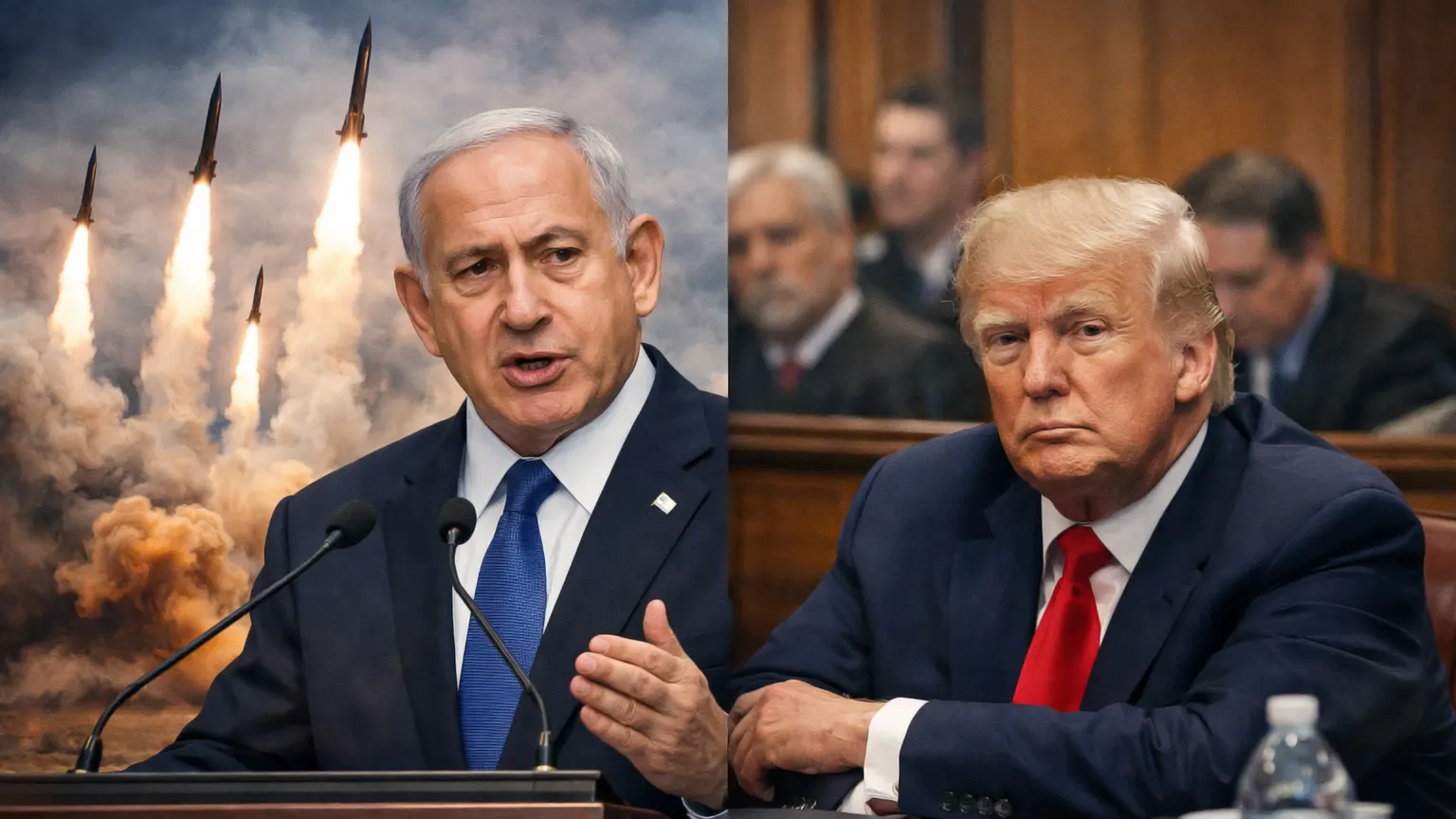
Hundreds of Israeli aircraft crossed into Iranian airspace. American cruise missiles streaked toward Tehran. U.S. stealth bombers struck hardened facilities in coordinated waves. Within hours, Iran responded with missile fire aimed at U.S. bases across the Gulf.
By nightfall, the world’s most critical energy chokepoint the Strait of Hormuz had entered crisis.
What Washington now calls Operation Epic Fury is not being described as a limited strike. The language from both Washington and Jerusalem has shifted toward something far more ambitious: the dismantling of Iran’s military infrastructure and potentially its ruling system.
But what makes this moment historic is not just the scale of the military campaign.
It is what was happening in the 72 hours before the first bomb fell.
Because while bombers were preparing for launch, diplomats believed they had just reached a breakthrough nuclear framework with Tehran.
And in Washington, a former presidents were testifying under oath about Jeffrey Epstein.
The War That Expanded Overnight
The opening phase of Operation Epic Fury was immense. More than 200 Israeli jets participated in the first wave reportedly the largest combat sortie in Israeli history. American B-2 bombers and cruise missiles targeted radar installations, missile batteries, nuclear facilities, and Revolutionary Guard command centers.
Iran retaliated within hours.
Missiles were launched toward U.S. bases in Bahrain, Qatar, Kuwait, and the UAE. One civilian was killed in Abu Dhabi by falling debris. Regional air defenses were activated across multiple Gulf states.
Then came the escalation that signaled the conflict was no longer geographically contained.
On March 4, a U.S. Navy fast attack submarine torpedoed the Iranian frigate IRIS Dena in international waters roughly 40 nautical miles south of Sri Lanka.
Sri Lanka’s Deputy Minister of Defence confirmed tonight that 87 bodies have been recovered from the water following the sinking. Search and rescue operations continue.
In a Pentagon briefing, Secretary of War Pete Hegseth described the strike as
a “quiet death,” warning that Iranian military assets are no longer safe even far beyond the Persian Gulf.
The war had moved into the Indian Ocean.
The Strait of Hormuz: Closed or Contested ?
Iran quickly declared the Strait of Hormuz “closed.”
But the reality is more complex.
General Dan Caine briefed that U.S. forces are maintaining what he called a “Contested Corridor”, a protected maritime channel for essential tanker traffic.
The Strait is not physically blocked by debris or confirmed minefields.
However, the economic impact is already severe.
Insurance firms have effectively suspended coverage for most commercial vessels entering the corridor. Without coverage, tankers do not sail.
The Strait may not be physically sealed but it is functionally frozen.
Energy analysts warn that prolonged instability could send global oil markets into sustained volatility.
The Deal That Was Within Reach
Just two days before the strikes began, U.S. and Iranian negotiators were meeting in Geneva, with Oman serving as mediator.
Omani Foreign Minister Badr bin Hamad Albusaidi publicly described what he called a breakthrough framework built on a principle known as “Zero Stockpiling.”
The proposal included:
- No retained enriched uranium.
- Immediate down blending of enriched material.
- Conversion into solid reactor fuel plates.
- Full International Atomic Energy Agency monitoring.
In plain terms, the material needed to build a nuclear weapon would not exist in usable form.
A technical meeting in Vienna was scheduled to finalize verification mechanisms.
It never took place.
Within hours of Albusaidi’s public remarks, the first Israeli strikes began.
A diplomatic path aimed at neutralizing nuclear material was overtaken by a military campaign aimed at neutralizing the regime.
Netanyahu’s Long War
For more than three decades, Israeli Prime Minister Benjamin Netanyahu has warned that Iran was approaching a nuclear threshold.
In the 1990s, the warning was three to five years away. In the 2000s, it was months away. The red lines shifted from enrichment levels, to centrifuge numbers, to stockpile size.
When the Geneva framework reportedly removed stockpiling altogether, the red line shifted again to the complete dismantling of enrichment capability.
Critics argue this evolution suggests something deeper.
If zero stockpiling was not enough, then perhaps nuclear material was never the only issue.
Netanyahu has long argued that the Islamic Republic itself represents an existential threat. The current campaign language now openly references regime change.
The objective appears broader than uranium.
Did Diplomacy Ever Have a Chance ?
The timing remains the most uncomfortable aspect of this story.
On February 26 and 27, negotiations were still underway.
On February 28, the bombing began.
Military operations of this scale require months of preparation. Carrier strike groups do not reposition in days. Target packages are not assembled overnight.
That reality does not prove that diplomacy was a facade.
But it suggests the decision to strike may have preceded the collapse of talks.
If war planning was already in motion, then negotiations were unfolding in the shadow of a conclusion already reached.
That distinction matters.
The Domestic Reckoning
While the Middle East entered open war, Washington was navigating its own crisis.
Under the Epstein Files Transparency Act, millions of pages of previously sealed documents have been released.
Last week, Bill and Hillary Clinton testified before the House Oversight Committee.
- Hillary Clinton testified February 26.
- Bill Clinton followed with a six hour deposition on February 27.
- On March 2, full video recordings were released to the public.
Both denied prior knowledge of Epstein’s crimes.
Bill Clinton acknowledged flying on Epstein’s plane but maintained it was for humanitarian work. Hillary Clinton described the proceedings as partisan.
One detail drew immediate attention.
In his testimony, Bill Clinton stated that Donald Trump told him in 2002 they had “some great times” together before falling out.
Democrats argue this contradicts Trump’s long standing claim that he barely knew Epstein.
The Pressure Turns Toward the President
The Oversight Committee has expanded its scope.
On March 4, Commerce Secretary Howard Lutnick agreed to testify voluntarily. Democrats argue that since a former presidents have sat for depositions,
“equal application of the law” requires that the sitting president eventually do the same.
The White House response centers on two arguments:
- Executive privilege during wartime.
- Trump’s alleged cooperation with Palm Beach police in 2005.
Whether those arguments withstand legal challenge remains uncertain.
What is clear is that the investigation has not slowed even if public attention has shifted.
Coincidence, Opportunism, or Strategy ?
The Clinton deposition videos were released March 2.
By March 4, headlines were dominated by a torpedoed warship and a widening regional conflict.
Political scientists describe this phenomenon as the “rally around the flag” effect when foreign crises temporarily overshadow domestic controversy.
Some critics argue the timing is suspicious.
Others point out that wars of this magnitude cannot be engineered in days to distract from hearings.
A more cautious interpretation may be this:
The war was likely planned independently but its timing proved politically convenient.
Regardless of intent, the effect is undeniable.
The Epstein investigation is no longer leading the news cycle.
The “Obliteration” Paradox
In 2025, President Trump declared that Iran’s nuclear facilities had been “completely and totally obliterated.”
Eight months later, officials warned that Iran was weeks away from a bomb.
Those two statements cannot both be entirely literal.
Nuclear infrastructure does not regenerate that quickly.
The contradiction suggests a shift in objective.
In 2025, the mission was to destroy facilities.
In 2026, the mission appears to be dismantling the system itself.
That is a far larger undertaking.
The Iraq Shadow
The parallels to 2003 Iraq are difficult to ignore.
Then, inspectors were reporting no active weapons program. War proceeded anyway.
Now, a mediator was publicly describing a breakthrough framework. War proceeded anyway.
The comparison does not prove intelligence distortion.
But it does revive an old question:
Was the nuclear issue the cause of war or the justification for it ?
What Comes Next
Pentagon briefings suggest sustained operations.
Phase Two is expected to target missile production networks, IRGC command structures, and remaining naval assets.
Clearing and stabilizing the Strait of Hormuz could take weeks, especially if insurance markets remain frozen.
Meanwhile, the domestic investigation continues beneath the surface.
More testimony is expected. Legal challenges over executive privilege could escalate. Political tensions are unlikely to ease.
The United States now faces two parallel confrontations one military, one institutional.
The Question History Will Ask
A diplomatic framework reportedly existed.
A verification meeting was scheduled.
Instead, a regional war is underway, the Indian Ocean has seen its first submarine sinking in decades, and 87 sailors have been pulled from the water.
At the same time, a domestic investigation is testing political accountability at the highest levels.
Was the strike necessary ?
Was the deal insufficient ?
Or was regime change always the true objective ?
History may ultimately conclude that February 2026 marked a decisive turning point not because diplomacy failed, but because it was overtaken.
The alternative path was visible. The chosen path was force.
And once that decision was made, the world crossed a line from which there may be no easy return.