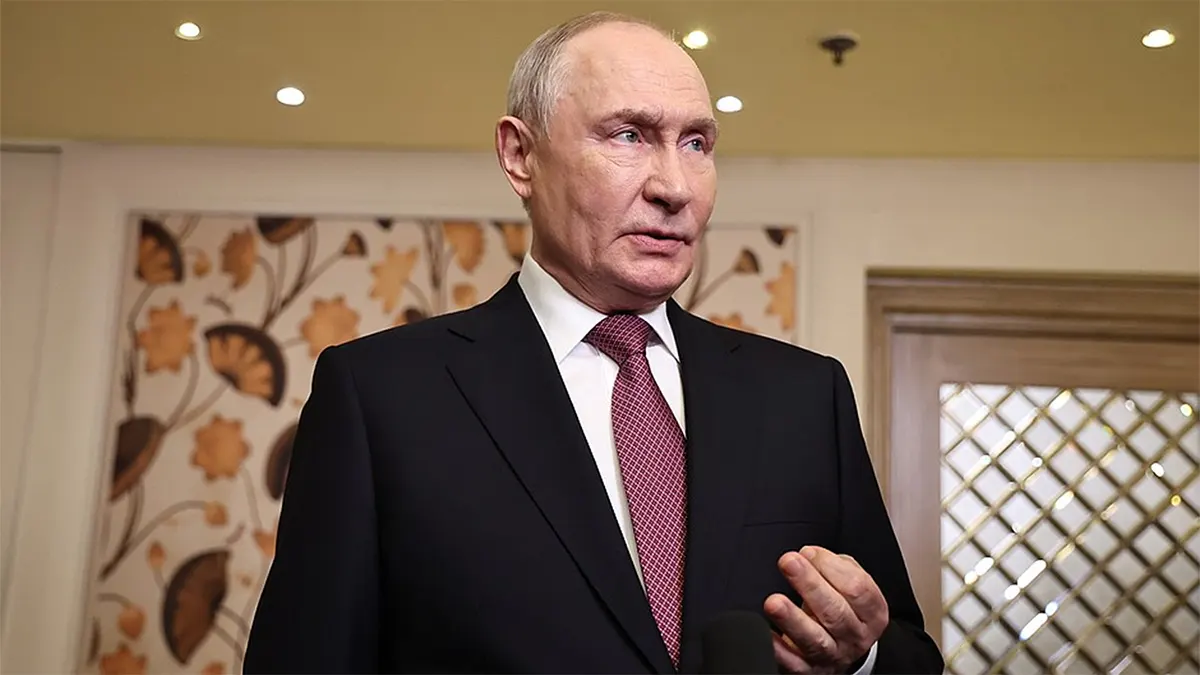


Russian President Vladimir Putin delivered a sharp critique of European political elites and the current NATO leadership. His comments specifically targeted NATO Secretary General Mark Rutte and highlighted what he perceives as a growing contradiction between European rhetoric and the official security posture of the United States.
Accusations of European Interference
Putin claimed that European political elites directly interfered in the recent U.S. presidential election by openly supporting the Democratic ticket. He suggested that Europe’s aggressive stance is tactical, aimed at the upcoming 2026 U.S. midterm elections, in hopes of regaining traditional allies who would exert pressure on the Trump administration.
The NATO–Washington Disconnect
The Russian president noted a strategic irony: while NATO Secretary General Rutte is “bracing for war with Russia,” the newly released U.S. National Security Strategy from NATO’s primary sponsor does not explicitly label Russia as an “enemy” or a “target.” Putin argues this reveals a disconnect between European rhetoric and Washington’s cautious approach.
Critique of Mark Rutte
Although Putin acknowledged Rutte’s prior success as the Prime Minister of the Netherlands, he questioned his current professional competence, describing his recent warnings of a prospective war as “nonsense.” Putin emphasized that Rutte’s current rhetoric contradicts both NATO’s backbone and U.S. strategic documents.
Economic “Cover-ups”
Putin also argued that European leaders are using aggressive foreign policy and the so-called “Russian threat” as a distraction from domestic economic and financial shortcomings.
Key Contexts Highlighted by Putin
-
The “Rutte–Trump” Relationship
Rutte was known as the “Trump Whisperer” during Trump’s first term and played a pivotal role in negotiating compromises on NATO defense spending. Putin contrasts this diplomatic reputation with Rutte’s current military rhetoric to highlight inconsistencies. -
The U.S. National Security Strategy (NSS)
Putin pointed out that the U.S. avoids explicitly labeling Russia as an “enemy,” using terms like “Pacing Challenge” (China) and “Acute Threat” (Russia). He uses this nuance to emphasize that NATO’s aggressive posture is out of sync with Washington. -
The 2026 Midterm Elections
Putin noted that Europe is anticipating a shift in the U.S. political landscape after the 2026 midterms, expecting Congress may realign U.S. foreign policy closer to traditional European preferences. This illustrates his view of a long-term strategic game being played by European elites.
Bottom Line
Putin’s briefing signals that Moscow perceives a divided West, where European leaders are out of sync with the more pragmatic or cautious security strategy currently emerging from Washington. His comments underscore both political and strategic tensions within NATO and highlight the role of domestic politics in shaping foreign policy narratives.