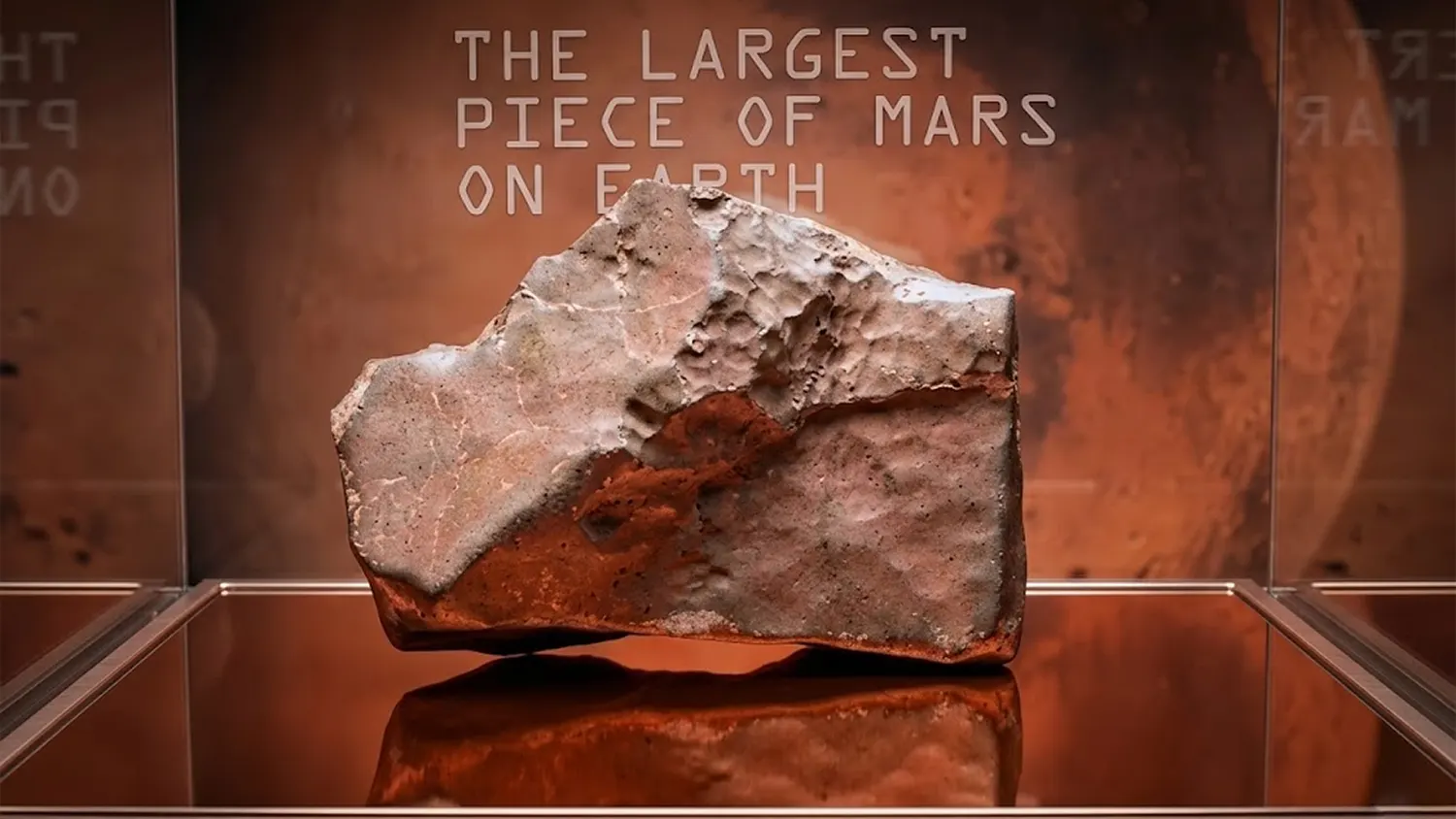
A 54 pound Martian meteorite, the largest ever discovered on Earth, sold for $5.3 million
at a Sotheby’s auction in New York on July 16, 2025.
Known as NWA 16788, the rock is the biggest piece of Mars ever found on Earth, and its final price exceeded initial estimates of up to $4 million, highlighting intense demand for rare space artifacts.
But beyond its price tag, this meteorite represents a rare physical connection to another planet, one that scientists and collectors rarely get access to.
A Record Breaking Piece of the Red Planet
The scale of NWA 16788 sets it apart immediately.
Weighing 24.67 kilograms (54 pounds), it is about 70% larger than the previous record holder, making it the largest known Martian meteorite by a wide margin.
Even more striking, it accounts for roughly 6–7% of all known Martian material on Earth, a remarkable share for a single object.
The meteorite’s journey is just as extraordinary. Scientists believe it was blasted off Mars by a massive asteroid impact, traveling around 140 million miles through space before landing in the Sahara Desert.
It was eventually discovered in Niger in 2023.
Why Martian Meteorites Are So Rare
What makes this find especially valuable is its rarity.
Out of more than 77,000 meteorites officially recorded on Earth, only about 400 are confirmed to come from Mars.
That means less than 1% of known meteorites originate from the Red Planet, making each discovery scientifically and commercially significant.
NWA 16788 also carries distinct physical features:
- A glassy fusion crust, formed during its fiery entry into Earth’s atmosphere
- Minerals like olivine and pyroxene, commonly found in Martian geology
- A coarse grained structure, offering clues about volcanic activity on Mars
These characteristics make it not just a collectible but a scientific resource.
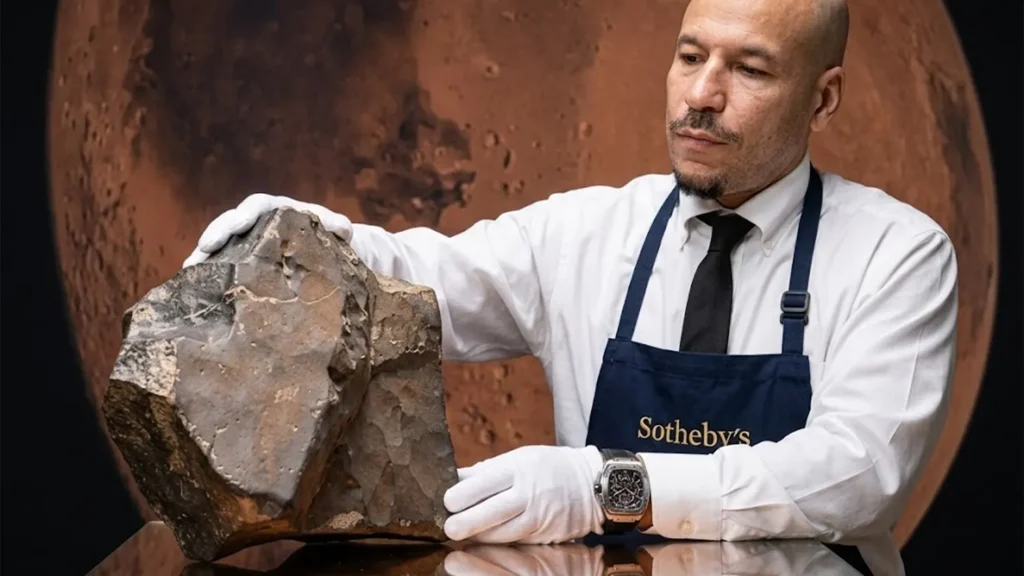
A Star Attraction at Sotheby’s “Geek Week”
The meteorite was the highlight of a high profile auction event.
Hosted by Sotheby’s in New York, the sale was part of its “Geek Week 2025,” a themed auction focused on natural history and science related items.
NWA 16788 was marketed as the “largest piece of Mars on Earth,” drawing global attention from collectors and institutions alike.
It shared the spotlight with other rare items, including a juvenile Ceratosaurus dinosaur skeleton, but the Martian rock ultimately became the centerpiece of the event.
Its final sale price of $5.3 million surpassed expectations, reinforcing the growing market for space related artifacts.
Science Meets Controversy
Despite the excitement, the sale has also sparked questions.
Shortly after the auction, the government of Niger launched an investigation into how the meteorite was exported, raising concerns about the protection of national geological heritage.
This highlights a broader issue in the world of rare natural objects:
- Who owns materials found within a country’s borders?
- Should scientifically important objects remain in public institutions?
As the value of such discoveries rises, so does the scrutiny around how they are collected and sold.
More Than a Collector’s Item
For scientists, the importance of NWA 16788 goes beyond its size or price.
Classified as a rare type of Martian rock, it provides insights into:
- Mars’ volcanic history
- The planet’s geological composition
- The effects of asteroid impacts on planetary surfaces
Each sample from Mars offers data that cannot be easily replicated even with modern space missions.
At the same time, private ownership raises questions about accessibility for research, especially when such rare specimens end up outside public institutions.
A Growing Market for Space Artifacts
The strong sale reflects a larger trend.
Interest in space related collectibles has surged in recent years, driven by renewed focus on Mars exploration and private space ventures.
For buyers, objects like NWA 16788 offer:
- A tangible connection to space
- Extreme rarity
- Long term investment potential
As humanity pushes further into space, the value of objects that have already made the journey back to Earth is rising.
A Piece of Mars, Now on Earth and Sold
In the end, NWA 16788 is more than just a rock.
It is the largest known fragment of Mars ever found on Earth, a relic of a violent cosmic event that traveled millions of miles before landing in the Sahara.
Its journey from Mars to Earth, and then to the auction block captures both scientific wonder and human fascination.
And as discoveries like this continue, the line between science, commerce, and exploration is only becoming more intertwined.