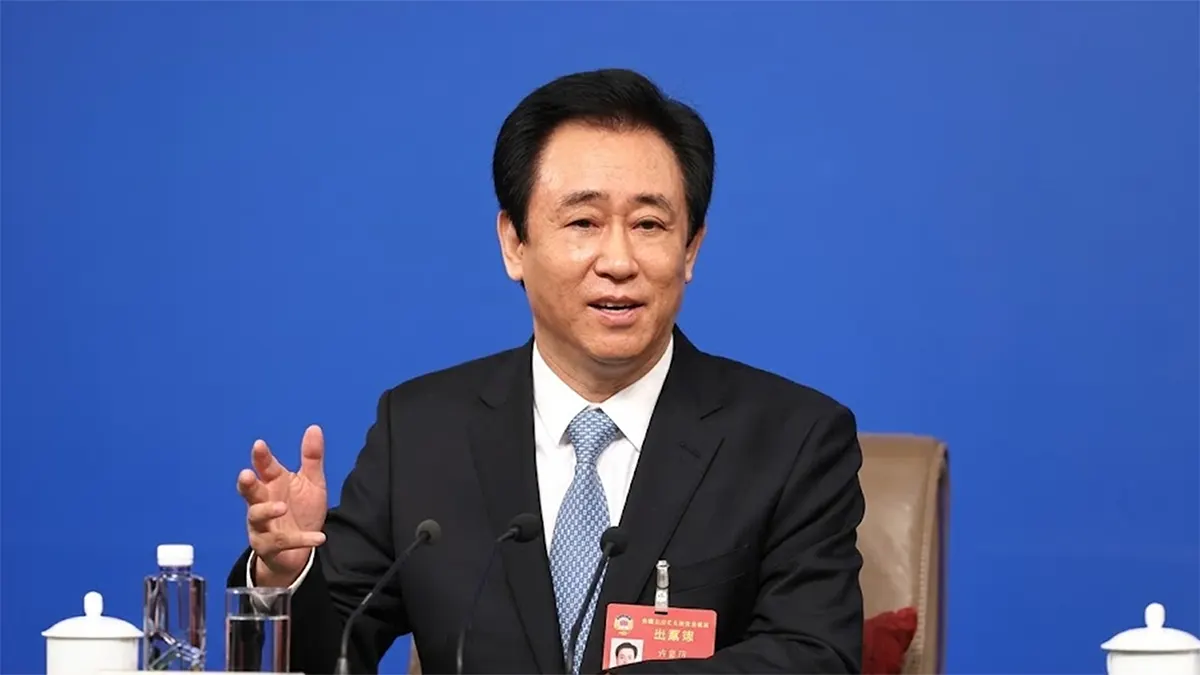
China’s former property billionaire Hui Ka Yan, the founder and former chairman of China Evergrande Group, has been sentenced to life in prison for a series of financial crimes linked to the collapse of the heavily indebted property giant.
The Shenzhen Intermediate People’s Court handed down the sentence on August 20, 2026, bringing one of the most closely watched corporate crime cases in China to a dramatic conclusion.
Hui, 67, was also ordered to have all of his personal assets confiscated and was stripped of his political rights for life. Evergrande Group and its mainland property subsidiary, Evergrande Real Estate Group, were separately fined a combined 15.82 billion yuan, or about $2.35 billion.
Court Says Evergrande Hid the Scale of Its Financial Problems
At the center of the case was the court’s finding that Hui oversaw large-scale financial fraud between 2016 and 2021.
During that period, Evergrande allegedly fabricated financial information to inflate the company’s assets and conceal its liabilities. The distorted figures helped the company raise money and issue securities while its underlying financial position was deteriorating.
Hui pleaded guilty in April 2026 to eight financial and economic offenses, including fraudulent fundraising, misuse of funds, illegal absorption of public deposits, fraudulent securities issuance, illegal lending-related activities, illegal use of funds, concealment of important financial information and bribery.
The court emphasized the scale of the economic losses and the damage to market order when imposing the life sentence.
The case was therefore prosecuted as a matter of serious financial and corporate crime rather than as a national-security case. Hui was not convicted of offenses such as treason, espionage or subversion.
From China’s Property King to the Center of a Financial Collapse
Hui’s downfall is striking because of how dramatically Evergrande rose before its collapse.
Founded in 1996, Evergrande expanded rapidly through a business model heavily dependent on borrowing and preselling homes. At its peak, the company became one of China’s largest property developers and expanded far beyond residential construction.
Its businesses included electric vehicles, financial products, mineral water, theme parks and professional football.
Hui himself became one of the world’s richest people, with his wealth reaching an estimated $45.3 billion in 2017, according to Reuters.
But the growth came with an enormous debt burden.
When Evergrande defaulted in 2021, it had more than $300 billion in liabilities, making it the world’s most heavily indebted property developer and turning the company into a symbol of China’s broader real estate crisis.
Why Evergrande’s Collapse Mattered Beyond the Company
Evergrande was not simply another failed developer.
Millions of Chinese homebuyers had paid for apartments before construction was completed, while investors had also put money into the company’s wealth-management products. Banks, suppliers, contractors and other businesses were exposed to the developer as well.
That meant Evergrande’s financial problems quickly became a wider economic and social issue.
The collapse also came as China’s property sector was already under pressure from government efforts to reduce excessive borrowing among developers. As financing became harder to obtain, developers increasingly struggled to complete projects and repay debts.
For Beijing, the challenge was therefore not just what would happen to Evergrande’s creditors, but how to prevent unfinished housing projects and financial losses from creating an even larger crisis.
Evergrande Entered Liquidation After Its Debt Crisis
The company’s international collapse continued after its 2021 default.
On January 29, 2024, Hong Kong’s High Court ordered China Evergrande Group into liquidation after the company failed to produce a viable restructuring plan for its creditors. The court-appointed liquidators subsequently began taking control of assets and pursuing recoveries.
The liquidation has proved difficult because much of Evergrande’s business and assets are located in mainland China, where creditors face complex legal and practical challenges.
By July 2025, creditors had submitted claims totaling about HK$350 billion, or roughly $45 billion, according to a liquidators’ progress report.
Evergrande’s shares remained suspended throughout the liquidation process. The Hong Kong Stock Exchange subsequently announced that the company’s listing would be cancelled effective August 25, 2025.
Hui’s Arrest Came Nearly Three Years Before the Verdict
Hui was taken into police custody in September 2023 and subsequently disappeared from public view.
His case moved slowly through China’s legal system before the April 2026 trial, when he pleaded guilty to the charges.
His sentencing now closes the criminal case against the former chairman, but it does not resolve the much larger financial fallout from Evergrande’s collapse.
More than 50 other people connected to the company were also sentenced, including Hui’s sons and senior executives. Prison terms for those convicted ranged from less than two years to 18 years.
A Warning to China’s Corporate Sector
The sentence sends a powerful message about the consequences of financial misconduct at companies considered important to China’s economy.
Hui’s case combines corporate fraud, excessive leverage, investor losses and the collapse of a systemically important property developer. The court’s decision makes clear that the scale of the damage was a major factor in the severity of the punishment.
Yet the verdict also comes after the damage has already spread far beyond Hui himself.
Evergrande’s collapse helped deepen China’s property downturn, left unfinished housing projects and large creditor claims in its wake, and became one of the clearest examples of the risks created by China’s debt-fueled property boom.
For Hui Ka Yan, the extraordinary rise from property tycoon to one of China’s richest businessmen has now ended with a life sentence and the confiscation of his personal assets.
For Evergrande, the legal verdict is only one chapter in a much longer effort to unwind the consequences of one of China’s biggest corporate failures.