The World Health Organization has declared the Ebola outbreak spreading across Central Africa a Public Health Emergency of International Concern the highest alert level the agency can issue. What makes this outbreak especially difficult to contain isn’t just how fast it is moving, but what’s driving it: a strain of the virus for which no approved vaccine or cure currently exists.
A strain that existing vaccines can’t stop
Most people associate Ebola with the better-known Zaire strain, the one responsible for past major outbreaks and the one that the approved ERVEBO vaccine protects against. This outbreak is different. It is caused by the Bundibugyo virus, a rarer strain that ERVEBO and current antiviral treatments simply do not cover. That means the entire medical response relies on one thing: early, aggressive supportive care. No vaccine, no cure, just intensive treatment to keep patients alive long enough for their immune system to fight back.
That single fact dramatically narrows the toolkit available to health authorities on the ground and makes preventing further spread even more critical.
Where the outbreak stands right now
The epicenter is in the northeastern Democratic Republic of the Congo, concentrated in Ituri province specifically around the gold-mining communities of Bunia, Rwampara, and Mongbwalu. But it has not stayed there. The virus has tracked the region’s high human mobility, spreading into North Kivu (with confirmed cases in Goma, a major transit hub) and South Kivu. All 746 suspected cases reported so far are within the DRC’s borders.
| 746 | 177 | 83 | 2 |
| Suspected cases (DRC) | Suspected deaths | Lab-confirmed (DRC) | Confirmed (Uganda) |
Uganda’s situation is being tracked differently. Kampala has not developed a pool of local “suspected” cases instead, its two confirmed patients were travelers who caught the virus in the DRC and crossed the border before showing symptoms. One of those individuals has since died. Ugandan health authorities are now monitoring over 120 contact persons, none of whom have developed symptoms so far.
| DRC | |
| Suspected cases | 746 |
| Suspected deaths | 177 |
| Confirmed cases | 83 |
| WHO risk level | Very high |
| Uganda | |
| Confirmed cases | 2 |
| Deaths | 1 |
| monitored | 120+ |
| Suspected cases | 0 |
| Germany | |
| Confirmed cases | 1 |
| Suspected cases | 0 |
| Status | Isolated |
| Contact | Monitored |
Beyond Africa, an American healthcare worker who was exposed in the DRC tested positive and has been medically evacuated to Germany for treatment. German and Czech authorities are monitoring that individual’s direct contacts as a precaution, but there are no community-level suspected cases in Europe.
Why gold mines and transit hubs are the problem
The Bundibugyo virus is not airborne. It spreads only through direct contact with the bodily fluids of a symptomatic person which means, in theory, it should be containable. The challenge is behavioral and geographic. The outbreak has taken root in densely populated gold-mining communities where workers move constantly between remote extraction sites and urban centers. Goma, a city of over a million people sitting on the border between the DRC and Rwanda functions as a regional transit hub, making it a high-risk amplifier for any infectious disease.
This mobility pattern is precisely why the WHO upgraded its local risk assessment from “high” to “very high” and set the regional risk covering DRC, Uganda, and South Sudan at “high.” The global risk, however, remains assessed as low, because the transmission requirements for Bundibugyo make sustained community spread outside of endemic settings extremely unlikely.
What the WHO is doing on the ground
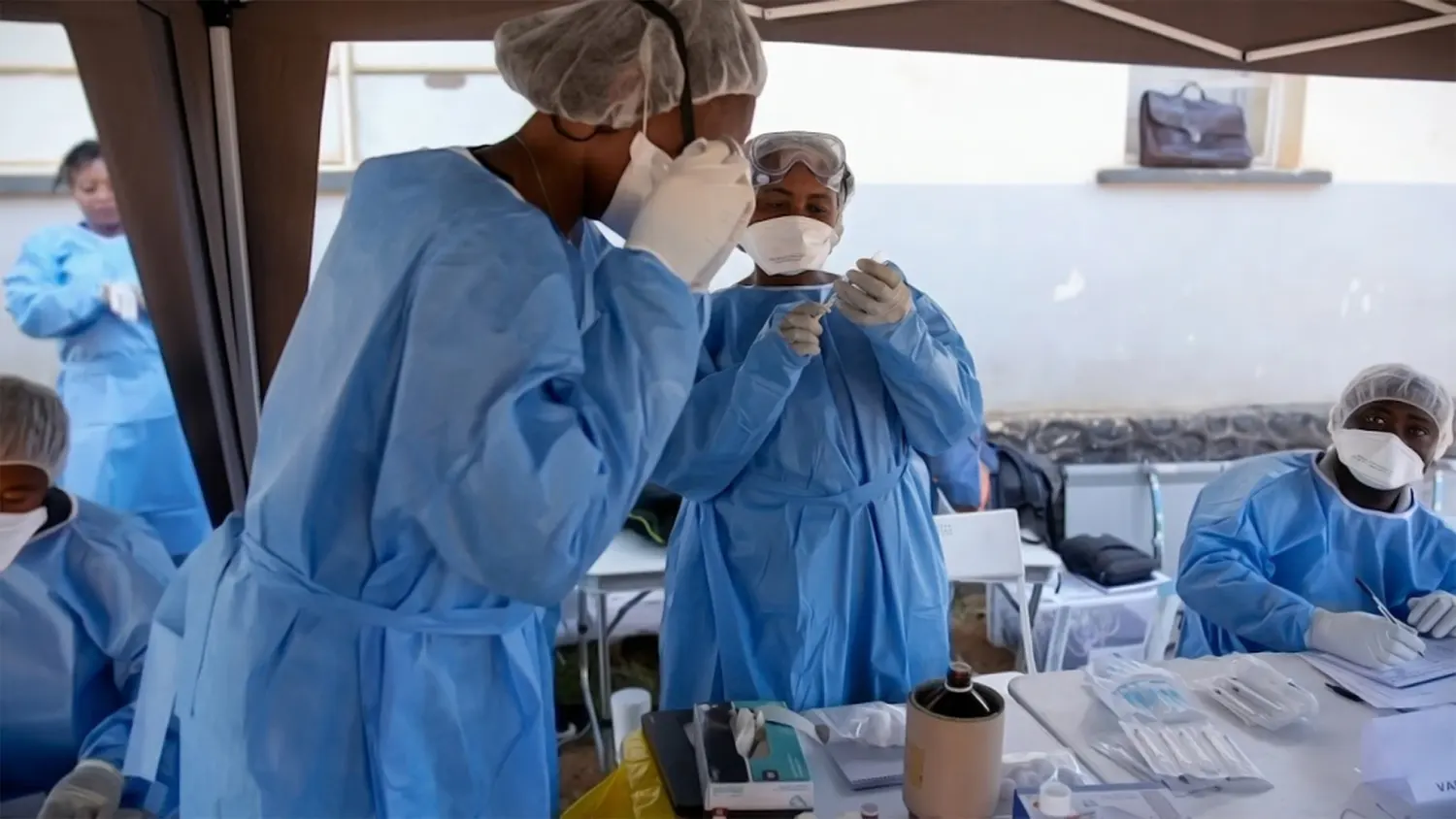
Because there is no approved vaccine to deploy, the WHO’s emergency strategy is built entirely around containment and mortality reduction. Rapid Response Teams have been sent into the hot zones in Ituri province and Kampala to map transmission chains and oversee safety protocols. Emergency supply airlifts coordinated out of the WHO AFRO logistics hub in Dakar have pushed sample collection kits, symptom management medication, and large quantities of Personal Protective Equipment into both the DRC and Uganda.
Safe Ebola Treatment Centers are being erected in partnership with Médecins Sans Frontières to properly separate suspected and confirmed patients, reducing the risk of healthcare-facility transmission. A high-level ministerial meeting in Kampala brought together health ministers from the DRC, Uganda, and South Sudan to synchronize border exit screenings and testing protocols across the region.
On the research side, the WHO has channeled a €7.4 million research agreement to fast-track clinical trial frameworks for experimental Bundibugyo-specific therapeutic candidates though any approved treatment remains some way off.
How the world is responding and where countries disagree
The WHO has been explicit: blanket travel bans are counterproductive. They crash local economies, push cases underground, and reduce the cooperation needed to contain an outbreak. The recommended approach is targeted border exit screening combined with 21-day health monitoring for arriving travelers. Despite that guidance, a clear split has formed between governments that agree and those that have imposed hard restrictions anyway.
Hard bans: The U.S. has barred non-citizens who visited the DRC, Uganda, or South Sudan in the last 21 days under a Title 42 public health order. Saudi Arabia suspended Umrah and tourism visas for travelers from those countries. South Sudan shut its southern border checkpoints to non-citizens entirely.
Strict screening (no ban): The EU, UK, India, Singapore, Japan, and China have all opted for mandatory health declarations, 21-day monitoring apps, thermal scanning, and rapid isolation protocols at airports stopping short of outright bans but creating significant friction for travelers from affected regions.
Singapore funnels symptomatic arrivals directly into a specialized containment ward at its National Centre for Infectious Diseases. Japan requires travelers from the DRC and Uganda to report their temperature daily via a government tracking app. China is conducting onboard thermal scanning of flights from African transit hubs before passengers can disembark. The UAE requires a certified negative PCR clearance before boarding any flight bound for Dubai or Abu Dhabi from the affected countries.
The Africa CDC has urged East African neighbors to keep trade routes open while heavily fortifying health checkpoints, a position aligned with the WHO’s guidance, and one that reflects a hard lesson from past outbreaks: economic isolation does not stop a virus. It just makes the communities most affected less likely to report cases.
What this means for the rest of the world
For the vast majority of people outside Central Africa, the practical risk remains very low. Bundibugyo does not spread through the air, through casual contact, or through food and water. The people most at risk are those in direct, unprotected contact with symptomatic patients primarily healthcare workers and family members providing care in affected areas.
What the PHEIC declaration does mean, practically, is that more resources, more international coordination, and more urgency are now being directed at a region that has historically struggled to contain Ebola without that level of global attention. The race now is whether the containment infrastructure treatment centers, contact tracing networks, and cross-border coordination can be built fast enough to outpace a virus that is already inside Goma, already in Kampala, and already on a plane to Europe.