Climate change is not hitting the world evenly. The nations suffering the most from extreme weather, flooding, and famine are almost always the ones that pumped the least carbon into the atmosphere. This is the defining injustice of our time and the numbers make it impossible to ignore.
When a catastrophic flood tears through a country, the headlines usually focus on the storm itself. What gets far less attention is the quiet, uncomfortable truth sitting just beneath the surface: the countries being destroyed by climate change are largely not the ones that caused it.
Understanding who is most affected and why requires looking at two very different types of impact. One is the raw, immediate devastation of extreme weather events. The other is the slower, grinding vulnerability of nations that simply do not have the resources to survive what is coming. Both tell the same story, just from different angles.
Not all disasters hit the same way
The most respected measure of climate damage is the Global Climate Risk Index, which tracks both human casualties and economic losses from extreme weather over time. When you look at the data, small island nations and developing countries dominate the top of the list not because their storms are necessarily bigger, but because a single hurricane can equal 200% of their entire annual economic output. For a country like Dominica, one bad season does not just cause damage. It forces the entire economy to restart from scratch.
Dominica ranks first for long-term climate impact over the past three decades. Myanmar, Honduras, Libya, and Haiti follow close behind. India, despite sitting further down the list at number nine, has suffered over 80,000 deaths and $170 billion in damage in absolute terms, a reminder that large populations, even with some resources, are not shielded from the scale of these events.
In the most recent data year, the pattern continued. St. Vincent and the Grenadines, Grenada, Chad, and Myanmar all faced singular, catastrophic events hurricanes, flash floods, and typhoons that overwhelmed whatever defenses existed.
Dominica — damage per storm
~200%
of annual GDP, from one hurricane
India — absolute losses
$170B
in damage over 30 years
Libya — storm probability
50×
more likely due to climate change
Global warming — rainfall
+7%
more moisture per 1°C of warming
How science connects the storms to warming
There is now a dedicated field of climate science called event attribution, which uses supercomputers to answer a precise question: how much did climate change increase the likelihood and severity of this specific disaster? The results, once theoretical, are now strikingly concrete.
In Libya, Storm Daniel caused catastrophic dam collapses in 2023. A World Weather Attribution study found that climate change made the extreme rainfall behind those collapses up to 50 times more likely and roughly 50% more intense. The physics behind this is straightforward: a warmer atmosphere holds more moisture about 7% more for every single degree of warming. When that moisture finally releases, it does not drizzle. It pours everything at once.
In the Caribbean, the mechanism is different but equally direct. The ocean has absorbed more than 90% of the excess heat generated by global warming. That stored heat is essentially rocket fuel for hurricanes, it accelerates storms and enables rapid intensification, where a Category 1 hurricane becomes a Category 5 within hours. In 2024, every single Atlantic hurricane was made more powerful by record ocean temperatures. There was no storm that season untouched by warming.
In Chad and the broader Sahel region, the effect is not one extreme event but a destabilized rhythm. Global warming is pushing the Sahara Desert southward, displacing predictable rainy seasons. Farmers who have grown crops the same way for generations now face long killing droughts followed by sudden flash floods each one erasing what the other left behind. In Myanmar and much of Southeast Asia, heatwaves that used to arrive once every century are now arriving every three to five years. In 2024 and 2025, temperatures surged past 45°C (113°F), a threshold that is not “hot summer.” It is a physiological danger zone.
A useful way to think about it
If you have a weak heart, meaning poor infrastructure and limited resources and someone makes you run a marathon in extreme heat, you are far more likely to collapse than a healthy person. Climate change is the heat and the marathon. Poverty is the weak heart. The combination is lethal.
The emissions gap that makes this a moral crisis
Here is where the data becomes genuinely difficult to sit with. The countries suffering the most are, almost without exception, the ones that contributed almost nothing to the problem.
The United States is responsible for roughly 20% of all historical greenhouse gas emissions, the largest cumulative share of any single nation. The EU and China together account for another large portion of what is currently in the atmosphere. And yet the U.S., due to its wealth and infrastructure, ranks relatively low on the climate vulnerability index. It can build sea walls. It can fund disaster recovery. It can absorb the bill.
Dominica’s share of global historical emissions is approximately 0.0001%. Haiti’s is around 0.01%. Chad’s is similarly negligible. These countries did not build the industrial economies that filled the atmosphere with carbon. They are paying for someone else’s growth.
| Country | Historical emissions share | Climate vulnerability |
|---|---|---|
| United States | ~20% (highest historically) | Low — high wealth and preparedness |
| China | ~11% (highest currently) | Medium-high — floods, but capacity to adapt |
| Dominica | 0.0001% | Extremely high — one storm can be catastrophic |
| Haiti | 0.01% | Extremely high — high death tolls, low recovery |
| Chad | 0.01% | Extremely high — famine, water crisis, floods |
Economists who study this divide between luxury emissions burning fuel for large SUVs, air-conditioned shopping malls, international tourism and survival emissions burning wood to cook a meal, using a small amount of coal to power a village make a critical point. The vast majority of what caused this crisis came from wealthy nations building wealthy lives. The vast majority of what is suffering for it exists at the opposite end of that spectrum.
When a hurricane hits Florida, the United States can allocate billions to rebuild within months. When a hurricane hits Grenada, it can consume the country’s entire recovery budget for the next decade.
The clean energy race running alongside the crisis
It would be easy to read all of this as purely grim. But 2026 also marks a moment of genuine, unprecedented momentum in the shift away from fossil fuels even if that momentum is uneven and complicated.
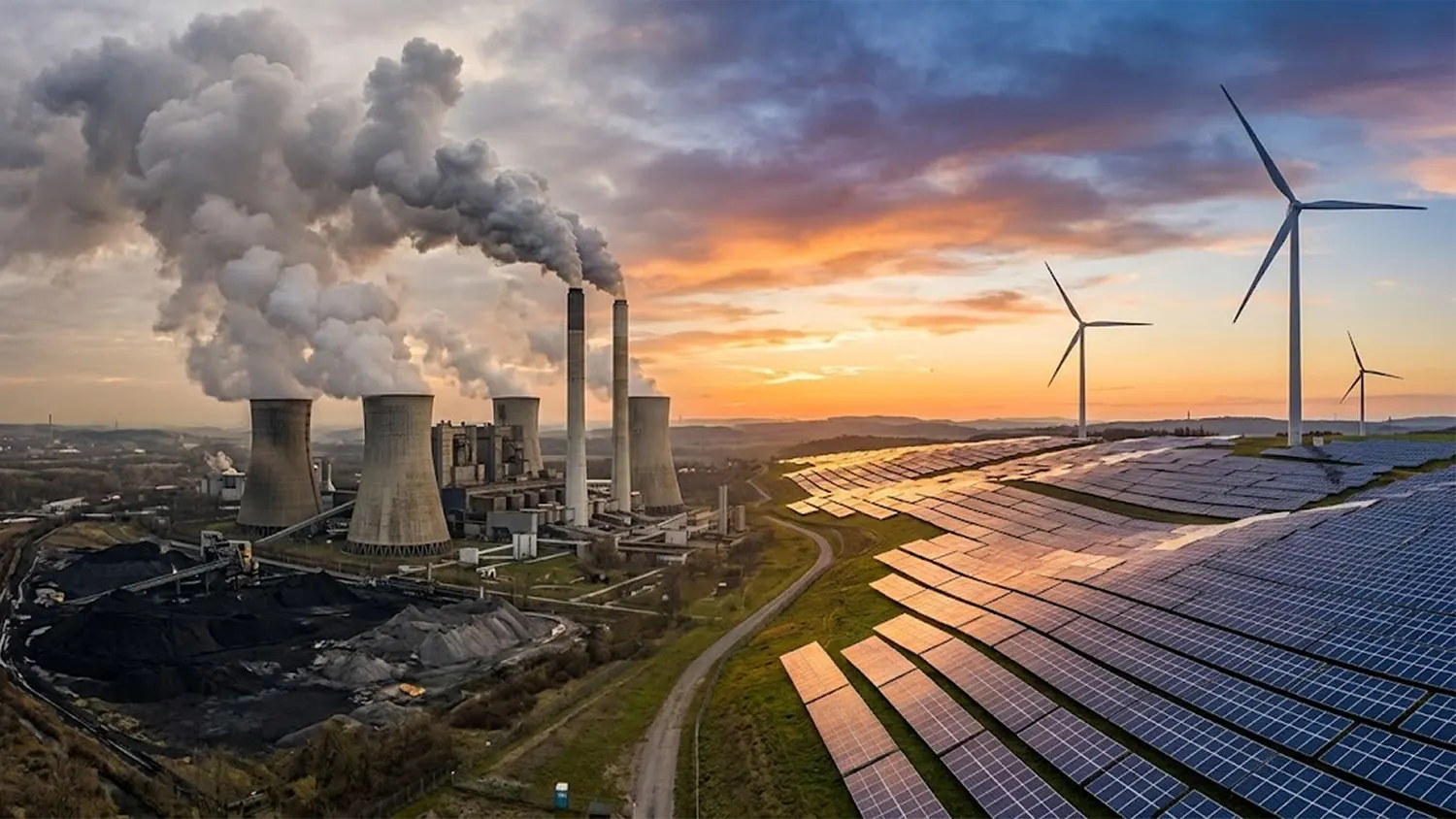
China is the undisputed heavyweight in sheer scale. It is expected to account for nearly 46% of all global renewable capacity additions this year. It produces 80–90% of the world’s solar panels. No country comes close to its manufacturing output. The catch is real, however: China remains the world’s largest coal consumer. It is building green and black energy simultaneously to fuel industrial growth that shows no sign of slowing.
The European Union has quietly become the most decarbonized large economy on earth. By early 2026, renewables reached roughly 47% of the EU’s power sector. In some months, solar has been the single largest source of electricity for the entire bloc. The motivation is not purely environmental following the conflict in Ukraine, the EU accelerated its clean energy push as a matter of energy security, legally committing to phase out Russian gas dependency by 2026–2027.
The United States, after years of lagging, shifted course dramatically with the Inflation Reduction Act. Since 2023, hundreds of billions in new investment have flowed into clean energy. Solar manufacturing capacity is on track to quadruple by 2033. The U.S. is now installing solar and battery storage at the fastest pace in its history driven less by climate policy than by the economics of the emerging green industrial economy.
| Feature | China | European Union | United States |
|---|---|---|---|
| Strength | Manufacturing & scale | Policy & decarbonization | Innovation & investment |
| Key figure | ~46% of global renewables added | 47% of power sector is renewable | $369B+ in green subsidies |
| Main challenge | Massive coal reliance | Grid connection delays | Political division on climate |
What the world agreed to and where it falls short
The UNFCCC, the United Nations body that coordinates global climate action held its most recent major summit, COP30, in Brazil in November 2025. It was a meeting focused less on broad targets and more on the concrete question of who pays for the damage already being done.
Brazil introduced what it called the “Global Mutirão”, a Portuguese word meaning collective effort shifting the UNFCCC’s focus from negotiating language to real-world action. For the first time, there was a clear political roadmap toward phasing out fossil fuels in a “just and orderly” way, and wealthy nations committed to tripling adaptation finance money specifically for building sea walls, drought-resistant farms, and early warning systems in vulnerable countries by 2035.
The most tangible outcome was the operationalization of the Loss and Damage Fund, which had been a flashpoint in climate negotiations for years. In early 2026, the fund began processing its first $250 million in direct grants to countries hit by climate disasters. The goal is to give money to places like Haiti or Chad after a catastrophe without forcing them to take on the kind of debt that traps nations in cycles of recovery and renewed vulnerability.
And yet the numbers tell a harder story. Even with new commitments from the EU, the UK, and others, current pledges put the world on track to cut emissions by only 12% by 2035. Scientists say a 57% cut is needed to keep warming under 1.5°C. Renewables are growing faster than at any point in history, but coal and oil are not being retired fast enough to meet the targets that would make those growth numbers matter.
The honest assessment
Before the Paris Agreement, the world was heading for roughly 4°C of warming, a scenario that climate scientists describe as catastrophic for most of human civilization. Because of UNFCCC frameworks, that trajectory has bent to approximately 2.4°C. That is meaningful progress. It is also nowhere near enough.
A problem of fairness as much as physics
What makes climate change uniquely difficult beyond the science, the politics, and the economics is the ethical dimension that sits underneath all of it. The countries least equipped to survive what is coming are the ones that did the least to cause it. The countries most responsible for filling the atmosphere with carbon are the ones with the greatest capacity to adapt, insulate themselves, and recover.
This is not an accident of geography. It is the direct result of which economies industrialized first, which ones built wealth on fossil fuels, and which ones were left out of that process. The ND-GAIN Index, which measures vulnerability against readiness to adapt, ranks Chad, the Central African Republic, Eritrea, and Sudan among the most at-risk nations on earth countries with minimal emissions histories, now facing the full weight of a crisis built elsewhere.
The Loss and Damage Fund is the international community’s first formal acknowledgment that this imbalance exists and must be corrected. Whether $250 million in initial grants is anything close to sufficient for the scale of what is already happening, let alone what is coming is a different question entirely. The physics of warming does not negotiate. And the clock, as every climate diplomat will quietly tell you, is moving faster than the talks.