Mexico City has long struggled with sinking ground. But new satellite data is revealing just how quickly the problem is accelerating and how little time there may be to respond.
According to measurements from the NISAR satellite, a joint mission between NASA and the Indian Space Research Organisation some parts of the city are now sinking by more than 2 centimeters per month. In the hardest hit districts, that adds up to nearly 25 centimeters, or about 10 inches, every single year.
The areas around the city’s main airport and historic center are among the most vulnerable. For residents, these are not abstract scientific projections. Streets crack. Buildings tilt. Water pipes rupture beneath neighborhoods already facing shortages.
But the real concern goes deeper than damaged infrastructure. Scientists warn that much of the sinking may now be permanent and irreversible raising urgent questions about whether one of the world’s largest cities can adapt fast enough to avoid a long-term urban crisis.
That crisis begins underground, in the ancient geology beneath modern Mexico City.
The City Was Built on a Lake That Never Truly Disappeared
Mexico City sits on the remains of Lake Texcoco, an ancient lakebed filled with soft volcanic clay and water-rich sediments. For centuries, the ground remained relatively stable because underground aquifers supported the soil from below. That balance changed as the city expanded into a megacity of more than 22 million people.
To supply enough drinking water, authorities pump enormous volumes of groundwater from beneath the city. Over time, that extraction removes the water trapped between clay particles, a process scientists call loss of pore pressure. Without that internal support, the clay compresses under the weight of roads, buildings, and concrete.
Experts often compare it to a wet sponge. When full of water, it holds its shape. Squeeze the water out, and the structure collapses. In Mexico City’s case, the collapse is far more serious, the clay does not rebound after compression.
The city is not simply “settling.” It is undergoing permanent land subsidence, a geological process that cannot be reversed even during heavy rain or flooding. And the consequences are already reshaping daily life across the capital.
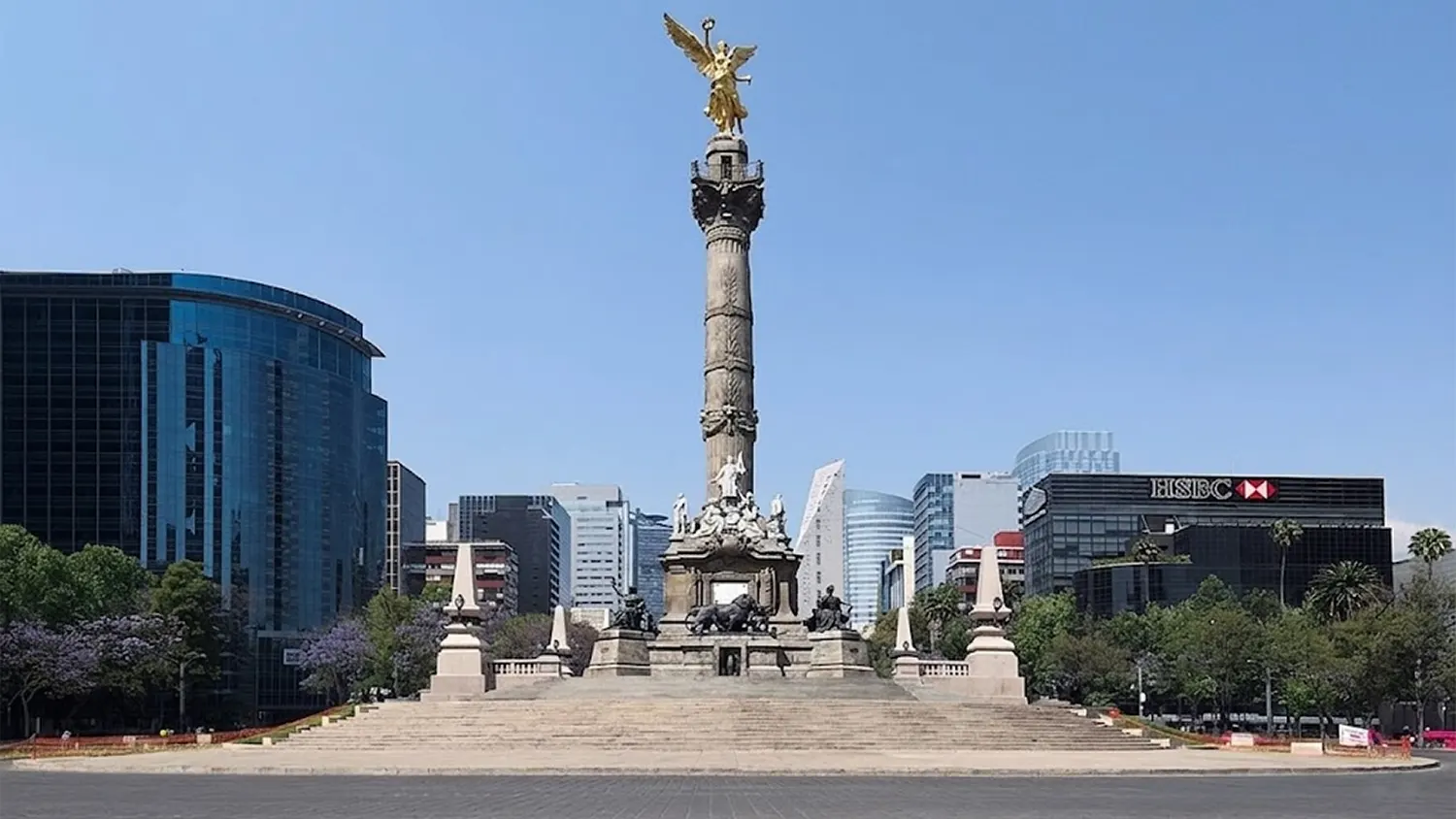
The Angel of Independence, one of Mexico City’s most iconic monuments offers perhaps the clearest visual proof. When it was inaugurated in 1910, its base sat level with the surrounding street. Today, officials have added 14 extra steps because the road around it has sunk while the monument’s deep foundation held firm.
But the real damage extends far beyond landmarks.
Why Different Streets Are Sinking at Different Speeds
The most destructive part of the crisis is not the sinking itself. It is the fact that different parts of the city sink at different rates. Scientists call this differential subsidence, and it places enormous stress on infrastructure designed for stable ground.
Metro lines warp as tracks tilt unevenly between stations. Roads fracture. Historic buildings crack under twisting pressure. The Metropolitan Cathedral began visibly leaning because one side rests on the more stable remains of an Aztec structure, while the other sits on softer lakebed sediments. Engineers spent years stabilizing it using specialized foundation work.
Similar problems are now spreading to newer infrastructure. Metro Line 9 has already required significant reinforcement because elevated sections are sinking faster than nearby stations. Officials fear some transit systems could eventually reach a point where repairs are no longer practical.
The underground water network is suffering just as badly. Pipes snap as the earth shifts beneath them, creating a devastating paradox: Mexico City is losing roughly 40% of its water supply through leaks while simultaneously facing severe water shortages.
That feedback loop is making the crisis harder to contain with every passing year.
The Subsidence Trap No One Knows How to Escape
Mexico City’s sinking problem is no longer just a geological issue. It has become a self-reinforcing cycle that threatens the city’s ability to function.
As pipes break and water is lost, authorities pump even more groundwater to compensate. But increased pumping accelerates the sinking. Faster sinking damages more infrastructure, creating more leaks and deeper shortages. Scientists call this a “subsidence trap” where every attempt to solve the water crisis risks making the geological crisis worse.
The problem extends to drainage as well. Because parts of the city have sunk below surrounding canals, wastewater can no longer flow naturally out of the basin. Instead, enormous pumping systems must force sewage and storm water uphill, a setup that is expensive, energy-intensive, and increasingly fragile during heavy storms.
If sinking continues at its current pace, researchers warn that some areas could face catastrophic flooding in future decades. During major rainfall events, parts of the city could effectively become a bowl with nowhere for water to drain.
Some Neighborhoods Could Eventually Become Uninhabitable
Current projections from researchers at the National Autonomous University of Mexico and the University of Oregon suggest some districts could sink by as much as 30 meters over the next 150 years if current trends continue.
That would not simply lower the city’s elevation. It would fundamentally reshape the valley. Large earth fissures could widen beneath roads and buildings. Underground gas lines and fiber-optic systems could rupture more frequently. Entire neighborhoods may require repeated reconstruction as foundations crack beyond repair.
Meanwhile, the aquifers themselves face collapse. As clay compresses, underground reservoirs lose their ability to store water efficiently. Deep cracks created by sinking ground may also allow sewage and contaminants to seep into freshwater reserves threatening water quality on top of water supply.
The social consequences could be just as severe. Wealthier districts built on more stable volcanic rock may become increasingly valuable, while lower-income communities on softer lakebed soils face worsening structural damage and unreliable services, a future shaped, in part, by geology.
Mexico Is Racing to Fix a Problem Decades in the Making
The Mexican government has launched several major initiatives aimed at reducing groundwater dependence. Officials acknowledge the scale is enormous, but progress is being made.
One of the most ambitious efforts is the expansion of “Cosecha de Lluvia” rainwater harvesting systems. Under the Casa por Casa program, thousands of homes in vulnerable districts now collect and store rainwater, with authorities estimating the systems can capture hundreds of millions of liters annually, reducing pressure on overused aquifers.
The government has also tightened oversight of private wells and introduced policies encouraging large developments to recycle treated wastewater instead of relying entirely on groundwater extraction. Engineers continue reinforcing critical infrastructure, including massive drainage projects like the Túnel Emisor Oriente, designed to move sewage and stormwater out of the sinking basin.
The biggest shift, however, may now be coming from space. The NISAR satellite, launched in 2025, allows scientists to measure land movement with millimeter-level precision using advanced radar imaging transforming the city’s response from reactive emergency repairs toward more predictive, targeted planning.
Still, scientists caution that the geology may be moving faster than policy. Without large-scale aquifer recharge pumping treated water back underground experts warn the city could continue losing elevation for generations. And because much of the clay compression is permanent, even aggressive intervention may only slow the process rather than stop it entirely.
The Ground Is Moving and the Clock Is Too
Mexico City remains one of the clearest examples in the world of how urban growth, water scarcity, and geological pressure can collide beneath a modern metropolis slowly at first, then all at once.
The satellite data now makes it impossible to look away. The ground beneath this city of 22 million people is literally changing shape, and it is happening faster than many planners once believed. The question is no longer whether Mexico City has a problem. The question is whether the response can match the speed of what is happening underfoot.