Human cloning is often portrayed as a technology that could eventually produce an identical copy of a person or even grow replacement organs on demand. The reality is much more complicated.
There are two very different ideas behind human cloning: reproductive cloning, which aims to create a cloned human being, and therapeutic cloning, which uses cloning-related techniques to produce cells for research or potential medical treatment.
Although scientists have made major advances in cell reprogramming, stem-cell research and tissue engineering, neither therapeutic cloning nor whole-organ cloning has reached the stage where doctors can routinely create replacement human organs from a patient’s cells. In fact, much of the field has shifted toward induced pluripotent stem cells (iPSCs), which can produce patient-specific stem cells without creating a cloned embryo.
Two Very Different Meanings of Human Cloning
The word “cloning” covers several technologies, which is why discussions about human cloning can become confusing.
Reproductive cloning would use cloning technology to create an embryo and then implant it into a uterus with the goal of producing a living child. No cloned human being has been scientifically verified, and reproductive human cloning is prohibited or restricted by laws and policies in many jurisdictions. UNESCO has specifically stated that reproductive cloning conflicts with human dignity.
Therapeutic or research cloning, by contrast, refers to using somatic cell nuclear transfer to create early-stage embryos as a source of genetically matched embryonic stem cells. The embryo is not intended to be implanted to produce a child.
That distinction is important because cloning cells is not the same thing as cloning a person.
How Somatic Cell Nuclear Transfer Works
One of the key techniques historically associated with cloning is somatic cell nuclear transfer (SCNT).
In simplified terms, researchers remove the nucleus from an unfertilized egg. The nucleus contains most of the cell’s nuclear DNA. They then introduce the nucleus from an adult somatic cell, such as a skin cell, into the emptied egg.
The reconstructed egg can then be activated so that it begins dividing. In reproductive cloning, the resulting embryo would theoretically be transferred to a uterus. In research cloning, the objective is instead to develop the early embryo far enough to obtain pluripotent stem cells.
The important point is that SCNT does not simply copy and paste a person’s entire biology. Nuclear DNA may be matched to the donor, but the resulting cells also contain mitochondrial DNA from the egg donor, and the process of reprogramming a mature cell is biologically difficult.
Why Cloning a Human Being Remains Unsafe
The biggest obstacle to reproductive cloning is not simply whether scientists can make cells divide. It is whether they can reliably and safely reprogram a mature cell so that an entire organism develops normally.
Animal cloning has demonstrated how difficult this can be. Nuclear transfer can produce embryos that fail to develop, while surviving clones can experience abnormalities associated with epigenetic reprogramming and abnormal development.
Researchers have also encountered major technical challenges involving the quality of donor eggs, nuclear reprogramming, embryo development and the regulation of gene activity.
For humans, those risks would be unacceptable in reproductive medicine.
There are also profound ethical questions. A cloned child would not simply be a “copy” in the everyday sense. Environment, development and experience would still shape the person. Questions about consent, exploitation, identity, parenthood and the use of human embryos would remain.
Therapeutic Cloning Has Promise but It Is Not Routine Medicine
Therapeutic cloning has long been proposed as a way to create patient-matched embryonic stem cells.
The basic idea is straightforward: if stem cells could be derived from a patient’s own nuclear DNA, researchers could potentially turn them into specialized cells such as neurons, pancreatic cells or heart muscle cells.
That could theoretically reduce immune incompatibility compared with cells obtained from an unrelated donor.
However, it is important not to confuse this potential with established clinical treatment. Therapeutic cloning using SCNT is still primarily a research technology, while many current regenerative-medicine programs are increasingly using iPSCs and other stem-cell approaches instead.
Why iPSCs Have Changed the Field
A major breakthrough came with induced pluripotent stem cells, or iPSCs.
Instead of transferring a patient’s nucleus into a donor egg, scientists can take an adult cell such as a skin or blood cell and reprogram it back into a pluripotent state.
The resulting iPSC can then potentially be differentiated into many specialized cell types.
This approach has a major practical advantage: it does not require human eggs or the creation of a cloned embryo.
Researchers are now investigating iPSC-based approaches for areas including Parkinson’s disease, diabetes, cardiovascular disease, retinal disorders and other conditions. Some iPSC-derived therapies have entered clinical trials, but researchers still have to address issues such as tumor formation, genetic abnormalities, manufacturing consistency, immune responses and long-term integration of transplanted cells.
Could Cloning Produce Replacement Organs?
This is where science-fiction imagery often gets ahead of the actual technology.
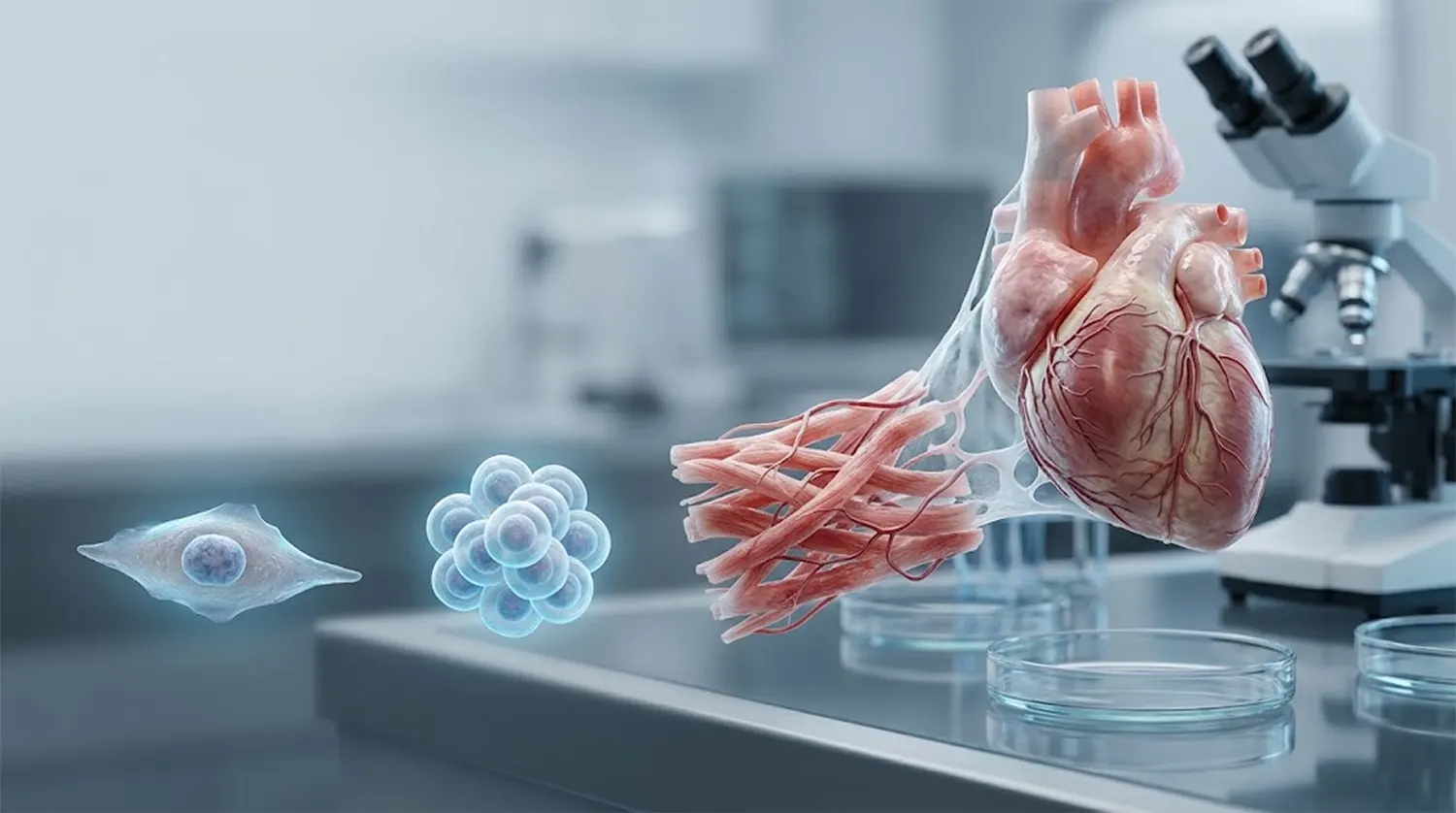
Scientists can grow organoids, which are small three-dimensional structures that reproduce some features of organs such as the kidney, liver, brain and heart. These models are valuable for studying diseases and testing medicines.
But an organoid is not the same as a transplantable human organ.
A full-sized kidney, for example, requires multiple specialized cell types arranged in precise structures. It also needs an intricate network of blood vessels capable of supplying oxygen and nutrients throughout the tissue.
That makes the difference between growing a collection of cells and engineering a functional organ enormous.
The Blood-Vessel Problem Is One of the Biggest Obstacles
Large tissues cannot survive simply by being supplied with nutrients from their outer surface.
A functioning solid organ requires an extensive microvascular network containing tiny blood vessels and capillaries that reach deep into the tissue.
Without that network, cells located far from the surface can become deprived of oxygen and nutrients.
This is one reason researchers are exploring combinations of stem-cell biology, tissue engineering, biomaterials, scaffolds and 3D bioprinting.
A future engineered organ could theoretically be built by producing patient-compatible cells, organizing them into the correct architecture and encouraging them to mature inside a controlled bioreactor.
But that is very different from saying that scientists can currently print a fully functional human heart or kidney and implant it as a routine treatment.
What Scientists Can Actually Grow Today
The current landscape is best understood as a spectrum rather than a simple “can” or “cannot.”
Researchers can grow and manipulate many types of human cells and tissues in laboratories. Tissue-engineering approaches have also produced clinically useful products in some areas, while stem-cell-derived organoids are increasingly important research tools.
At the same time, fully functional, full-sized complex organs such as hearts, kidneys and livers remain beyond routine laboratory manufacturing.
Even when researchers create tissue that resembles part of an organ, additional problems remain: vascularization, structural organization, mechanical strength, electrical activity, immune compatibility, long-term survival and integration with the patient’s body.
In other words, making the cells is only one part of the challenge.
What About Diabetes, Parkinson’s and Heart Disease?
The potential medical applications are substantial, but they should be described as research goals and emerging therapies, rather than established treatments based on therapeutic cloning.
For Type 1 diabetes, researchers are investigating ways to replace insulin-producing pancreatic beta cells using stem-cell-derived cells.
For Parkinson’s disease, scientists are studying dopamine-producing neurons generated from pluripotent stem cells.
For heart disease, researchers are investigating whether stem-cell-derived cardiomyocytes and other cardiac cells can repair or replace damaged tissue.
Similar approaches are being studied for spinal-cord injuries, retinal diseases and other conditions.
The underlying concept is regenerative medicine: instead of replacing an entire organ, doctors may eventually be able to replace or repair the specific cells and tissues that have been damaged.
That distinction could prove more important clinically than the idea of cloning an entire organ.
Why “Cloned Organs” Are Still Far Away
A transplantable organ has to do much more than look like an organ.
A kidney must filter blood and regulate fluids. A heart must contract continuously and respond to electrical signals. A liver must perform hundreds of biochemical functions. All of these organs require sophisticated internal structures and vascular systems.
Researchers therefore face several interconnected problems:
- Vascularization: billions of cells need access to oxygen and nutrients.
- Cell diversity: complex organs contain many specialized cell types.
- Architecture: those cells must be arranged in highly precise structures.
- Maturation: laboratory-grown cells must develop the characteristics of adult tissue.
- Integration: transplanted tissue must connect with the patient’s blood vessels, nerves and surrounding tissues.
- Safety: engineered cells must not develop dangerous mutations or form tumors.
- Scale: producing enough high-quality cells for a full adult organ is a major manufacturing challenge.
These barriers explain why a lab-grown organ model is not equivalent to a replacement organ.
The Future May Not Depend on Cloning at All
The most interesting development may be that medicine does not necessarily need reproductive-style cloning to achieve some of the goals originally associated with cloning.
iPSCs can provide patient-specific cells without using SCNT. Tissue engineering can organize those cells into larger structures. Biomaterials and scaffolds can provide physical support, while 3D bioprinting may eventually help researchers reproduce increasingly complex anatomy.
Meanwhile, another strategy is being explored to address the shortage of donor organs: xenotransplantation, which uses cells, tissues or organs from genetically modified animals such as pigs. The FDA identifies pig kidneys, skin and pancreatic islets among the areas being investigated for xenotransplantation.
This means the future of organ replacement may involve several technologies working together rather than a single “cloning machine.”
Human Cloning Is Still More Science Than Science Fiction
Human cloning remains one of biotechnology’s most misunderstood subjects.
Scientists have demonstrated that cells can be reprogrammed and that cloning-related techniques can generate genetically matched cell populations in research settings. But no scientist can currently take an adult person’s cells, clone them into a healthy human being, or manufacture a fully functional replacement heart, kidney or liver from those cells for routine transplantation.
The field has instead moved toward more practical forms of regenerative medicine, particularly iPSCs, cell therapies, organoids and tissue engineering.
The long-term goal is increasingly less about creating a biological copy of a person and more about repairing damaged parts of the body with cells that are safe, functional and compatible with the patient.
That may ultimately be a more useful achievement than human cloning itself.