
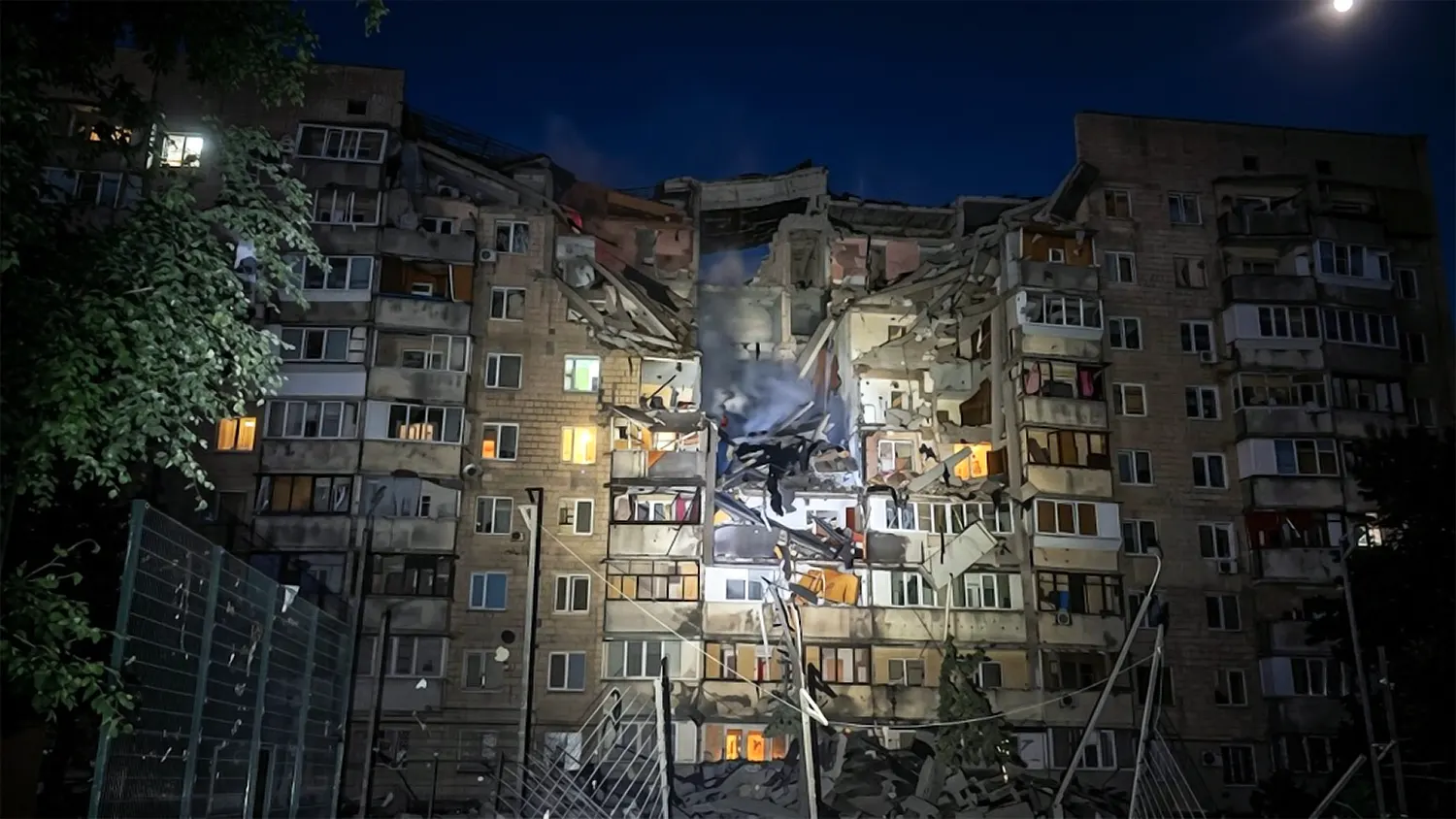
Kyiv woke up to explosions, not sunlight, on Monday, July 6, 2026. Russia unleashed one of its largest coordinated air assaults of the war, sending a wave of missiles and drones into the Ukrainian capital just hours before world leaders were set to gather for the NATO summit in Ankara, Turkey. The timing wasn’t lost on anyone. As Ukraine’s allies prepared to discuss the country’s defense, Russia was busy demonstrating exactly how thin that defense has become.
By the time the smoke cleared, at least 14 people were confirmed dead, 11 in Kyiv City and 3 more in the surrounding region with over 110 people wounded, including at least 7 children. Rescue crews are still digging through collapsed apartment blocks, and officials warn the numbers could climb higher as search operations continue.
A Barrage Built to Overwhelm Ukraine’s Defenses
This wasn’t a small strike. Ukraine’s Air Force reported that Russia fired 68 missiles, a mix of cruise, ballistic, and hypersonic variants alongside 351 attack drones and decoys, all in a single coordinated wave. The sheer volume appears designed to overwhelm Ukraine’s already-stretched air defense network.
Ukrainian forces did manage to intercept 326 of the drones and 37 of the cruise missiles, which is no small feat. But here’s the troubling part: not a single ballistic or hypersonic missile was shot down. Military officials pointed to an acute shortage of U.S.-supplied Patriot interceptors, the only system in Ukraine’s arsenal capable of countering missiles that move at those speeds. Without enough of them, the fastest and most destructive weapons in Russia’s toolkit are flying through unopposed.
Where the Missiles Landed
The human cost of that gap showed up almost immediately across three separate sites.
In the Podilskyi district, a historic residential neighborhood, a high-rise apartment building took a direct hit and partially collapsed, trapping residents inside. In Darnytskyi district, multiple residential blocks sustained heavy damage, with people pulled from the rubble by emergency crews using ladder trucks and heavy machinery. And just outside the city in Vyshneve, a strike on a nearby weapons depot triggered secondary explosions so severe that roughly 500 residents had to be evacuated from their homes.
None of these were frontline military bases. They were apartment buildings and neighborhoods where people were asleep when the strikes hit.
The Toll Keeps Climbing
This attack didn’t happen in isolation. Just four days earlier, on July 2, a separate strike on Kyiv killed 31 people. Add Monday’s toll, and the Ukrainian capital has now lost 45 civilians to Russian strikes in less than a week.
That kind of frequency and scale is part of a pattern Ukrainian officials and international monitors say has defined this war for years, one where residential areas are hit again and again, regardless of what Moscow claims its missiles are aimed at.
Moscow’s Explanation vs. What’s Actually Happening
Russia’s Ministry of Defense described the July 6 strikes as retaliation for Ukraine’s recent deep-strike drone campaigns against Russian oil export hubs like Ust-Luga and Vysotsk. Officials in Moscow said the targets were purely military drone factories, fuel storage hubs, and energy infrastructure feeding the war effort.
But that explanation runs into a well-documented problem. According to the United Nations, human rights groups, and the International Criminal Court, Russia’s stated targets rarely match where the missiles actually land. Strikes routinely hit deep residential neighborhoods, hospitals, supermarkets, and schools places with no military value whatsoever.
Analysts point to three reasons this keeps happening:
- Deliberate terror targeting. The ICC and independent defense experts argue that hitting civilian infrastructure far from the front lines is meant to break public morale and psychologically wear down the population, not just degrade military capacity.
- Outdated, imprecise weapons. Russia has repeatedly used Soviet-era missiles like the Kh-22 originally designed to hit ships at sea against land targets in cities. These missiles can miss their mark by hundreds of yards, landing wherever they happen to fall.
- Falling debris from intercepted weapons. Even when Ukrainian air defense successfully shoots down an incoming missile or drone, the wreckage and shrapnel often crash into nearby apartments and streets, still causing serious harm.
The Power Grid Has Become a Weapon Itself
Perhaps the clearest evidence of intent is Russia’s years-long campaign against Ukraine’s energy grid. The ICC has already issued arrest warrants for senior Russian military officials, including former Defense Minister Sergei Shoigu, specifically for directing strikes against civilian infrastructure. Under international law, deliberately attacking power plants, water systems, and heating facilities that civilians depend on to survive is classified as a war crime.
The reality is straightforward: Russia isn’t choosing between military and civilian targets. It’s hitting both. Military sites get struck to weaken Ukraine’s fighting capacity, while homes, hospitals, and power plants get struck to inflict pain on everyday people economically, physically, and psychologically.
Zelenskyy Presses NATO for More Air Defense
In the aftermath, President Volodymyr Zelenskyy used the moment to make a direct appeal to Western allies gathering in Ankara. His message was simple: Ukraine needs more advanced air defense systems, and it needs them faster. With Patriot interceptors running low and ballistic missiles slipping through untouched, Ukrainian officials say the gap between what they have and what they need is now costing lives on a near-daily basis.
Whether NATO responds with faster shipments remains to be seen. For the families searching through rubble in Podilskyi and Darnytskyi this week, the answer can’t come soon enough.