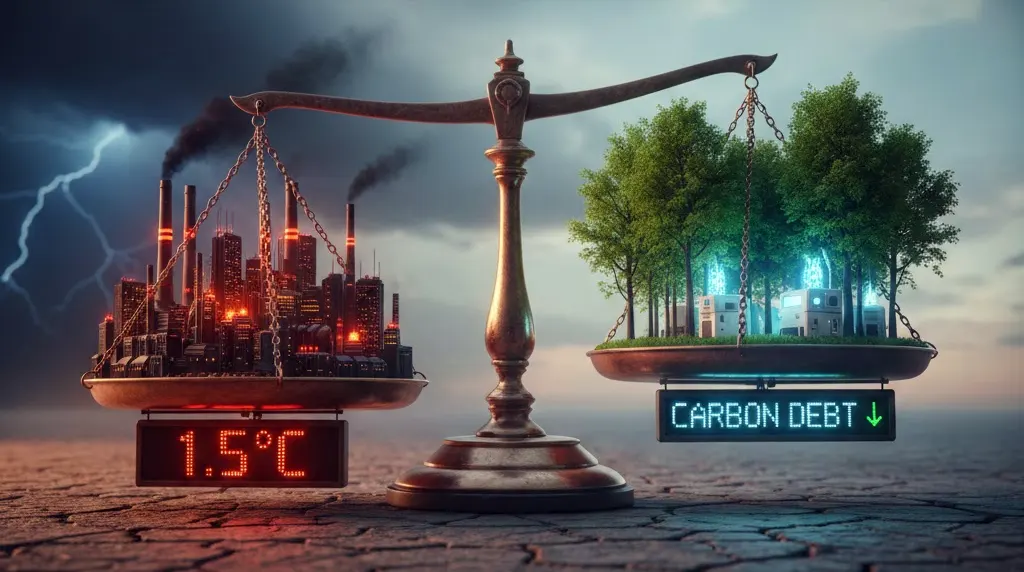
In late 2025, the COP30 summit in Belém, Brazil, concluded with a sobering consensus: the 1.5°C guardrail of the Paris Agreement has not just been neared, it has been breached.
While our previous analysis focused on the “Code Red” warnings from the WMO and UNEP, a new and more litigious phase of the climate crisis has begun. On February 2, 2026, a landmark commentary published in Nature by experts from the International Institute for Applied Systems Analysis (IIASA) formally declared our entry into the “Overshoot Era.”
This declaration marks a fundamental shift in global climate strategy. We are moving away from the era of “Mitigation and Hope” into an era defined by “Backward Looking Accountability” and the legal enforcement of “Carbon Debt.”
The Failure of the “Guardrail” Narrative
For three decades, the international community treated 1.5°C as a target that could be “saved.” However, as IIASA Energy Program Director Keywan Riahi noted this month, “Exceeding 1.5°C marks our failure to prevent minimum levels of dangerous human interference.”
The “Overshoot Era” assumes that the global temperature will now stay above 1.5°C for several decades. The scientific focus has shifted from stopping the rise to managing the return. However, unlike previous cycles, the scientific community is now demanding that this “return” be accompanied by a rigorous accounting of how we got here.
Rethinking Accountability: The Rise of “Climate Debt”
The most explosive element of the 2026 IIASA commentary is the call for backward looking accountability. For years, climate policy has focused on “Net Zero” targets, a forward looking goal that often allows high emitters to delay action by promising future carbon removal.
In the Overshoot Era, this is no longer acceptable. Leading scientists, including Gaurav Ganti and Carl Friedrich Schleussner, argue that we must now quantify the foreclosed option space. In simpler terms: Science must now calculate exactly which “safe” futures were destroyed by the delay tactics of the last decade and who, specifically, is responsible for those lost options.
This has given rise to the concept of Carbon Debt Repayment. The logic is simple:
- Every tonne of CO2 emitted past the 1.5°C budget is a “loan” taken from future generations.
- In an overshoot world, “Net Zero” is insufficient.
- High emitting nations and “Carbon Major” corporations must now be held to Net Negative obligations effectively paying back their carbon debt by removing more CO2 than they emit, with “interest” paid in the form of Loss and Damage finance.
The Legal Hammer: The ICJ and the 1.5°C Obligation
The political shift is being fueled by a massive legal development. In 2025, the International Court of Justice (ICJ) issued a landmark Advisory Opinion stating that the 1.5°C limit is not merely a “pursuit of efforts” but a primary legal obligation under the Paris Agreement.
In the 2026 Overshoot Era, this ruling is being used to trigger a wave of “Accountability Litigation.” If a state acts wrongfully by failing to use all means at its disposal to stay within the 1.5°C limit, they are now legally vulnerable. We are seeing the first cases where small island nations are suing G20 members not just for future damages, but for the restitution of the 1.5°C threshold itself.
The IPCC AR7: A New Mission for UN Science
As the Intergovernmental Panel on Climate Change (IPCC) begins its Seventh Assessment Cycle (AR7) in early 2026, the mandate has changed. The IIASA and its collaborators have called for the AR7 to “firmly anchor 1.5°C” as the baseline for Overshoot Policy.
The upcoming reports (expected to start appearing in 2028) will likely focus on:
- The Reversibility Gap: Assessing which tipping points (like coral reef collapse or permafrost thaw) become irreversible during a 20 year overshoot.
- Equity Under Overshoot: Developing metrics to ensure that the burden of carbon removal doesn’t fall on the Global South, which did not incur the “Carbon Debt.”
- Integrated Remedies: Linking Carbon Dioxide Removal (CDR) directly to Loss and Damage finance, ensuring that removal technologies serve the climate vulnerable rather than just the fossil fuel industry.
The Economic Reckoning: From Pledges to Obligations
The economic implications of the Overshoot Era are starting to manifest in global markets. In February 2026, the International Monetary Fund (IMF) warned that the “complacency” of current growth models fails to account for the looming storm of climate debt.
Governments are now facing a “Ticking Time Bomb.”
As temperatures stay above 1.5°C, the cost of adaptation is tripling, while the “Carbon Debt” continues to accrue interest. We are seeing the emergence of Carbon Removal Obligations (CROs), where corporations are required to hold a “removal bond” for every tonne they emit, effectively a deposit that ensures they will pay for that carbon to be vacuumed out of the sky in 2040.
Conclusion: Beyond the 1.5°C Mourning Period
As the reports from COP30 and the IIASA make clear, the time for mourning the 1.5°C threshold has passed. We have entered a grimmer, more complex reality. The “Overshoot Era” is not a license to give up, it is a summons to hold the line.
The difference between a “limited and short” overshoot and a “prolonged and catastrophic” one depends entirely on accountability. If the world allows the 1.5°C breach to be treated as an “accidental” tragedy rather than a “culpable” failure, we risk target backsliding that could push us toward 2.8°C.
In 2026, the mantra for the climate movement has evolved:
The limit was breached, The debt is due
The era of accountability has arrived.