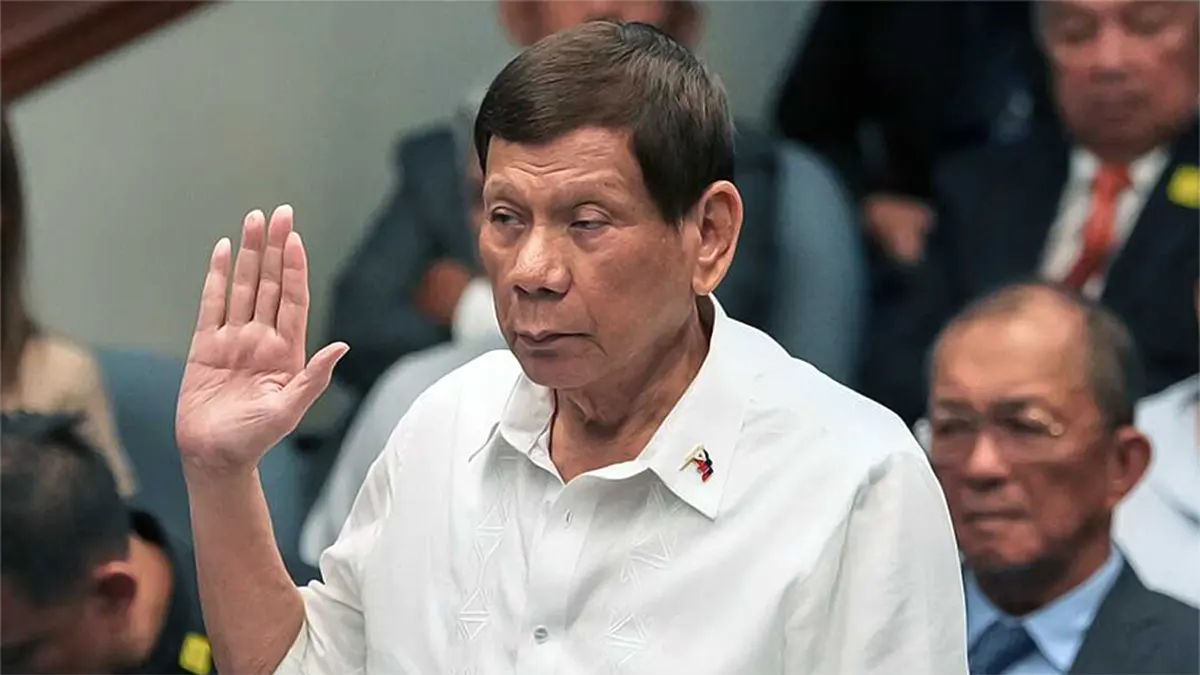
Former Philippine President Rodrigo Duterte is now facing crimes against humanity charges at the International Criminal Court (ICC), marking a historic moment in international law and Asian politics.
The ICC formally charged Duterte over killings linked to his controversial “war on drugs” and his time as mayor of Davao City. The case makes him the first former Asian head of state to be indicted by the court.
Duterte is currently being held in The Hague after Philippine authorities arrested him earlier this year under an ICC warrant.
ICC Accuses Duterte Over Drug War Killings
The ICC’s case centers on allegations that Duterte played a direct role in a large-scale campaign of extrajudicial killings during both his presidency and his years leading Davao City.
Prosecutors accuse him of “murder as a crime against humanity” through a network of police officers and alleged vigilante groups involved in anti-drug operations.
The charges were detailed in a 15-page document released by the court.
According to prosecutors, the killings formed part of a coordinated and systematic campaign targeting suspected drug users, street-level dealers, and other alleged criminals.
First Charge Focuses on Davao Death Squad Killings
The first count involves alleged murders committed between 2013 and 2016 while Duterte served as mayor of Davao City.
ICC prosecutors claim a group known as the Davao Death Squad (DDS) carried out at least 19 killings during that period.
The court alleges Duterte instructed members of the group to target suspected criminals, including alleged drug dealers, thieves, and robbery suspects.
For years, human rights organizations accused the DDS of operating as a vigilante-style death squad with ties to local authorities.
Nationwide Drug Operations Under Scrutiny
The second charge focuses on the deaths of 14 alleged “high-value targets” killed across the Philippines between 2016 and 2017 after Duterte became president.
Prosecutors claim law enforcement networks and other operatives were involved in coordinated killings tied to anti-drug operations.
The third and largest charge involves 43 deaths and two attempted killings linked to nationwide police “clearance operations” conducted between 2016 and 2018.
According to the ICC, the 76 deaths listed in the indictment represent only a small sample of the broader campaign.
Human rights groups have long estimated that thousands of people may have been killed during Duterte’s anti-drug crackdown.
Duterte’s Lawyers Challenge ICC Authority
Duterte’s legal team has strongly rejected the charges and questioned the ICC’s authority to prosecute him.
The Philippines officially withdrew from the Rome Statute, the treaty that created the ICC, in 2019 during Duterte’s presidency.
However, ICC prosecutors argue the court still has jurisdiction because the alleged crimes occurred while the Philippines remained a member state between 2011 and 2019.
The case is now being closely watched internationally because it could help define how far the ICC’s authority extends after a country leaves the court.
Questions Raised Over Duterte’s Health and Trial Fitness
The legal proceedings recently faced another complication after Duterte’s lawyers requested a postponement of the Confirmation of Charges hearing.
His defense team cited reports of “cognitive impairment” and argued that the former president may not currently be fit to stand trial.
The ICC must first decide whether Duterte is medically and mentally capable of participating in court proceedings before the case can move forward.
His lawyers have also challenged the legality of his arrest, accusing the Philippine government under President Ferdinand “Bongbong” Marcos Jr. of bypassing proper legal procedures.
Philippines Divided Over Historic ICC Case
The case has triggered strong reactions across the Philippines.
Human rights groups and families of victims view the charges as a major step toward accountability after years of alleged abuses linked to the anti-drug campaign.
Meanwhile, Duterte’s supporters have condemned the ICC proceedings as politically motivated and an attack on Philippine sovereignty.
The issue has also deepened political tensions inside the country, especially as Duterte’s daughter, Vice President Sara Duterte, continues to publicly support her father and assist with his defense efforts.
A Landmark Test for International Justice
Legal experts say the outcome of the Duterte case could become one of the most important international justice precedents in recent years.
The proceedings will test whether former world leaders can still be held accountable for alleged human rights violations even after leaving office.
Beyond Duterte’s personal legacy, the case may also shape the future role and credibility of the International Criminal Court itself.
As hearings continue in The Hague, the world will be closely watching how international law handles one of Asia’s most controversial political figures.