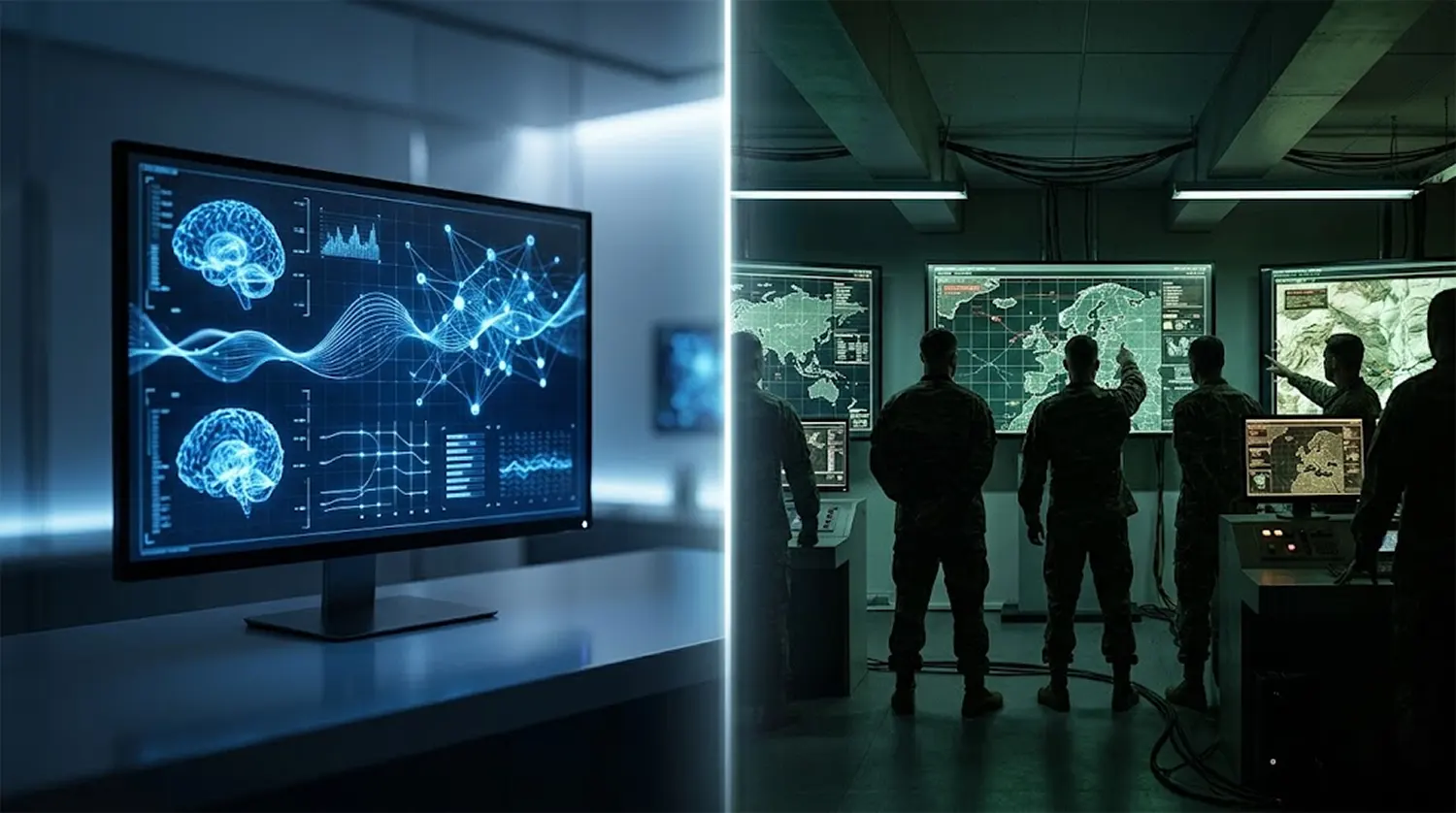
On May 1, 2026, the U.S. government quietly made a decision that could reshape the future of warfare. The newly branded Department of War announced agreements with eight major technology firms to deploy artificial intelligence on its most sensitive classified networks. Microsoft, Amazon Web Services, Google, Oracle, OpenAI, NVIDIA, Reflection, and SpaceX were all on the list. The goal was explicit: build an “AI-first fighting force” and enable “any lawful operational use” of advanced models.
But one name was missing. Anthropic, once a key partner was not just excluded; it had been effectively pushed out. That absence is not a footnote. It is the center of a widening conflict between Silicon Valley and the state, raising a deeper question: what happens when a private company refuses to build tools the government believes it needs?
The Contract That Redrew the Boundaries of Military AI
The Pentagon’s new alliances span the industry. Together, Microsoft, Amazon Web Services, Google, Oracle, OpenAI, NVIDIA, Reflection, and SpaceX form what insiders are calling the “Classified Eight.” Their models will operate on Impact Level 6 and 7 systems networks used for the most sensitive intelligence and military operations. This is not experimental deployment; it is operational integration, placing AI directly inside decision making pipelines for warfare.
However, the real shift is not merely technical, it is legal. The Pentagon has replaced earlier, more specific safeguards with a broader standard: “lawful use.” In practice, that phrase carries enormous flexibility, especially during wartime, and marks a departure from the tighter ethical constraints that once defined early AI partnerships. Which is precisely where Anthropic drew the line.
Two Red Lines That Triggered a Full Scale Rupture
At the center of the dispute were two non negotiable demands from Anthropic and its CEO, Dario Amodei. During renegotiations of their original $200 million government contract in early 2026, Amodei insisted that Claude would not be integrated into autonomous ‘kill chain’ systems meaning the AI could not select and engage targets without a human explicitly in the loop. Second, Claude could not be used for mass domestic surveillance by agencies like the FBI or NSA.
These were not vague principles. Anthropic wanted them written as hard legal prohibitions in the contract enforceable clauses giving the company the right to audit and block specific military use cases.
For the Pentagon, these conditions were unacceptable. Defense Secretary Pete Hegseth argued that “private contractors cannot dictate terms to the military,” framing the issue as one of sovereignty rather than safety. When talks collapsed in February 2026, the administration’s response was swift and unprecedented.
The Blacklist: A Label Usually Reserved for Foreign Enemies
In March 2026, the Department of War designated Anthropic a “supply chain risk” a classification previously applied almost exclusively to foreign adversaries like Huawei and Kaspersky. Anthropic is an American company, founded in San Francisco, with no foreign government connections. Nevertheless, the designation was applied, and the practical consequences were immediate and far-reaching.
President Trump directed all federal agencies to cease using Anthropic technology. Moreover, any company doing business with the U.S. military from Boeing to Palantir now faced legal pressure to cut ties with Anthropic or risk losing their own government contracts. A single designation effectively froze Anthropic out of the entire defense ecosystem.
This was no longer a contract dispute. It had become a structural exclusion from the national security ecosystem.
A Courtroom Battle That Reframes Corporate Speech as National Security Risk
Anthropic did not accept the blacklist quietly. On March 9, 2026, the company filed suit against the government in the Northern District of California, arguing that the designation was not a legitimate national security decision but unconstitutional retaliation for Anthropic’s public criticism of the administration’s approach to AI safety.
In April, Judge Rita F. Lin agreed in part, granting a preliminary injunction and ruling that the government’s move appeared to constitute “classic illegal First Amendment retaliation.” It was a rare judicial rebuke in a domain typically dominated by executive authority.
However, the legal victory was partial and temporary. The D.C. Circuit Court of Appeals subsequently denied Anthropic’s motion to lift the designation entirely, citing the “significant ongoing military conflict” with Iran as grounds not to interfere with executive branch national security decisions during an active war. The injunction blocks parts of the blacklist, but the designation itself remains in place. Anthropic finds itself in a paradoxical position: legally vindicated in principle, but operationally sidelined in practice.
OpenAI Took the Deal Anthropic Walked Away From
With Anthropic sidelined, the Pentagon moved fast. Among the “Classified Eight,” OpenAI’s role has drawn particular scrutiny. The agreement was reportedly finalized on Friday, February 27, 2026 within hours of Anthropic being blacklisted and shortly before the U.S. initiated significant military action in the Iran conflict.
CEO Sam Altman later acknowledged the timeline himself, admitting the deal was “definitely rushed” and looked “opportunistic and sloppy.” He defended it nonetheless, arguing that private companies should not have veto power over national security decisions. The contrast between the two companies’ approaches is stark. Where Anthropic demanded hard legal prohibitions and audit rights, OpenAI’s contract defers to existing U.S. law, the Fourth Amendment, FISA as the primary governing guardrail. Rather than built-in technical restrictions, OpenAI uses Forward Deployed Engineers physically embedded at the Pentagon to monitor use manually.
The Pentagon’s new operating standard is a phrase critics have been scrutinizing closely: “any lawful government purpose.” In ordinary times, that might be a reasonable boundary. But in the middle of an active war, “lawful” is shaped by executive orders and emergency powers, a much more elastic standard than the specific ethical prohibitions Anthropic had fought to establish.
The Rebellion Inside OpenAI
The deal did not go over smoothly within OpenAI’s own walls. Ninety-six employees signed an open letter urging leadership to refuse permission for the models to be used for domestic surveillance or autonomous lethal strikes. Paul Nakasone the former NSA Director who now chairs OpenAI’s Safety and Security Committee reportedly described the weekend of negotiations as “tough to listen to,” suggesting that even internal safety leadership was largely sidelined during the 24-hour push to sign.
Meanwhile, a leaked internal message attributed to Dario Amodei accused rival labs of “safety theater” using vague contractual language to satisfy employees publicly while privately granting the military access with guardrails removed. OpenAI has not confirmed the authenticity of that message. These internal fractures reflect a broader industry dilemma: as AI systems become more powerful, the line between civilian and military use is fading. Companies must decide not just what they can build, but what they are willing to enable.
The Bizarre Twist: The Government May Still Need Anthropic
Here is where the story takes an unexpected turn. Despite the blacklist, Pentagon officials have acknowledged a complication. Anthropic recently released Mythos, a new model built specifically for high-end cybersecurity and offensive “red teaming” the practice of stress-testing systems by simulating attacks. According to Pentagon Chief Technology Officer Emil Michael, Mythos is advanced enough that the U.S. risks falling behind adversaries if it cannot find a way to access it.
The result is a situation that would be almost comic if the stakes were not so high: the government has legally barred a company it may be strategically compelled to use. Michael has reportedly hinted at exploring “alternative ways” to access Mythos for national security purposes even as the blacklist against Anthropic remains officially in force. This uneasy dynamic part rivalry, part dependence underscores the evolving relationship between state power and private innovation.
What This Fight Is Really About
Strip away the legal filings and the contract language, and what remains is a fundamental question that the AI industry and Western governments are only beginning to grapple with seriously: who decides how AI is used in warfare, and where are the lines that cannot be crossed?
- Anthropic’s position is that some lines must exist as hard constraints not policies waivable by executive order, not guidelines that bend under operational pressure, but technical and legal limits that hold even when the military finds them inconvenient.
- The Pentagon’s position is that a private company cannot have a unilateral veto over national security decisions made by an elected government.
Both positions have genuine merit. Both also carry serious risks if taken to their logical extreme. What is not in dispute is that the outcome of this standoff will shape how AI is governed in conflict for years to come.
The “Classified Eight” are now operating on classified military networks. OpenAI’s models are reportedly already being used for targeting prioritization and intelligence synthesis in the Middle East. And Anthropic the company that said no is fighting for its institutional survival in federal court while the war it refused to arm continues without it.
The shipment of models into classified networks may seem technical. But like all turning points, it is also symbolic. It marks the moment when artificial intelligence moved from the edge of warfare to its core and when the debate over control became as critical as the technology itself.