On February 22, 2026, the death of El Mencho sent shockwaves through Mexico and far beyond its borders. For over a decade, Nemesio
“El Mencho” Oseguera Cervantes stood at the center of one of the world’s most powerful criminal organizations: the Jalisco New Generation Cartel (CJNG).
Now he’s gone. But if you expected calm to follow, think again.
In the 48 hours after the raid, more than 250 road blockades paralyzed highways across 20 Mexican states. Security forces mobilized nationwide. Airlines canceled flights. And analysts began asking a harder question:
Is this the beginning of stability or a new cycle of fragmentation?
The Tapalpa Raid: How It Happened
The operation unfolded in the mountains near Tapalpa, long considered a CJNG stronghold.
The “Weak Link” Breakthrough
For years, El Mencho avoided digital communication and lived a highly mobile, low profile life. Instead of tracking him directly, investigators reportedly followed someone close to him, a romantic partner whose movements led to a secluded cabin.
Once aerial surveillance confirmed armed guards openly carrying military grade weapons, authorities approved the strike.
This reflected what officials describe as a network defeat strategy targeting relationships, logistics, and financial nodes rather than waiting for a kingpin to surface.
Think about it like dismantling a spiderweb. You don’t chase the spider first. You map the web.
The Firefight
The confrontation was intense. Cartel gunmen used rocket propelled grenades (RPGs), striking a military helicopter and forcing an emergency landing. At least eight cartel members were killed during the clash.
El Mencho was wounded while attempting to flee into nearby forest terrain and died while being airlifted to Mexico City.
Symbolically, this marks the most significant cartel leader killed since Joaquín “El Chapo” Guzmán’s capture nearly a decade ago.
The Role of the Joint Interagency Task Force-Counter Cartel (JIATF-CC)
A key factor behind the death of El Mencho was the newly operational Joint Interagency Task Force-Counter Cartel (JIATF-CC).
Formally opened on January 15, 2026, at Davis Monthan Air Force Base, the task force represents a structural shift in U.S. strategy. Rather than relying solely on traditional law enforcement, it integrates military intelligence, financial tracking, and interagency coordination under one command center.
Instead of focusing on drug seizures, the JIATF-CC compiles comprehensive “target packages” digital dossiers mapping leadership networks, finances, logistics, and communications.
The Tapalpa raid occurred just 38 days after the unit became fully operational. Officials have called it a “proof of concept.” In military doctrine, momentum matters.
CJNG Retaliation: A National Shockwave
Here’s the thing. Removing a leader doesn’t dissolve an organization overnight.
Since Sunday, CJNG retaliation has been swift and highly coordinated:
- Over 250 “narcobloqueos” (road blockades) across 20 states
- 27 security personnel killed
- 46 suspected criminals dead in clashes
- 69 Oxxo stores and nearly 20 bank branches torched
- A prison break freeing at least 23 inmates
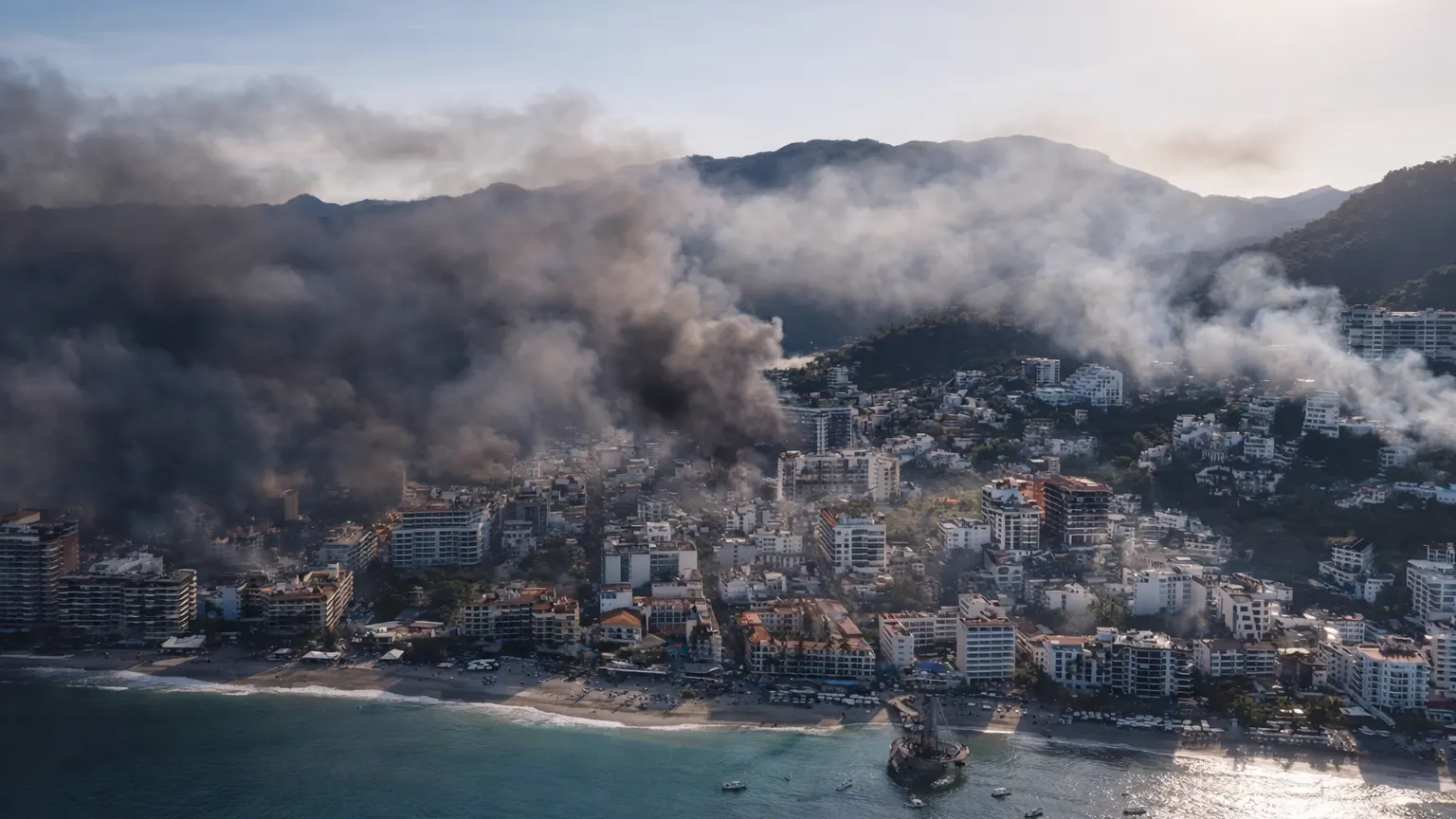
Cities like Guadalajara and Puerto Vallarta briefly shut down. Public transportation stopped. Schools closed. More than 1,000 residents reportedly sheltered overnight at the Guadalajara Zoo to avoid violence outside.
Security analysts refer to this pattern as the Hydra Effect when removing a centralized leader causes fragmentation into smaller, often more volatile factions.
We’ve seen this dynamic before. One large organization fractures, and suddenly instead of one command structure, there are several competing ones.
A Strategic Win or a Risky Escalation ?
On one side of the aisle, officials are betting that this moment proves something bigger than a single takedown. From their perspective, cartels are no longer just criminal enterprises, they’re national security threats.
If that’s the case, using military grade intelligence isn’t escalation.
It’s adaptation.
They point to the speed. A high value target located and eliminated within weeks of the task force’s launch signals operational capability.
But there’s another way to look at it.
History shows that decapitation strikes can destabilize criminal networks in unpredictable ways. When leadership disappears overnight, mid level commanders scramble. Alliances shift. Violence can spike before it subsides.
The CJNG is not a family based organization with clear bloodline succession. It operates through powerful regional commanders.
That structure increases the risk of internal conflict over trafficking routes that generate billions annually.
For Mexican President Claudia Sheinbaum, the situation carries political weight. Cooperation with Washington delivers immediate intelligence advantages. Yet accepting a U.S.-driven, military first framework also invites scrutiny at home, where critics warn about sovereignty and long term militarization of drug policy.
The tactical victory is clear. The strategic outcome remains uncertain.
International Ripple Effects
The impact hasn’t stopped at Mexico’s borders.
Airlines such as United Airlines and Air Canada canceled flights to parts of Mexico’s Pacific coast due to security concerns along access routes.
Meanwhile, preparations for the 2026 FIFA World Cup are under renewed scrutiny. Guadalajara is scheduled to host matches later this year, and questions about World Cup stability concerns are already surfacing among international security planners.
There’s also an economic layer, U.S.–Mexico trade relations remain closely tied to security cooperation. Successful joint operations may strengthen diplomatic alignment but prolonged instability could
complicate investment and tourism.
What Happens Next ?
Security experts anticipate several near term developments:
- Expanded financial sanctions targeting cartel linked businesses.
- Increased drone and intelligence surveillance along Mexico’s Pacific corridor.
- Pressure to extradite captured lieutenants quickly.
- Potential focus on rival organizations such as the Sinaloa Cartel.
Momentum is central to the JIATF-CC’s doctrine. Now that one high value target has fallen, expectations for follow up operations are high.
But expectations cut both ways. Each additional strike carries both deterrent value and escalation risk.
FAQ: The Death of El Mencho
Why is the death of El Mencho significant?
He led one of Mexico’s most powerful and violent cartels. His removal disrupts centralized leadership but does not automatically dismantle the organization.
What is the JIATF-CC?
It is a U.S.-led interagency task force that integrates military intelligence, financial tracking, and law enforcement coordination to target cartel leadership.
What are narcobloqueos?
They are coordinated road blockades in which cartel members burn or hijack vehicles to paralyze transportation and overwhelm authorities.
Will violence decrease now?
Possibly in the long term. In the short term, fragmentation often leads to increased instability as factions compete for control.
Conclusion: What the Death of El Mencho Really Signals
The death of El Mencho represents a clear tactical milestone.
It demonstrates unprecedented intelligence coordination and a shift toward a military integrated counter cartel strategy.
But strategy unfolds over years, not headlines.
If Mexico can stabilize key regions and prevent fragmentation, this moment may mark the beginning of sustained disruption. If not, it could accelerate the very decentralization that makes cartels harder to contain.
Either way, the death of El Mencho has reshaped the security landscape in North America. What follows will determine whether it becomes a blueprint for future operations or a cautionary chapter in a long and complicated fight.