There is pressure at Real Madrid, and then there is whatever is happening now at the Santiago Bernabéu. The club that measures success in European Cups and league titles is enduring a season that many supporters are already calling one of the darkest modern campaigns in club history. What began as an inconsistent year on the pitch has spiraled into a full institutional crisis, complete with dressing room fractures, public controversies, and emergency meetings behind closed doors.
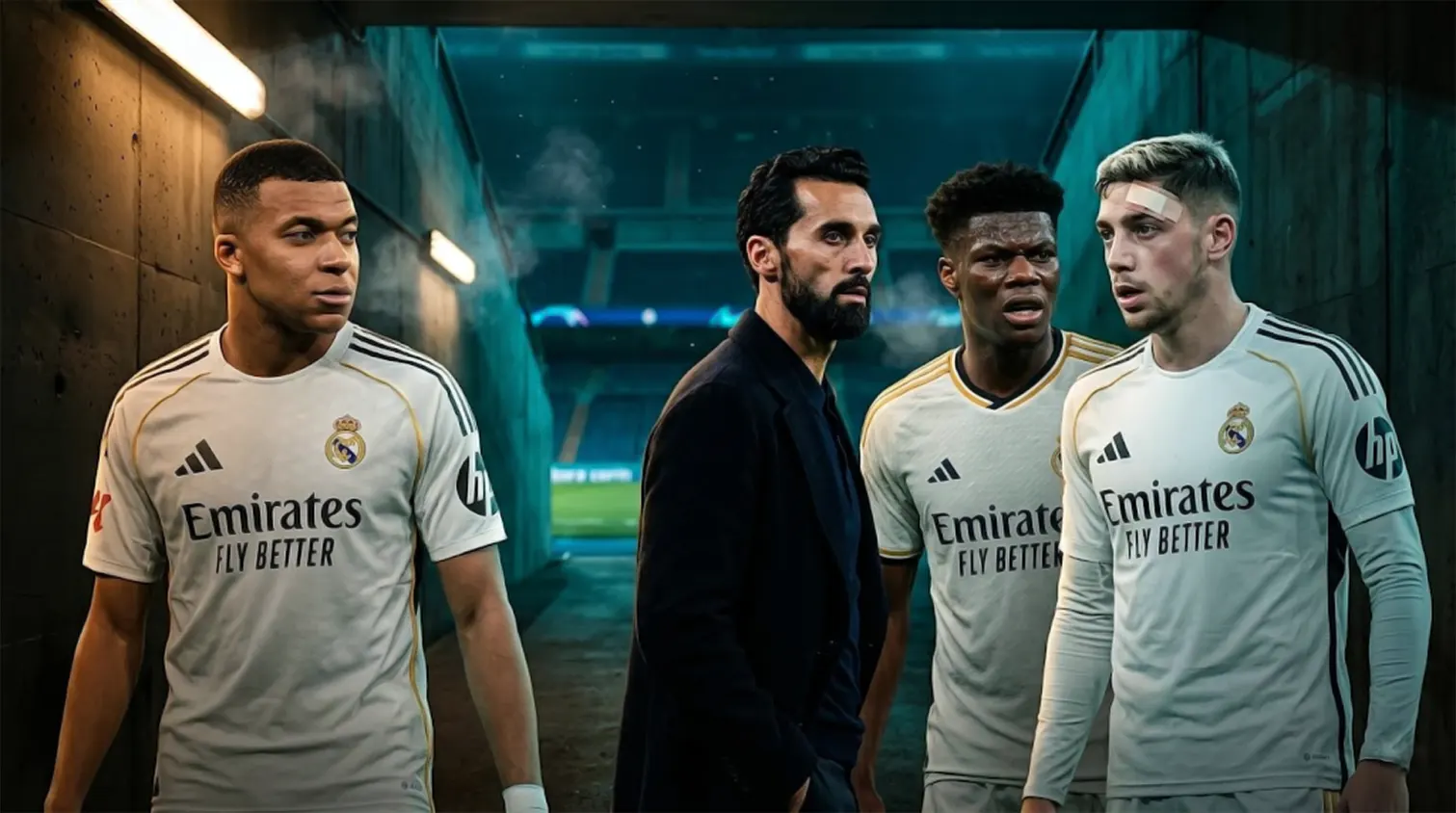
The latest explosion came this week when Federico Valverde and Aurélien Tchouaméni reportedly became involved in a physical altercation at training. According to multiple reports from Spain, the confrontation escalated inside the dressing room and ended with Valverde suffering cranioencephalic trauma after striking his head during the scuffle. The midfielder was taken to the hospital and later ruled out of El Clásico, the biggest match remaining in Madrid’s season.
That incident did not happen in isolation. Instead, it exposed a squad already cracking under pressure. Real Madrid entered May trailing Barcelona in La Liga, eliminated from the Champions League by Bayern Munich, and still reeling from a humiliating Copa del Rey exit against Albacete. For a club built on dominance, second place feels like collapse, and every setback has intensified the tension inside Valdebebas.
But the real shift came when reports emerged that manager Álvaro Arbeloa had lost significant portions of the dressing room. Spanish media outlets claim that at least six senior players have stopped speaking to him entirely, while several others have effectively been frozen out of the squad. Dani Carvajal, Dani Ceballos, Raúl Asencio, and Álvaro Carreras are all reportedly among the players sidelined by the coach as relationships deteriorate.
A locker room once built on winners now looks fractured
The most alarming detail for Madrid supporters is not simply the poor results. It is the sense that the club has lost its internal structure. Real Madrid has survived disappointing seasons before, but rarely has the atmosphere appeared this toxic in public view.
The Valverde-Tchouaméni fight became symbolic because of what it represented. Valverde has long been viewed by fans as the emotional engine of the team relentless, combative, and fiercely committed. In contrast, the reaction to Kylian Mbappé has been far colder. While Madrid dealt with the fallout from the training ground incident, Mbappé was photographed on a luxury yacht in Sardinia during his injury recovery, sparking outrage across Spanish social media.
The backlash intensified after footage reportedly showed Mbappé laughing while leaving the training ground just hours after Valverde’s hospitalization. For many supporters, the optics were devastating. The criticism was not about recovery time or personal freedom. It was about leadership. At Real Madrid, especially during a crisis, supporters expect visible commitment. Perception matters as much as performance.
That frustration has now evolved into something much larger. An online “Mbappé Out” petition has reportedly gathered tens of millions of signatures, though analysts believe bots and rival fans likely inflated the numbers. Even so, the scale of the reaction reflects a growing belief among sections of the fanbase that Mbappé’s individual brilliance has not translated into collective unity.
What makes this even more volatile is the contradiction at the center of Mbappé’s season. Statistically, he has delivered. The French star has scored 41 goals despite injury interruptions and tactical instability. Yet in Madrid, goals alone do not guarantee acceptance. The club’s culture has always demanded sacrifice alongside stardom, and critics increasingly believe Mbappé has failed that test.
Florentino Pérez is already preparing for a reset
Behind the scenes, Real Madrid president Florentino Pérez appears to have shifted into damage-control mode. Reports suggest the club immediately opened disciplinary proceedings against both Valverde and Tchouaméni after the altercation. Potential sanctions could include suspensions and financial penalties, underscoring how seriously the hierarchy views the incident.
At the same time, the leadership’s confidence in Arbeloa appears to be collapsing. Although publicly protected for now, the manager is widely expected to leave this summer and could reportedly be dismissed immediately if Barcelona secures the league title in the upcoming Clásico. Internally, the feeling is that Arbeloa no longer controls the dressing room, a fatal flaw at a club where authority is non-negotiable.
That has already triggered speculation about possible replacements. José Mourinho’s name has resurfaced because of his reputation for restoring discipline during periods of chaos. Jürgen Klopp is admired for his charisma and tactical identity, while Unai Emery is viewed by some executives as a stabilizing option capable of rebuilding structure quickly. The very fact that all three names are circulating reveals how seriously Madrid views the situation.
The uncertainty extends beyond the bench. Transfer rumors surrounding Juventus forward Kenan Yıldız continue despite Madrid already possessing an overcrowded attack. At the same time, whispers about a possible Mbappé exit once unimaginable are growing louder. Club officials have not publicly entertained the idea, but reports from Spain suggest Pérez would at least consider a world record offer if it meant restoring harmony.
That raises a larger question: how did a squad this talented unravel so quickly?
The season’s failures have stripped away Madrid’s aura
For most clubs, finishing second in La Liga and reaching the Champions League quarter-finals would qualify as a respectable season. At Real Madrid, it is treated as institutional failure. Expectations at the Bernabéu are measured against dynasties, not stability.
The defeats themselves have been damaging enough. Bayern Munich exposed Madrid’s defensive fragility in Europe. Albacete delivered one of the most shocking cup upsets in recent Spanish football memory. Barcelona now stands one result away from clinching the league title at Madrid’s expense. Each setback chipped away at the squad’s confidence until the tension finally exploded internally.
Yet the deeper issue may be psychological. This team was assembled to dominate an era. Instead, it has looked emotionally disconnected at key moments. Veterans appear frustrated. Younger players seem uncertain of their roles. The coaching staff has struggled to establish authority. And every public controversy has magnified the sense of instability.
The timing could hardly be worse. El Clásico on May 10 is no longer just a title race fixture. It has become a referendum on the direction of the club itself. A defeat would likely hand Barcelona the championship while intensifying calls for sweeping change inside Madrid.
For now, Real Madrid remains trapped between two identities: a global superteam filled with elite talent and a fractured squad fighting itself at the worst possible moment. The coming summer increasingly looks less like a routine transfer window and more like a purge.
And at the Bernabéu, purges rarely end quietly.