Real Madrid came into the 2025–26 season with one of the most expensive squads ever assembled. They leave it without a single trophy, watching Barcelona lift the La Liga title at their expense.
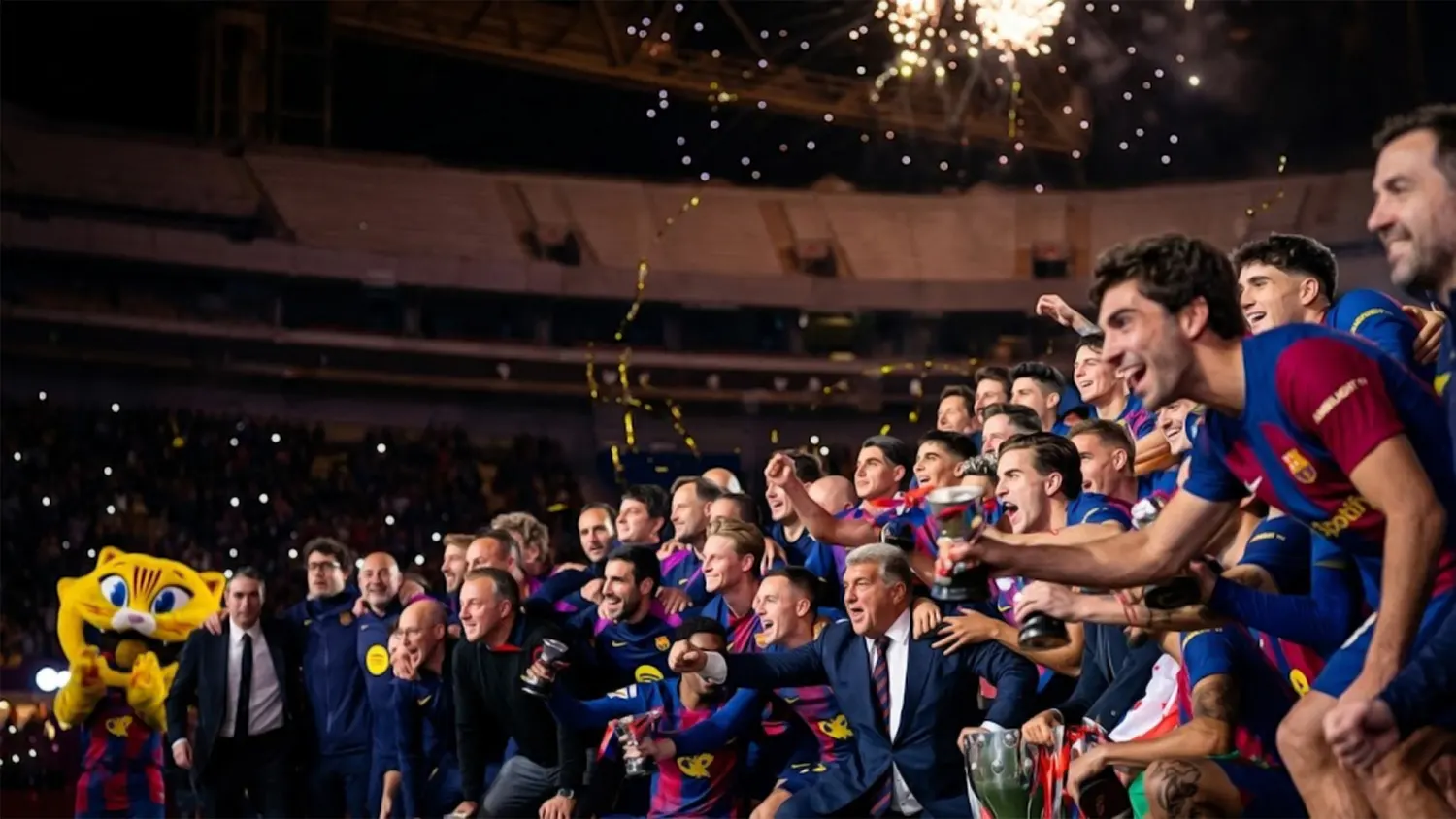
The final act came on May 11, 2026, at the Spotify Camp Nou. Barcelona defeated Real Madrid 2–0 in El Clásico, and with that result, mathematically clinched their 29th La Liga championship with three matches still to play. It was the first time since 1932 that a Clásico directly decided the title. The timing, the margin, and the opponent made it the perfect summary of everything Madrid got wrong this season.
The Match That Sealed It
Barcelona did not wait long to make their statement. By the 18th minute, the game was already over in spirit.
Marcus Rashford, one of the shrewdest signings of the Hansi Flick era, opened the scoring in the 9th minute with a direct free-kick that curved cleanly past Thibaut Courtois into the top corner. Nine minutes later, Ferran Torres doubled the lead, finishing off a move sparked by a cheeky backheel from Dani Olmo that split Madrid’s defence open.
The numbers told the full story of Barcelona’s dominance. Pedri completed 66 of 67 passes, effectively running the midfield without interruption. Barcelona finished with 58% possession, eight shots on target, and a pass accuracy of 91%. Madrid, by contrast, managed five shots on target and looked disjointed every time they tried to build.
Jude Bellingham had a goal disallowed for offside in the second half. That ruling extinguished Madrid’s last flicker of hope. Six yellow cards including bookings for Bellingham, Trent Alexander-Arnold, and Dani Olmo reflected how heated and, ultimately, how desperate the contest became.
Barcelona’s Dominance Is No Accident
This is not a one-match story for Barcelona. Under Hansi Flick, they have become the most complete side in Spanish football, built on a high-intensity pressing system and a tactical framework the club calls “minimum width” compressing space, overloading central areas, and suffocating opponents before they can settle.
The results have been extraordinary. Entering the final three fixtures against Alavés, Betis, and Valencia, Barcelona sit on 91 points and are tracking toward what could be a historic 100-point season. They are averaging over 2.5 goals per game. Rashford and the electrifying Lamine Yamal have been the attacking catalysts, while the midfield axis of Pedri, Gavi, and Dani Olmo has given Flick a level of control that other managers can only study from a distance.
This is also Flick’s second consecutive La Liga title, following their 2024–25 triumph. The consistency is the message. Barcelona are not peaking accidentally, they are being built.
What Madrid’s Trophyless Season Actually Means
For context, Real Madrid still hold the record for the most La Liga titles in history with 36 championships. Barcelona’s 29th still leaves a seven-title gap. On paper, the historical ledger still favours Madrid heavily.
But the 21st century tells a different story. Since 2000, Barcelona have won 12 La Liga titles to Madrid’s nine. The gap is closing in the era that matters most to modern supporters, and this season widened it further.
What makes 2025–26 particularly difficult for Madrid fans is not just finishing second. It is finishing second without fighting for anything else. Their Champions League run ended in the quarter-finals, a 6–4 aggregate defeat to Bayern Munich that exposed deep defensive vulnerabilities. The Copa del Rey was gone even earlier, with a stunning 3–2 loss to Albacete in the round of 16, one of the most embarrassing results in the club’s recent history.
No league. No Europe. No cup. A squad worth hundreds of millions of euros, and nothing to show for it.
Mbappé’s Goals Could Not Fix a Broken Dressing Room
The Kylian Mbappé experiment did not fail statistically. He scored 41 goals despite injury interruptions and tactical inconsistency around him. By any individual measure, that is a remarkable return.
But at Real Madrid, individual brilliance has never been enough on its own. The club’s culture demands that its stars also carry the dressing room, in attitude, in leadership, in the visible weight of the badge. And throughout this season, the collective chemistry between Mbappé and the rest of the squad never truly clicked, with his relationship with Vinícius Júnior drawing particular scrutiny.
The low point in public perception came weeks before the Clásico, when Mbappé was photographed on a luxury yacht in Sardinia during his injury recovery while the team was imploding around him. Footage reportedly showing him laughing as he left training just hours after a team-mate was hospitalised in a dressing room incident only deepened the damage. An online petition calling for his departure gathered tens of millions of signatures inflated by bots and rival fans, analysts noted, but still a reflection of a fanbase that had grown cold toward its most expensive star.
Goals matter. But perception, at the Bernabéu, matters just as much.
The Manager Who Lost the Room
Manager Álvaro Arbeloa enters the summer almost certain not to see another competitive match in charge. Reports from Spain suggest at least six senior players stopped communicating with him, while several others including Dani Carvajal, Dani Ceballos, Raúl Asencio, and Álvaro Carreras were sidelined as the relationship between coach and squad deteriorated beyond repair.
Bayern exposed his tactical limitations in Europe. Albacete humiliated his team in the cup. And in the final weeks of La Liga, as the title race slipped definitively away, Arbeloa lost not just results but authority, the one thing a manager at Real Madrid can never afford to lose.
Florentino Pérez is now understood to be preparing a significant reset. Names circulating as potential replacements include José Mourinho, whose reputation for restoring dressing room discipline during chaos makes him an obvious fit in the abstract; Jürgen Klopp, whose charisma and identity-driven football aligns with Madrid’s ambitions; and Unai Emery, viewed by some within the club as the most pragmatic option for rapid structural rebuilding.
The very fact that all three of these managers are being discussed simultaneously signals how urgent the situation feels behind closed doors.
A Summer That Will Define the Next Era
The transfer window that follows this season will not be routine. Reports have suggested that even a Mbappé exit once unthinkable is no longer completely off the table if an offer arrives that Pérez views as sufficient to reset the squad’s dynamic. Disciplinary proceedings remain open against players involved in training ground incidents. Squad depth, chemistry, and leadership are all under review.
Meanwhile, Barcelona will spend the summer as champions again, with momentum, a clear identity, and a manager who has two years of evidence that his system works at the highest level.
Real Madrid’s task is harder. They must decide who stays, who leads, who coaches, and what version of the club they want to build next, all while processing a season that stripped away the aura of invincibility they spent years constructing.
Thirty-six La Liga titles says nothing about what happens next. And right now, next is all that matters.