
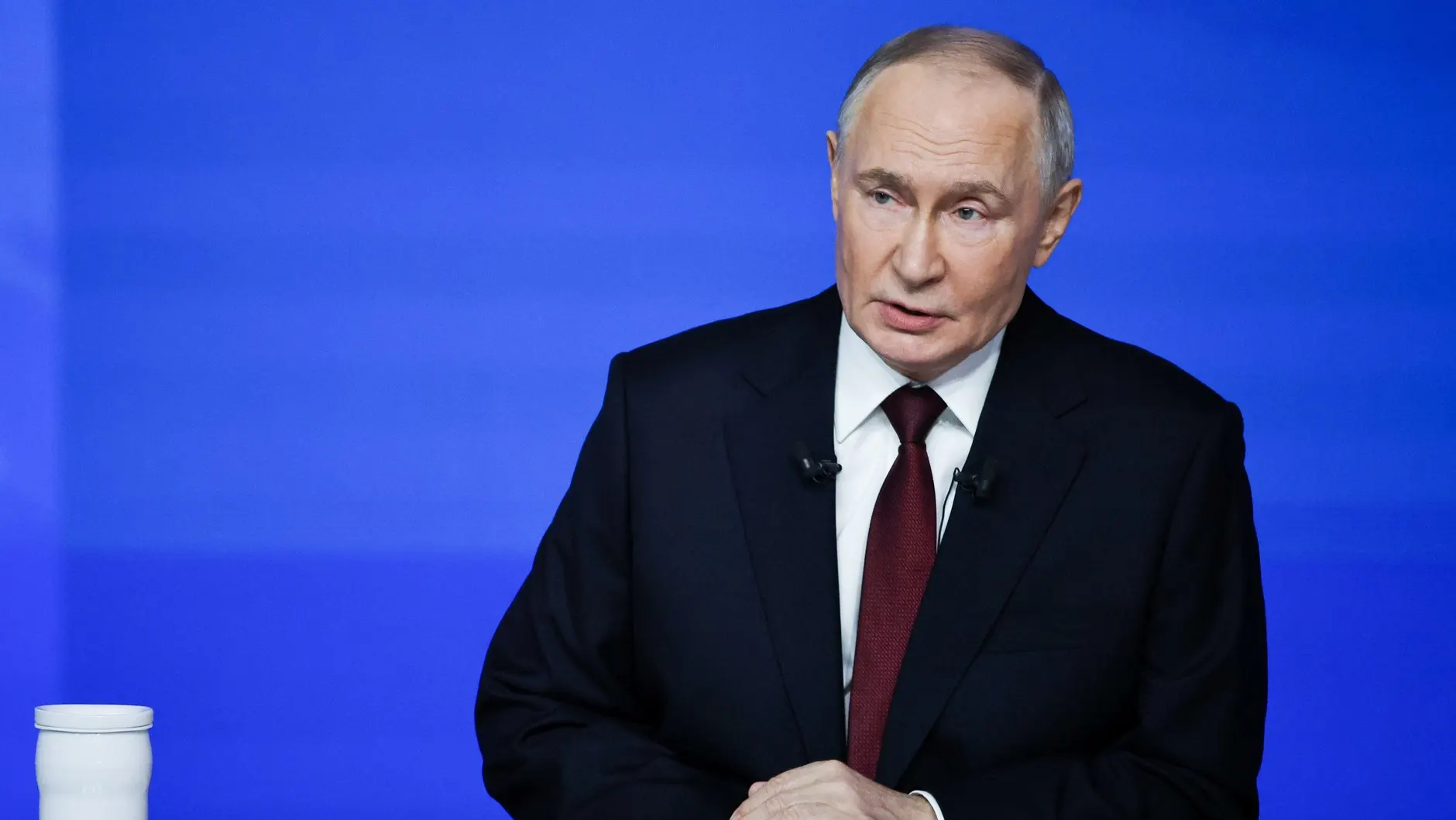
As military operations intensify between Iran, the United States, and Israel, Russian President Vladimir Putin has positioned Moscow as an advocate for negotiation over escalation.
In recent remarks, Putin questioned whether the ongoing air campaign is achieving its strategic objectives and warned that history shows external pressure often produces the opposite of its intended effect.
Political Consolidation, Not Collapse
Putin argued that intense external military pressure typically leads to internal consolidation rather than regime breakdown.
His comments come amid confirmed reports that Iran’s Supreme Leader Ali Khamenei was killed during the February 28 strikes, a development publicly acknowledged by both Iranian state media and U.S. President Donald Trump.
While Washington has framed the removal of Iran’s top leader as a decisive blow, Putin suggested that such a vacuum may trigger institutional hardening rather than political fragmentation.
“Almost everywhere, when a country faces external pressure, political forces consolidate,” he noted.
Analysts now speculate that instead of a pro Western uprising,
Iran’s power structure particularly the Islamic Revolutionary Guard Corps (IRGC) could rally under an interim governing council, tightening its grip during wartime conditions.
The “Ghost” Nuclear Facilities
Putin also cast doubt on the effectiveness of the sustained air campaign targeting Iran’s nuclear infrastructure.
He stated that Iran’s underground facilities continue to function and “nothing is happening to them,” signaling skepticism that air power alone can dismantle deeply fortified sites.
That assessment appears aligned with international monitoring data. According to recent statements from the International Atomic Energy Agency (IAEA) in Vienna on March 2, there is no evidence of damage to core nuclear fuel cycle facilities despite hundreds of sorties flown by U.S. and Israeli aircraft.
Specifically, the heavily fortified Fordow Fuel Enrichment Plant and the Bushehr Nuclear Power Plant reportedly remain physically unaffected.
This reality raises a strategic dilemma: If the most critical nuclear sites remain intact, what is the achievable military end state?
Balancing Iran’s Nuclear Rights and Israel’s Security
Putin described the situation as a “delicate issue” requiring calibrated diplomacy.
He argued that any durable settlement must:
- Preserve Iran’s right to develop peaceful nuclear energy
- Provide Israel with unconditional security guarantees
- Reduce the broader risk of regional war
According to Putin, these objectives are not mutually exclusive but cannot be solved through airstrikes alone.
The “Russian Shield” Factor
Russia’s historical involvement in Iran’s civilian nuclear sector adds a strategic layer to Moscow’s proposal.
After German firms withdrew from earlier nuclear construction projects, Russian specialists completed and expanded key facilities. Today, hundreds of Russian nuclear engineers and technicians reportedly remain stationed at Iranian sites.
Putin referenced this presence directly.
This creates a significant geopolitical complication: any further escalation that strikes nuclear infrastructure could risk Russian casualties.
It is not merely a diplomatic posture it is a physical reality on the ground. The presence of Russian personnel effectively introduces a deterrent layer, increasing the stakes of expanded U.S. or Israeli operations.
A Regional “Burn” Expanding Beyond Iran
While the debate over Iran’s “peaceful atom” continues, the broader region is already absorbing the shockwaves.
Recent reports on March 2 indicate:
- U.S. warplanes reportedly crashed during operations near Kuwait.
- Drone strikes have hit infrastructure in the United Arab Emirates and Saudi Arabia.
- Iranian linked retaliatory actions are expanding beyond immediate battle zones.
These developments suggest the conflict is no longer geographically contained.
What began as a targeted military operation is evolving into a regional confrontation with widening economic and security consequences.
Russia’s Proposed Path Forward
Putin indicated that Moscow has quietly communicated proposals to Washington, Tel Aviv, and Tehran.
The framework reportedly centers on:
- Ensuring transparent civilian nuclear development for Iran
- Creating enforceable security guarantees for Israel
- Establishing monitoring mechanisms acceptable to all sides
- De escalating military activity before further regional spillover
“We are not imposing anything,” Putin stated.
“We are simply presenting how we see a possible way out.”
The Bigger Picture
The Iran–US–Israel confrontation has shifted from a limited strike campaign to a broader geopolitical crisis with global implications.
Several realities now define the situation:
- Core nuclear infrastructure remains intact.
- Leadership decapitation has not guaranteed regime collapse.
- Russian personnel on the ground complicate escalation calculus.
- Regional spillover is accelerating.
Whether diplomatic channels gain traction remains uncertain. But as retaliatory strikes spread and military costs mount, the strategic question grows sharper:
Can escalation achieve what negotiation has not or will diplomacy ultimately become unavoidable ?
The coming days may determine not just the future of Iran’s nuclear program, but the stability of the entire Middle East.