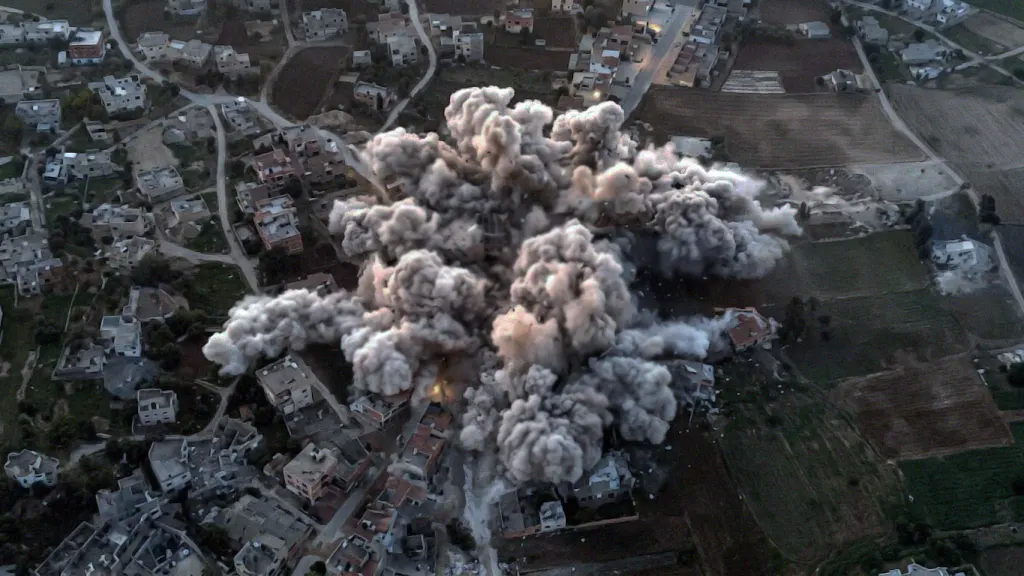
As of March 31, 2026, Israel’s ground offensive in southern Lebanon has intensified, with rising casualties, attacks on UN peacekeepers, and a collapsing healthcare system signaling a dangerous new phase of the conflict.
What was previously a question of territorial control is now a test of how far the conflict can expand and how much damage Lebanon’s institutions can absorb before broader destabilization.
But the real shift came in the past 72 hours, as multiple pressure points converged at once. Israeli forces continued their push north, while civilian systems began to fail at scale, and the United Nations and key governments escalated their warnings in response.
To see why this moment is different, look at the battlefield itself. The Israeli military is no longer just advancing, it is sustaining operations under growing cost. The IDF confirmed that four additional soldiers were killed in 24 hours, underscoring that the campaign is entering a more attritional phase rather than a rapid push.
And that raises a second question: if the military tempo is holding, what is happening behind the front lines?
When battlefield momentum meets systemic collapse
The answer is increasingly stark. While fighting continues in the south, the effects are radiating outward, particularly into civilian infrastructure. Airstrikes in Beirut’s Dahiyeh suburb have persisted, with Israel claiming to target Hezbollah command centers embedded in dense urban areas.
At the same time, the operational pattern suggests a broader objective. By hitting urban strongholds and transport corridors simultaneously, Israeli forces are not only degrading Hezbollah but also restricting the movement of people, goods, and emergency services.
“This is where military strategy intersects with state fragility,” said a regional analyst at Chatham House. “You are seeing pressure applied to both armed groups and the civilian systems around them.”
What makes this even more urgent is how quickly those systems are breaking down especially healthcare.
A healthcare system pushed past the point of recovery
The collapse of medical services in southern Lebanon is no longer a warning, it is an
active reality. According to the World Health Organization, at least 52 health workers have been killed since early March, with casualties continuing to rise in recent days.
But the numbers only tell part of the story. In towns like Bint Jbeil, medical warehouses have been destroyed, ambulances disabled, and hospitals forced to shut down entirely. The result is a functional shutdown of emergency care across entire regions.
Recent incidents illustrate the pattern. A paramedic was killed in a strike on an ambulance, following what responders described as a “black Saturday” in which nine paramedics died within 24 hours. These events have raised urgent concerns about the safety of frontline medical personnel.
And that leads to a deeper crisis: what happens to civilians when there is no system left to treat them?
The rise of a “silent” death toll
For those still in the south, survival is becoming increasingly uncertain. With bridges destroyed and access routes cut, an estimated 150,000 people remain effectively isolated, unable to reach functioning hospitals or receive urgent care.
This isolation is producing what aid groups call a “silent mortality wave.” Patients with chronic conditions are now cut off from medication, while vulnerable populations particularly pregnant women have no access to routine or emergency services.
Human rights organizations are raising alarms. Amnesty International warned that attacks on medical personnel and infrastructure may violate international humanitarian law, especially in the absence of clear evidence of military use.
“Healthcare workers are risking their lives to save others,” the group said, emphasizing that protected status under international law must be upheld even in active combat zones.
But the humanitarian crisis is now intersecting with another flashpoint, one that carries global implications.
Attacks on UN peacekeepers trigger diplomatic escalation
The deaths of three Indonesian peacekeepers have transformed the conflict into a diplomatic crisis. The United Nations Interim Force in Lebanon (UNIFIL) is now facing its most dangerous period in years, with two separate incidents under active investigation.
In response, UN Secretary General António Guterres issued a rare and forceful warning.
He described the incidents as “grave violations of international humanitarian law” and stated that deliberate attacks on peacekeepers may constitute war crimes.
The language matters. By invoking potential war crimes, the UN is signaling that legal accountability mechanisms could follow, depending on the outcome of investigations.
Diplomatic pressure is building. Indonesia has called for an emergency UN Security Council meeting, with support from France, while insisting it will maintain its troop presence despite the risks.
What makes this moment particularly sensitive is the precedent it sets. If peacekeepers are no longer protected, the entire framework of UN operations globally could be weakened.
A conflict increasingly tied to regional power dynamics
These developments are not unfolding in isolation. The escalation in Lebanon is closely linked to the broader confrontation involving Iran, Israel, and the United States that intensified in late February.
Hezbollah’s entry into the conflict earlier this month effectively opened a new front, aligning the Lebanon front with a wider regional contest of influence and deterrence.
That linkage is shaping how global powers are responding.
Analysts suggest the United States may seek to limit its long term involvement, even as it supports Israel’s immediate objectives. Meanwhile, European governments are pushing for de escalation, concerned that Lebanon’s institutional collapse could trigger wider instability.
But Israel’s actions suggest a different timeline. According to analysts at Chatham House, the current operation appears designed for sustained control rather than rapid withdrawal, increasing the likelihood of a prolonged presence in southern Lebanon.
And that returns the focus to the central uncertainty: how long can this continue?
A conflict entering its most unpredictable phase
The trajectory of the past week points to a conflict that is becoming harder to contain. Military operations are intensifying, civilian systems are collapsing, and international pressure is rising but not yet altering the course on the ground.
Hezbollah is expected to adapt, likely shifting toward guerrilla tactics that can bypass fixed frontlines and sustain long term resistance. At the same time, Israel appears committed to holding its buffer zone despite mounting costs.
The result is a volatile equilibrium. Neither side is positioned for a quick resolution, and each new development whether on the battlefield, in hospitals, or at the UN adds another layer of complexity.
As of now, the conflict has moved beyond a question of territory. It has become a test of endurance military, political, and humanitarian.
And if the past few days are any indication, the line being drawn in southern Lebanon is not stabilizing the situation. It is hardening into a prolonged and potentially irreversible frontline.