On February 28, 2026, the Middle East entered one of the most dangerous chapters in its modern history. What began as a “preemptive” strike has rapidly escalated into a coordinated, large scale military conflict
involving Israel, the United States, and Iran.
Under the U.S. led Operation Epic Fury and Israel’s Operation Shield of Judah (also referred to as “Roaring Lion”), airstrikes, cruise missiles, and drone swarms have targeted key Iranian military and nuclear infrastructure. Within hours, Iran responded with ballistic missile and drone attacks on Israeli cities and U.S. regional assets, transforming the operation into a full scale exchange of fire.
Here is a clear breakdown of what is happening, who is involved, and what it means for the region and the world.
The Opening Salvo: A Multi Domain Assault on Iran
In the early hours of Saturday morning, President Donald Trump announced that the United States had initiated “major combat operations” inside Iran. The campaign is being conducted in close coordination with the Israel Defense Forces (IDF).
Key Objectives
According to official statements, the mission aims to:
- Destroy Iran’s missile industry
- Target nuclear infrastructure
- Eliminate what Washington describes as “imminent threats”
- Create conditions for potential regime change
In a video address, Trump explicitly called on the Iranian people to
“take over your government,” signaling that the strategic objective goes beyond degrading military capabilities.
The IRGC Ultimatum
In a dramatic addition to his address, Trump issued a direct message to members of Iran’s Islamic Revolutionary Guard Corps (IRGC). He offered what he described as an “immunity deal” to any IRGC personnel who immediately lay down their arms and refuse further orders.
At the same time, he warned that those who continue to resist coalition forces would face “certain death.”
The statement highlights that this campaign is not only military,
it is also psychological and political, aimed at weakening the regime’s inner structure.
Targets Hit Across Iran
Strikes have been confirmed in multiple cities, including:
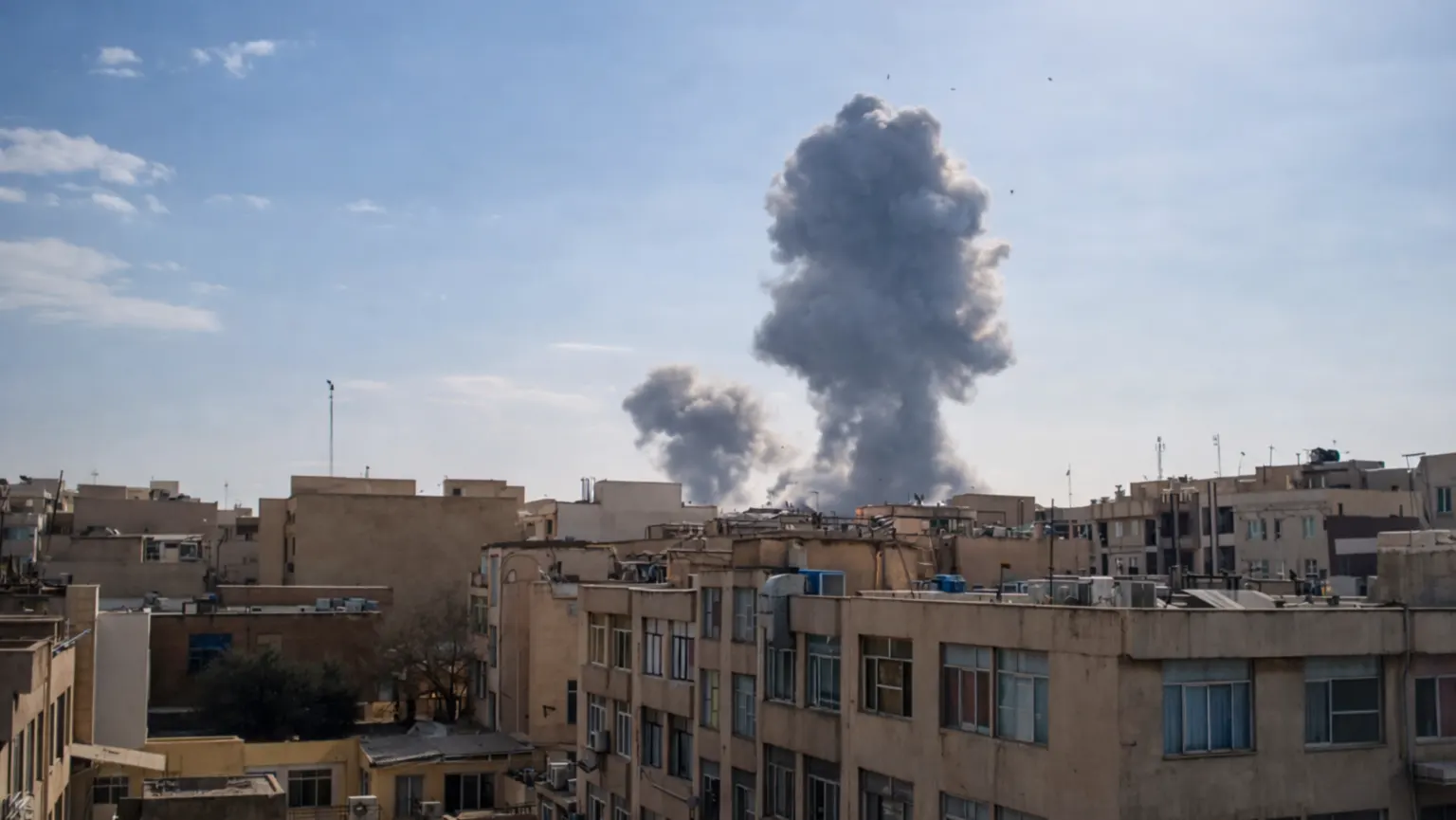
- Tehran – Explosions in the Pasteur district near government buildings.
- Qom – Reports of impacts near sensitive facilities.
- Isfahan – Known nuclear and military sites targeted.
- Karaj – Missile-related infrastructure hit.
- Tabriz – Explosions reported.
- Kermanshah – Ballistic missile bases targeted.
- Bushehr – Near the nuclear power plant.
- Ilam – Border region strikes reported.
The operation is described as high precision but broad in scale, hitting command centers, missile silos, and facilities tied to the IRGC.
The Dual Carrier Strategy: A Strategic Pincer
A defining feature of this conflict is the U.S. Navy’s dual carrier strike posture, forming what analysts describe as a strategic pincer around Iran.
Primary Carrier Strike Groups
- USS Gerald R. Ford – Positioned off Israel’s coast, coordinating with U.S. stealth assets deployed at Ovda Airbase.
- USS Abraham Lincoln – Stationed in the Arabian Sea near the Strait of Hormuz, providing the “southern hammer.”
- USS George H.W. Bush – En route as a potential reinforcement.
This positioning allows coalition forces to strike Iranian targets from multiple directions while maintaining control of key maritime chokepoints.
Iran’s Retaliation: Nationwide Missile Exchanges
Within hours of the first strikes, Iran confirmed retaliatory launches.
Israeli Cities Under Fire
Air raid sirens have sounded across:
- Tel Aviv – Multiple interceptions over the metropolitan area.
- Jerusalem – Warnings across the capital.
- Haifa – Interceptions in the north.
- Beersheba – Targeted due to proximity to Nevatim Airbase.
Israel declared a 48 hour national state of emergency.
Schools and non essential businesses are closed, and citizens have been ordered to remain within reach of bomb shelters.
So far, Israeli missile defense systems have reportedly intercepted the majority of incoming projectiles. Emergency services are treating minor injuries and anxiety related cases.
Regional Expansion: Bahrain and the Gulf
The conflict has already spilled beyond Israel and Iran.
In Manama, air raid sirens were activated near U.S. military installations. Bahrain hosts the U.S. Navy’s Fifth Fleet, making it a high value target in Iranian retaliation.
Qatar and Kuwait, which also house major U.S. bases, have reportedly intercepted incoming threats. Regional governments are now on heightened alert for further escalation.
Casualties and Infrastructure Damage
In Iran
- Significant military casualties reported at IRGC sites.
- Government buildings in Tehran damaged.
- Internet connectivity has dropped sharply amid a near total blackout.
- Independent verification remains extremely limited.
In Israel
- No confirmed civilian deaths as of late afternoon.
- Minor injuries reported during shelter evacuations.
U.S. Forces
- No confirmed American fatalities at this stage.
- Officials have warned the public to prepare for potential losses.
Reliable casualty counts remain fluid, as active combat and communication blackouts limit verification.
The United Nations: Emergency Diplomacy and Likely Deadlock
An emergency session of the UN Security Council is underway in New York.
- China and Russia are demanding condemnation of the strikes.
- The United States is expected to defend the action as lawful self defense under Article 51 of the UN Charter.
- A veto and diplomatic gridlock appear likely.
Nuclear safety concerns have also emerged, with international officials warning against strikes on nuclear facilities due to the risk of radiological fallout.
Economic and Travel Fallout
- Iranian and Israeli airspace closures have triggered widespread flight suspensions.
- Major international carriers have rerouted or canceled flights.
- Oil markets are bracing for volatility as the conflict threatens the Strait of Hormuz.
Energy analysts warn that prolonged fighting could send global oil prices sharply higher.
A Conflict at a Critical Crossroads
What began as a coordinated Israel–U.S. strike has now become a rapidly expanding regional confrontation. Ballistic missile exchanges, carrier strike group deployments, emergency UN diplomacy, and direct appeals for regime fracture inside Iran signal that this is not a limited operation.
The addition of an immunity offer to IRGC members underscores that the campaign is as political as it is military, an attempt to destabilize the regime from within while degrading its strategic capabilities.
As of late afternoon on February 28, 2026, the situation remains fluid. Retaliatory waves are ongoing. Diplomacy is strained. Airspaces are closed. Civilians across multiple nations are sheltering.
The central question now is stark:
Will this remain a contained regional war or escalate into a broader conflict that reshapes the global order ?