
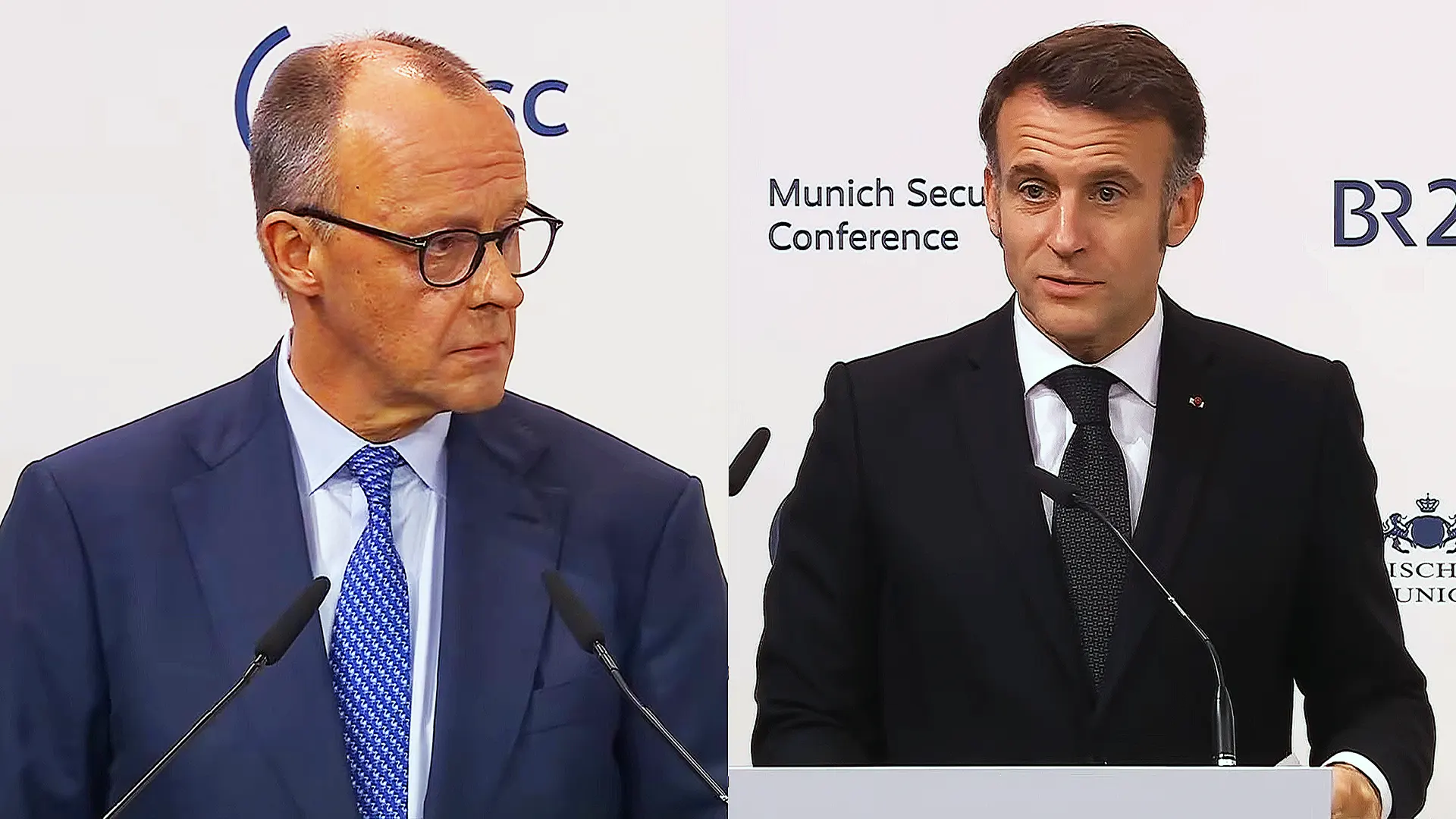
The 62nd Munich Security Conference (MSC) has become the stage for what some observers are calling a historic pivot in European diplomacy. Chancellor Friedrich Merz of Germany and President Emmanuel Macron of France have sent a clear message: Europe is preparing to stand on its own as a global power.
Germany Stakes Its Claim: “A Self-Supporting Pillar”
In his address, Chancellor Merz positioned Europe as capable of defending itself, pushing back against the current unilateralist tendencies of the U.S. administration.
He noted that the post World War II rules based order
“no longer exists in its original form” and signaled that
Europe can no longer rely unconditionally on American leadership.
In a pointed moment, he switched to English and told the U.S. delegation: “The culture war of the MAGA movement is not ours.” While reaffirming the U.S. as an essential partner,
Merz stressed that Europe will resist “excessive dependency” on Washington.
He also revealed, for the first time, that Germany has entered confidential discussions with France to develop a European nuclear deterrent, a move designed to ensure the continent is
not left vulnerable should the U.S. retract its “nuclear umbrella.”
Macron’s Vision: Economic and Territorial Sovereignty
President Macron underscored “European Strategic Autonomy,” warning of economic and geopolitical risks stemming from U.S. policies. His comments included a sharp reference to the recent Greenland standoff, a move seen as a firm rebuke of Washington’s attempt to leverage trade threats against Danish sovereignty.
Macron highlighted the threat of tariffs used as leverage during the Greenland crisis and urged the EU to deploy its
“anti coercion mechanism” while prioritizing “Made in Europe” technology and defense industries. On arms control, he insisted Europe must have its own seat at the table for future treaties with Russia, refusing to allow Washington and Moscow to dictate European security.
Shifting Priorities at Munich
The MSC has evolved from a forum focused on “how to help the U.S.” to one exploring “how to survive without the U.S.”
| Topic | European Stance | U.S. Response (Rubio) |
|---|---|---|
| NATO | Build a strong European pillar | Deeply tied, wants burden sharing |
| Trade | Free trade; resist coercive tariffs | “America First”; bilateral deals only |
| Values | Climate action, WHO cooperation | Withdrawal from globalist endeavors |
Observers note that the “Trump shock,” though disruptive, has accelerated European unity and forced the continent to address long-standing weaknesses.
The Catalyst of “Shock Therapy”
Europe is responding to decades of overreliance on U.S. support:
- Ending Strategic Sleepwalking – With American support now conditional, European nations have begun significantly increasing their defense budgets. In 2025 alone, the EU recorded unprecedented military spending.
- Forced Consolidation – Fragmented military capabilities are being integrated, exemplified by the Merz-Macron nuclear discussions.
- Economic Independence – Threats like tariffs and U.S.-China tensions have spurred Europe to pursue trade deals with India, Brazil, and other nations, strengthening resilience.
- Clarity of Mission – European leaders are uniting around protecting “European values” amid global volatility.
Deepening Fault Lines
The push toward autonomy carries substantial risks:
- Greenland Crisis – Washington’s use of trade threats tested allied sovereignty, creating tensions reminiscent of the Cold War.
- Ukraine Gap – Reduced U.S. support leaves Europe facing a significant security vacuum.
As NATO Secretary General Mark Rutte observed,
“Without Trump, none of this [European rearmament] would have happened.”
Europe’s Divided Response
Despite French and German leadership, the continent remains fractured:
| Region | Stance on Autonomy | Key Concerns |
|---|---|---|
| France/Germany | Driving the project | U.S. volatility, loss of global relevance |
| Poland/Baltics | Cautious; prefer NATO/USA | Russian aggression, U.S. withdrawal |
| Northern Europe | Economic skeptics | High costs, joint debt, loss of sovereignty |
| Hungary/Slovakia | Opponents | Pro-Russian alignment, anti-integration |
| Italy | Middle roaders | Balancing European industry and U.S. relations |
Poland and the Baltic states, historically wary, recently joined a joint statement with France and Germany, signaling growing distrust of Washington. Northern European nations resist large scale joint defense spending, though even Sweden is exploring nuclear cooperation with France and the UK. Hungary and Slovakia remain major internal obstacles, maintaining closer ties to Moscow.
Europe on the Edge of a New Era
With the old order in the rearview, Europe is now in a race to define a “new way” before its internal fractures catch up to its global ambitions. The MSC in Munich has become a symbol of this high-stakes gamble: building strategic autonomy strong enough to navigate a world where U.S. support is no longer guaranteed. While Merz and Macron provide the blueprint, the continent’s unity remains fragile, shaped by economic, geographic, and political divides.