
In many parts of the world, a new year begins quietly, midnight fireworks,
a toast, a resolution written down and forgotten by February.
But in Chinese culture, the year does not simply change. It turns over.
And when it does, it brings with it 3,500 years of memory.
A New Year with Two Names
In 1912, China officially adopted the Gregorian calendar.
January 1 became Yuándàn (New Year’s Day).
The traditional lunar new year was renamed Spring Festival (Chūnjié).
It was a practical decision, modern trade required alignment with the Western calendar. But ordinary people did not abandon their older way of counting time. Instead, they kept both.
To this day, many Chinese families live with what feels like a “double calendar”:
- The Gregorian date for school, work, flights.
- The lunar date for festivals, weddings, and choosing “auspicious” days.
Even now, the small “Yellow Calendar” (Huangli)or its modern app version shows both systems side by side. One tells you the meeting time.
The other tells you whether it’s a good day to begin something new.
Time, in this tradition, is not just linear. It is cyclical.
The Sixty Year Pulse
Unlike the Western calendar’s simple numerical count,
the traditional Chinese system moves in a 60 year cycle. It combines:
- The 12 Zodiac Animals
- The 5 Elements: Wood, Fire, Earth, Metal, Water
Every year is not merely a number. It has a character.
In 2026, we enter the Year of the Fire Horse Bingwu (丙午).
Fire over Horse. Energy upon speed.
This exact combination happens only once every sixty years.
The last Fire Horse year was 1966.
For many, that matters.
Why the Date Moves
The Chinese calendar is lunisolar.
It follows the moon but adjusts to stay aligned with the seasons.
Because the lunar year is about eleven days shorter than the solar year,
a leap month is added every few years. Without this adjustment,
Spring Festival would slowly drift into winter.
Instead, it remains between late January and mid February, where it belongs.
In 2026, the festival falls on Tuesday, February 17.
And as always, it arrives not just as a date but as a return.
The Monster Named “Nian”
Long before official calendars, there was a story.
A beast called Nian would appear at the end of each year, devouring crops and frightening villages. The people discovered it feared three things: loud sounds, bright lights, and the color red.
So they answered with firecrackers, lanterns, and red paper pasted onto doors.
Whether or not the monster ever existed, its legacy remains.
Every red envelope, every string of fireworks, every crimson banner carries a whisper of that ancient defense.
Red is not decoration. It is protection.
From Ritual to Reunion
During the Shang Dynasty, early forms of the festival centered on harvest rituals and ancestor offerings. By the Han Dynasty, the date was standardized to the first day of the first lunar month. Over centuries through Tang and Song eras religious solemnity blended with celebration. Gunpowder turned burning bamboo into fireworks. Red envelopes emerged as gifts of protection and blessing.
In 1912, the holiday was renamed “Spring Festival.”
In the late 1960s, public celebrations were restricted.
By 1996, the government established the “Golden Week” holiday, triggering Chunyun, the largest annual human migration on Earth. Millions travel home, not for spectacle, but for dinner.
Because at its heart, this festival is about one thing: reunion.
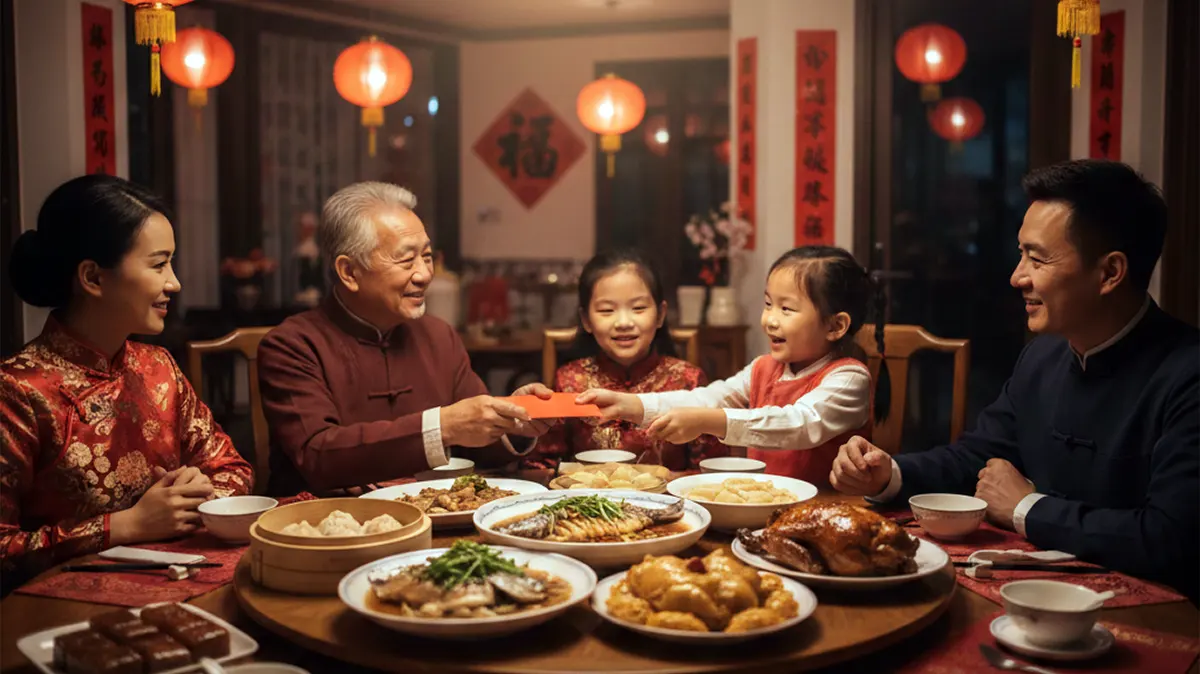
The Table Before Midnight
The night before New Year’s Day, families gather.
Dumplings shaped like gold ingots promise wealth.
Fish is served whole, symbolizing surplus may there always be “more than enough.”
Sticky rice cake, Nian Gao, suggests rising higher year by year.
Children wait for red envelopes Hongbao filled with money and well wishes.
Adults pretend not to care about superstition.
But many quietly observe the taboos.
On the first day:
- No sweeping. Don’t sweep away new luck.
- No arguments. Don’t begin the year in anger.
- No cutting hair. The word for hair (fa) echoes the word for wealth (fa cai).
Whether taken literally or lightly, these customs create mindfulness.
They slow people down. They mark the threshold.
Enter the Fire Horse
Each zodiac year carries its own temperament. The Horse represents motion, freedom, boldness. Fire intensifies it.
A Fire Horse year is described as dynamic, high voltage, ambitious, restless.
Some feng shui practitioners suggest balancing the intensity with cooler colors white, blue, gold while red remains essential. Lion dances may feel more vigorous. The idiom “Mǎ Dào Chéng Gōng” success upon the horse’s arrival becomes a hopeful refrain.
But beyond predictions and personality traits, what truly changes each year is simpler:
We clean our homes.
We repair what is broken.
We try again.
Two Calendars, One Feeling
You can call it Lunar New Year. You can call it Spring Festival.
You can track it by the Gregorian year 2026 or by a traditional count tracing back to the legendary Yellow Emperor.
But in the end, the meaning is not mathematical.
It is human.
For Chinese families, it is the sound of luggage wheels rolling through train stations. The smell of food prepared since morning. The quiet moment before midnight when doors are opened to let the old year out.
For non Chinese observers, it may look like fireworks and red lanterns.
For those who grew up with it, it feels like returning to a version of yourself that never quite disappears.
Every year, the calendar turns twice.
And each time, we are reminded that renewal is not just about time passing forward, it is about coming home again.