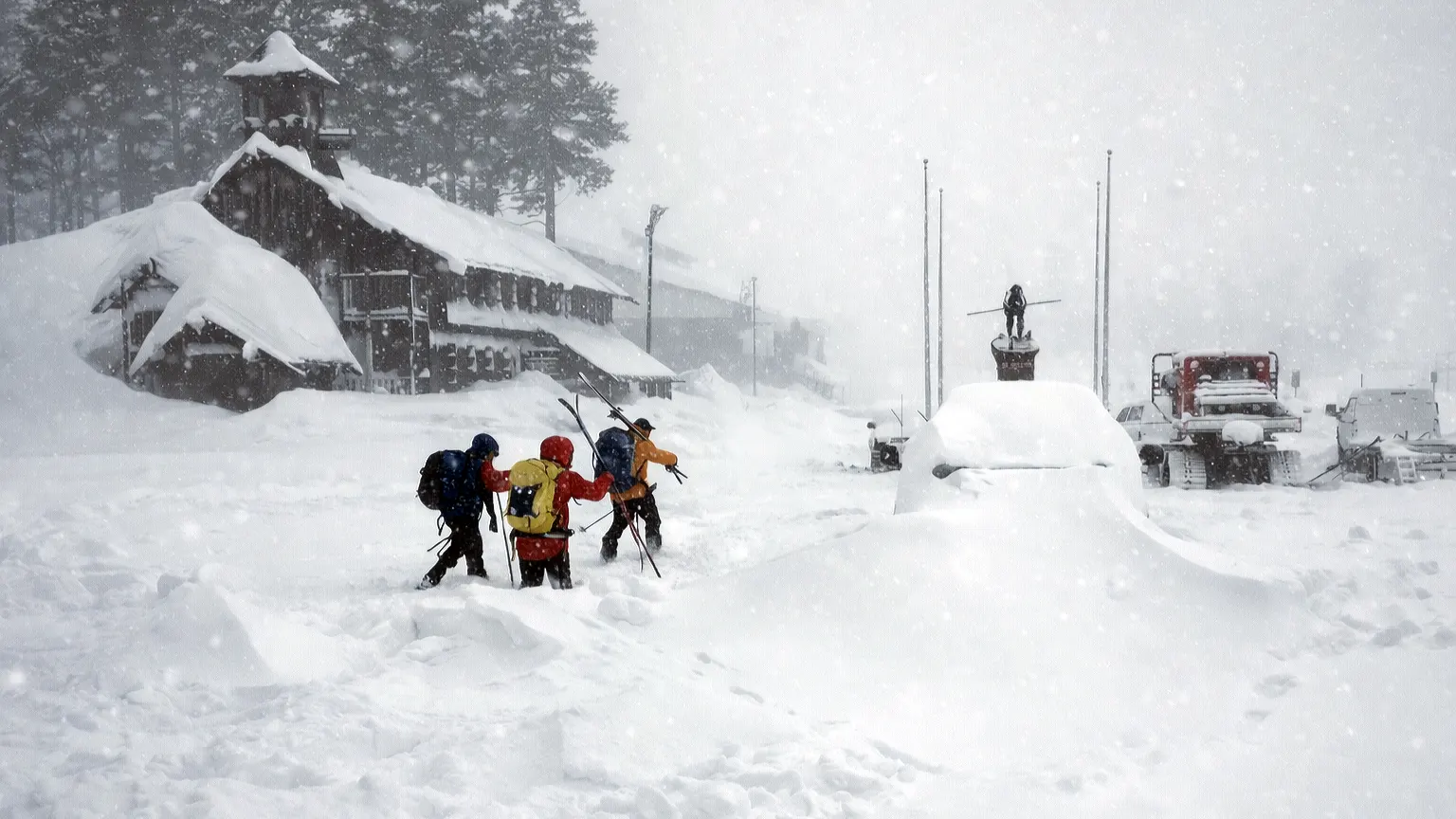
A severe winter storm sweeping across the Sierra Nevada has triggered a major rescue operation after an avalanche struck a guided backcountry skiing group near Castle Peak, northwest of Lake Tahoe. As of Wednesday afternoon, February 18, 2026, nine people remain missing as search teams battle blizzard conditions and a high risk of additional slides.
Authorities say the avalanche hit the Frog Lake area around 11:30 a.m. Tuesday. The Nevada County Sheriff’s Office has confirmed that 15 people not 16, as initially reported were caught in the slide. The group was on the final day of a three day guided backcountry trek organized by Blackbird Mountain Guides, a Truckee based outfitter.
Search Intensifies in Dangerous Conditions
Six people have been rescued. According to officials, they spent hours sheltering under makeshift tarps and were able to communicate with rescuers using emergency text beacons. Two of the survivors were transported to local hospitals with injuries, while the others were evaluated on site by Truckee Fire personnel.
Nine skiers remain unaccounted for.
More than 46 first responders are involved in the search effort, including specialized ski teams from Boreal and Tahoe Donner. However, progress has been slow. Winds exceeding 80 miles per hour along exposed ridgelines and near zero visibility have forced rescuers to proceed cautiously. Snowmobiles were initially grounded due to avalanche danger, leaving ski in teams and SnowCats to navigate unstable terrain.
Officials have emphasized that the situation remains fluid.
High Avalanche Warning in Effect
The Sierra Avalanche Center issued a “HIGH” (Level 4 of 5) avalanche warning for the Central Sierra Nevada beginning at 5:00 a.m. Tuesday the morning of the slide. Forecasters warned that large avalanches were likely.
Recent storms have deposited two to three feet of fresh snow atop a weak, fragile snowpack formed during a dry spell in January. Experts describe this layering as particularly dangerous because the new snow does not bond well to the older surface, increasing the likelihood of large releases.
Authorities have urged the public to avoid all backcountry travel, warning that slopes are “reloading” rapidly with new snow.
A Remote Backcountry Setting
The avalanche occurred near the Frog Lake huts, a remote cluster of stone cabins roughly four miles from the nearest trailhead at Donner Summit. The huts are accessible only by skiing, snowboarding, or snowshoeing. There are no chairlifts, paved roads, or avalanche mitigation systems in place.
Unlike commercial ski resorts which routinely use explosives and professional crews to trigger small, controlled slides before the public arrives backcountry terrain has no such safeguards. Visitors must carry their own safety equipment, including avalanche beacons, probes, and shovels, and rely on their own judgment or that of their guides.
The Frog Lake huts are operated by the Truckee Donner Land Trust as
a premium backcountry experience. The booking policy makes clear that there are no refunds for “too much snow” or avalanche hazard.
In effect, the cabins remain available even during storms; it is up to visitors to determine whether conditions are safe enough to travel.
While nearby commercial resorts closed lifts due to the blizzard,
the backcountry remained physically accessible but inherently high risk.
Who Was Involved
Authorities have not yet released the names or home cities of the missing individuals. The group consisted of 11 or 12 clients and four guides from Blackbird Mountain Guides. At least two of the rescued survivors are guides.
Such trips typically require strong physical conditioning and specialized safety training. According to officials, the group was not descending a steep slope when the avalanche struck. Instead, they were reportedly exiting the wilderness along what they believed was a relatively low angle route toward the trailhead when the slide came down from above.
That detail underscores a central challenge of backcountry travel: avalanches can originate on slopes well above a traveler’s position.
The “Catch 22” of Backcountry Travel
Professional guides often adjust routes during storms, favoring slopes under 30 degrees where avalanches are less likely to start. However, once a group has spent multiple nights at a remote hut several miles from the trailhead, options can narrow quickly.
If severe weather intensifies, groups may face a difficult choice:
remain at the hut and risk depleting food and supplies, or attempt to navigate dangerous terrain to return to their vehicles. In this case,
the avalanche struck as the group was attempting to leave on the final day of their trip.
The slide has been classified as a D2.5 avalanche, large enough to bury a car or destroy a small structure highlighting the force involved.
Families Await Answers
The Nevada County Sheriff’s Office is in direct contact with the families and emergency contacts of those involved. Officials typically wait until all families are notified before publicly releasing names.
For now, search teams continue to work in hazardous conditions, balancing urgency with the risk of triggering secondary avalanches.
As the storm system continues to batter the Sierra Nevada, authorities are repeating a stark warning: even experienced backcountry travelers face extreme danger when heavy snowfall combines with unstable layers beneath. In the mountains, rescue can take hours and sometimes longer when conditions deteriorate this quickly.
The outcome of the search remains uncertain.