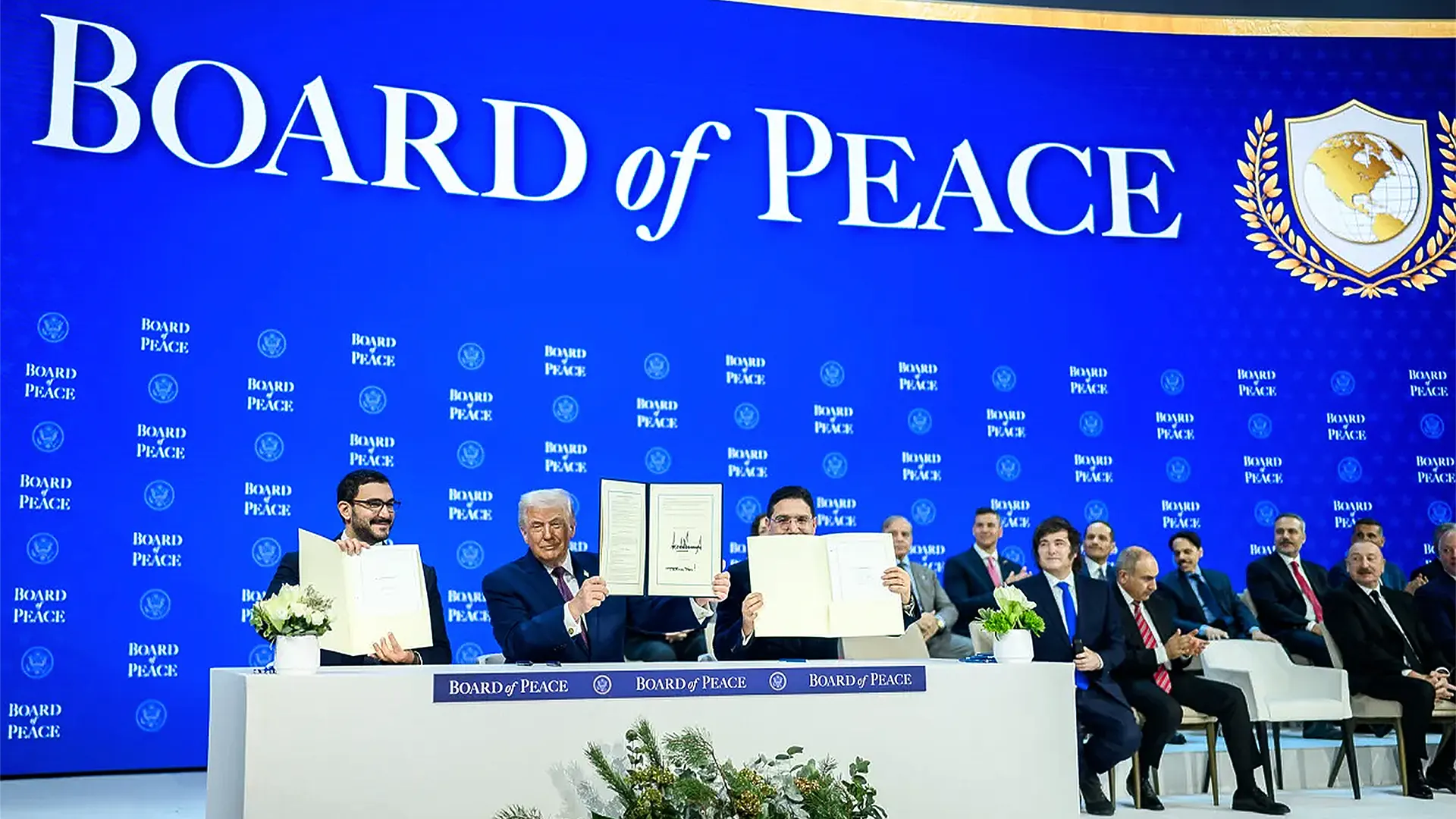
President Donald Trump is moving forward with what supporters call a bold alternative to the United Nations system. The newly formed Board of Peace (BoP) will hold its first official meeting this Thursday, backed by a $5 billion pledge to begin rebuilding Gaza and a governance model that breaks sharply from traditional multilateral institutions.
At stake is more than reconstruction funding. The initiative represents a direct challenge to how global crises are managed and who gets to decide.
A $5 Billion Opening Move
Front and center at the inaugural session is a collective $5 billion commitment for humanitarian relief and early stage reconstruction in Gaza.
Organizers describe it as “Phase One”, a down payment meant to stabilize conditions and prove the board’s model can work.
International estimates from the UN, World Bank, and European Union place the total cost of rebuilding Gaza closer to $70 billion. The gap is substantial. Supporters argue the first tranche is designed to unlock larger flows of capital, both public and private.
Washington is leading the effort. The United States has pledged more than
$1 billion in seed funding tied to Trump’s regional framework introduced in late 2025. Gulf states including Saudi Arabia, Qatar, the United Arab Emirates, and Turkey are expected to contribute significantly to the remaining balance.
Private capital may also play a role. Plans for so called “Peace Bonds” aim to attract corporations and institutional investors into what officials describe as a market driven redevelopment strategy.
A New Stabilization Force
Leading the vanguard of this new security architecture is Indonesia.
Jakarta has indicated that up to 8,000 troops could be ready for deployment by June as part of the International Stabilization Force (ISF).
Unlike UN peacekeepers, these forces will operate under the BoP charter.
That charter emphasizes “vetted” local policing and direct oversight from the board’s leadership. Supporters say the structure allows for faster coordination and tighter accountability.
The mandate, however, remains a gray area. Because the ISF answers to the board rather than the UN, questions remain about legal authority, rules of engagement, and long term oversight.
Aid itself is conditional. Trump has stated that reconstruction support depends on Hamas committing to full demilitarization. That requirement adds a political layer to what is already a complex rebuilding effort.
A “Shareholder” Model of Diplomacy
The Board of Peace is structured around a $1 billion permanent membership contribution. Any country that pays the amount within the first year secures a permanent seat. Those that do not can serve renewable three year terms as rotational members.
The structure has effectively divided participants into what some diplomats describe as “shareholders” and “spectators.”
Hungary and Vietnam have embraced permanent status.
Israel formally signed the charter earlier this month.
Middle Eastern contributors are widely expected to complete their financial commitments as part of the Gaza funding package.
Canada took a different path. After publicly declining to pay for permanent status, its invitation was rescinded, a move that underscored how financial participation now determines influence within the board.
Roughly two dozen nations have signed the charter so far, though not all have finalized their payment status. Some governments frame the $1 billion as a voluntary contribution rather than a mandatory fee. The wording matters, but the structure remains clear: financial commitment secures lasting authority.
Centralized Leadership
Governance within the BoP is highly centralized. The charter designates Trump as permanent Chairman in a role independent of his presidency.
The position carries sole veto authority over administrative decisions.
An executive board of eight senior figures will manage daily operations. Among them are Marco Rubio overseeing diplomatic coordination;
Ajay Banga providing financial expertise; former British Prime Minister
Tony Blair focusing on governance; and investor Steve Witkoff advising on development strategy. Jared Kushner is expected to play a central role in reconstruction planning and capital mobilization.
Supporters describe the structure as streamlined and decisive. Detractors argue it concentrates too much authority in a single office.
A Venue That Reflects the Moment
Thursday’s meeting will take place at the recently renamed Donald J. Trump U.S. Institute of Peace in Washington. The site itself is part of an ongoing legal dispute following its restructuring and redesignation as the board’s headquarters.
For critics, the venue symbolizes the broader shift underway: a move away from consensus driven institutions toward executive led diplomacy backed by capital commitments.
The Russia Question
One of the most closely watched developments involves Russia. President Vladimir Putin reportedly proposed allocating $1 billion from frozen Russian assets to secure permanent status. U.S. legal restrictions on those assets have so far blocked the arrangement, leaving Moscow outside the official membership list for now.
The episode illustrates the tension between the board’s financial logic and existing legal frameworks.
A High Stakes Experiment
The Board of Peace enters the global stage with momentum, money, and controversy. Its founders argue that speed and financial leverage can succeed where traditional diplomacy has stalled. Its critics warn that sidelining established institutions risks fragmenting international coordination.
Everything now turns on results. If the initial $5 billion stabilizes Gaza and draws broader investment, the BoP could emerge as a durable parallel structure in global governance. If the effort falters, doubts about legitimacy and sustainability will intensify.
Either way, Thursday’s inaugural meeting signals a decisive shift in how power, money, and diplomacy intersect in 2026.