
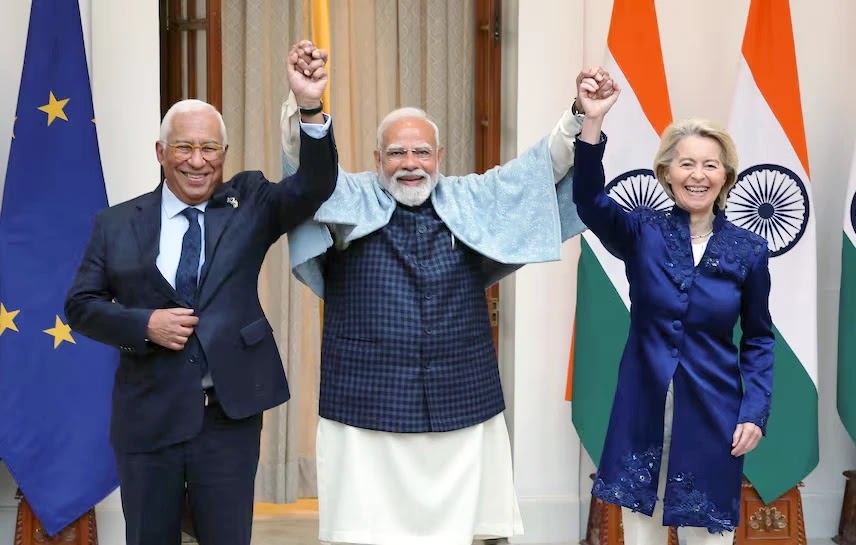
The 18-year wait is over. The conclusion of the India–European Union Free Trade Agreement (FTA) on January 27, 2026, is not just a commercial milestone for New Delhi and Brussels
it is a stabilizing move in a global trade environment under visible strain. Finalized in New Delhi after an accelerated diplomatic push, the agreement links two major economic blocs in what European Commission President Ursula von der Leyen called the “Mother of All Deals.”
Together, India and the EU account for roughly 25% of global GDP and form a combined market approaching two billion people. The scale of integration positions this pact as a structural shift in global commerce rather than a routine tariff-cutting arrangement.
A Market Opening on Unprecedented Scale
At its core, the agreement targets tariff elimination or reduction on 96.6% of goods by value. European firms are projected to save €4 billion annually in duties, while Brussels expects EU exports to India to double by 2032. For India, the deal removes longstanding tariff disadvantages that had steered European buyers toward alternative Asian suppliers.
These commercial gains unfold within a broader strategic logic. Negotiations were accelerated with unusual urgency over the past six months, as both sides sought to secure predictable trade corridors amid rising tariff actions and supply chain volatility elsewhere.
Strategic Sectors: Where the Barriers Fall
The final negotiating phase focused on sectors long shielded by steep duties.
Automobiles saw a breakthrough, but with phased precision. Tariffs on European luxury vehicles will initially enter at 40%, then decline to 10% over five years, within an annual quota of 250,000 units. Duties on auto parts will also be gradually phased out, encouraging European manufacturers to deepen production linkages in India.
Agri-food and consumer goods followed. Tariffs on wines and spirits previously 150% will fall to
20–40%, while duties on products such as olive oil, pasta, chocolate, and pet food will be reduced to zero over time.
Industrial goods including machinery, chemicals, pharmaceuticals, iron, and steel will see broad tariff elimination, integrating European industrial firms more deeply into India’s infrastructure expansion.
India’s reciprocal gains are concentrated in labor-intensive sectors. Textiles, apparel, leather goods, gems, jewellery, and marine products will gain zero-duty access, narrowing a prior 10–12% tariff gap with competitors. These sectors employ millions and represent a significant export expansion channel.
Market Reaction: Optimism Meets Adjustment
Financial markets responded with a mix of enthusiasm and recalibration. India’s Nifty 50 index closed up 0.51%, reflecting broader optimism around export growth and foreign investment flows.
However, domestic auto manufacturers told a different story. Shares of Mahindra & Mahindra and Maruti Suzuki fell roughly 3–5%, as investors priced in the competitive pressure from lower-tariff European luxury vehicles. The divergence highlights how large trade agreements often generate both expansion opportunities and sector-specific adjustment costs simultaneously.
Services and Mobility: A Talent Corridor
The agreement establishes one of India’s most ambitious professional mobility frameworks with a Western bloc. Predictable pathways for contractual service suppliers and independent professionals will ease access for Indian engineers, IT specialists, accountants, and consultants.
Provisions for intra-corporate transferees allow Indian technology firms to deploy staff across EU operations with clearer rights for dependents. In parallel, the EU secured expanded access to India’s financial and maritime services sectors.
Cultural and sectoral nuances also appear. Practitioners of Indian traditional medicine, including Ayurveda, gained recognition provisions in jurisdictions where regulation permits, illustrating how services trade increasingly includes “soft power” components alongside commercial ones.
Digital Trade: The Systems Layer
The digital trade chapter addresses the non-tariff barriers that shape modern commerce. The deal permanently bans customs duties on electronic transmissions, mandates recognition of electronic signatures and paperless documentation, and strengthens online consumer protection.
A notable provision shields proprietary source code, ensuring companies cannot be required to disclose algorithms as a condition for market access. Data flows are facilitated for commercial purposes, while India retains authority to localize data in sensitive sectors.
Regulatory dialogue creates a pathway for closer alignment between EU privacy standards and
India’s data protection regime, supporting cross-border digital services while preserving national regulatory autonomy.
Safeguards and Sustainability
India preserved protections for sensitive agricultural areas such as dairy, cereals, poultry, and soymeal, while reductions on alcohol duties unfold over a decade.
Environmental cooperation is embedded through alignment with climate commitments and structured engagement on the EU’s Carbon Border Adjustment Mechanism (CBAM), with technical and financial assistance aimed at easing compliance for smaller producers.
A Geopolitical Buffer
The agreement unfolds amid shifting trade alignments. By locking in predictable, rules-based trade corridors, both sides seek greater insulation from external volatility. The deal effectively expands each partner’s range of stable economic relationships at a time when unilateral tariff measures have become more frequent.
This strategic dimension was underscored by reaction beyond Europe and India. In Washington, U.S. Treasury Secretary Scott Bessent criticized the pact, arguing it risked undercutting Western leverage over energy and security policy, a reminder that large trade agreements now carry immediate geopolitical interpretations alongside economic ones.
Parallel to the FTA, a Security and Defence Partnership was signed, expanding cooperation in maritime security, cyber resilience, and industrial collaboration.
The Road to Implementation
Although negotiations are concluded, the text now enters legal review expected to last five to six months. Formal signing is anticipated later in 2026, with entry into force likely in early 2027 following ratification procedures.
A Structural Shift
The India–EU FTA links advanced industrial capacity with one of the world’s fastest growing large economies through synchronized rules on goods, services, digital trade, mobility, and sustainability. Rather than a short-term stimulus, it represents a long-horizon effort to stabilize trade relationships through institutional integration.
In an era of trade fragmentation, the agreement signals a continued commitment by two major actors to rules based economic engagement and establishes a framework likely to influence how large-scale trade partnerships are structured in the coming decade.