What started as a targeted military exchange between the United States and Iran has spiraled into a multi-front regional war, pulling in Gulf allies, choking global shipping lanes, and rattling energy markets from Asia to Europe. Iranian President Masoud Pezeshkian has openly acknowledged the shift, declaring that the country is now engaged in a “full-scale war.”
Iran Declares “Full-Scale War” After U.S. Strikes
The escalation followed days of precision U.S. airstrikes on Iranian command centers, air defenses, transit bridges, and power infrastructure. Washington has framed the campaign as punishment for American troop fatalities and enforcement of a broader blockade strategy. Pezeshkian, in turn, warned Iranian citizens to brace for the “natural consequences of this resistance” as strikes on infrastructure leave domestic power grids struggling to keep up.
The fighting hasn’t stayed contained to Iran and the U.S. Tehran has retaliated directly against American allies across the Gulf, expanding a conflict that was already reshaping the region.
Iran Widens Its Target List Across the Gulf
As the war has grown, Iran has deliberately shifted its strategy toward striking countries that host U.S. military assets or cooperate with Washington, even when those countries aren’t directly part of the fighting.
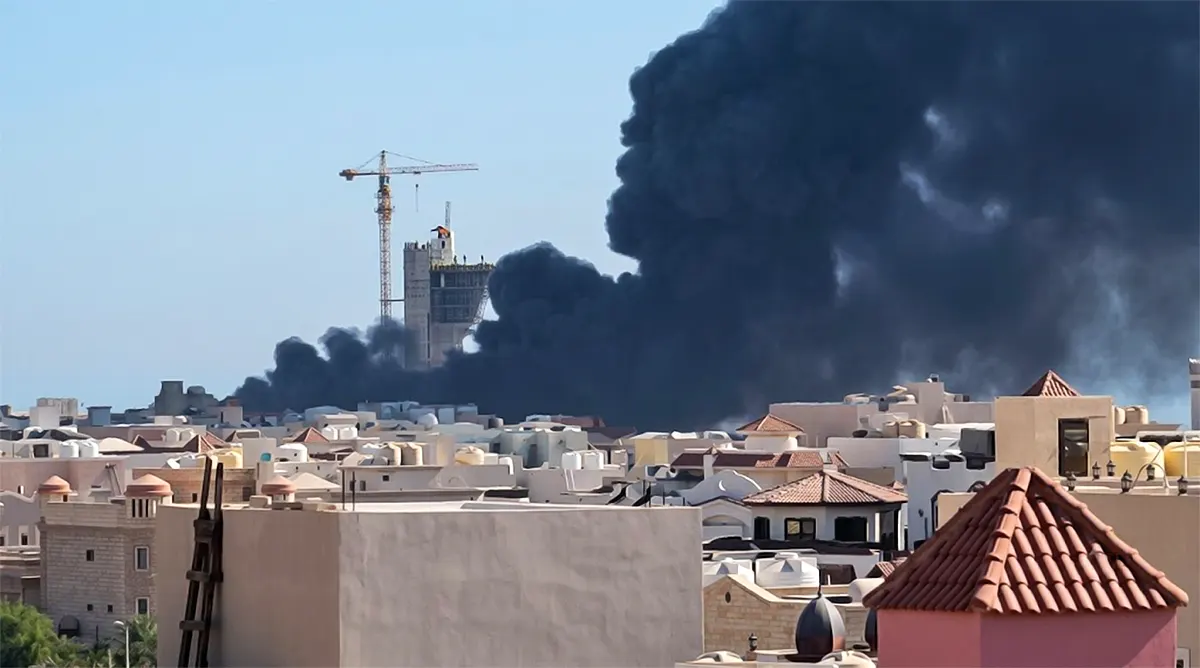
Kuwait has taken the heaviest hit. Over the weekend, Iran launched multiple waves of drones and missiles across the country. The industrial area of Al Mangaf was hit hard, with satellite images showing thick black smoke rising over the site. The Kuwait Petroleum Corporation confirmed that one of its major oil installations in Mangaf suffered significant damage and injuries after repeated strikes. A power generation and water desalination complex was also struck twice, sparking fires that burned for two consecutive days and disrupting electricity and water supplies for residents.
Iran’s Islamic Revolutionary Guard Corps (IRGC) claimed responsibility for hitting U.S. military infrastructure inside Kuwait as well, including drone hangars and radar systems at Ali Al Salem Air Base and a maritime support hub at Camp Arifjan. Kuwaiti air defenses have been working around the clock to intercept incoming projectiles.
Saudi Arabia and Bahrain have also been drawn into the line of fire. Iran’s Revolutionary Guard has launched ballistic missiles and explosive drones at Saudi targets, including a strike on a U.S. military hub and an earlier drone attack on a labor camp in Al Kharj. In Bahrain, air raid sirens have sounded nationwide as local air defenses attempt to intercept drones aimed at air navigation systems and infrastructure.
Iranian state media has been explicit about the reasoning: because these nations host American bases, Tehran considers them active operational nodes for the U.S. military and is striking them in an attempt to force a halt to the aerial campaign.
A New Front: The Houthi Blockade on Saudi Arabia
Just as one crisis was stabilizing, another opened up. Yemen’s Houthi rebels declared an immediate maritime blockade against Saudi Arabia, calling it an “eye for an eye” response to a recent Saudi strike on the Sana’a airport. The Houthis are now targeting Saudi shipping lanes directly.
This move threatens one of the few remaining safety valves in the region’s energy trade. When the wider U.S.-Iran conflict effectively shut down traffic through the Strait of Hormuz, Saudi Arabia rerouted much of its crude oil exports to its Red Sea port in Yanbu to keep supply moving. By threatening the Bab el-Mandeb Strait and the Red Sea corridor, the Houthi blockade puts that backup route — and millions of barrels of daily oil exports — directly at risk.
Why the Strait of Hormuz Closure Is Shaking the Global Economy
The near-closure of the Strait of Hormuz isn’t just a regional problem. The strait normally handles roughly 20 to 25% of the world’s seaborne oil and 20% of global LNG shipments, so choking it off sends financial shockwaves far beyond the Gulf.
Energy prices and inflation are climbing fast. Economists describe the sudden drop in available crude as a massive, instant tax on income for countries that import fuel. Oil and gas prices have spiked, driving up manufacturing, transportation, and utility costs. In Europe, the blockage of Qatari LNG exports is reviving memories of the continent’s last major energy crisis, forcing governments to lean on dwindling reserves and pricier alternate suppliers.
Asian manufacturing is especially exposed. China, India, Japan, and South Korea together receive roughly 80% of the crude that flows through the Strait of Hormuz. With that supply disrupted, factory input costs are surging, squeezing corporate profit margins and eating into the purchasing power of everyday consumers across the region.
Global shipping is under serious strain. Thousands of commercial cargo ships and more than 20,000 seafarers are effectively stranded around the Gulf. Because the region is now a declared war zone, maritime insurance premiums have jumped sharply, and even ships taking long diversions face longer transit times and higher freight rates, costs that eventually show up in the price of everyday goods worldwide.
Food and agriculture are feeling it too. The Gulf is a major hub for global fertilizer and methanol exports. With those shipments frozen, agricultural supply chains are tightening, raising the risk of higher food prices in places as far apart as Manila and Johannesburg.
Is a Ceasefire Realistic Right Now?
Despite the intensity of the fighting, diplomatic channels haven’t completely closed. Regional mediators have proposed a 10-day ceasefire aimed at cooling hostilities and reopening a path toward basic understandings between Washington and Tehran. That both sides are still willing to entertain the idea suggests neither wants a fully unchecked escalation even as the fighting continues.
That said, the reality on the ground is far from a breakthrough. There are currently no formal, high-level peace negotiations happening between the U.S. and Iran, a sharp contrast to the diplomatic push seen earlier in the year. Regional mediators, including Pakistan, continue floating temporary pause proposals behind the scenes, but neither side has taken the offer seriously yet.
Military and foreign policy analysts expect this phase of the conflict to drag on for weeks. With Iran having expanded its strikes to Kuwait, Bahrain, and Saudi Arabia, and the U.S. intensifying its bombing campaign inside Iran, both sides appear locked into a retaliation-first mindset. Barring a sudden diplomatic breakthrough, the region should brace for an extended period of intense conflict with global energy markets and supply chains caught in the middle.