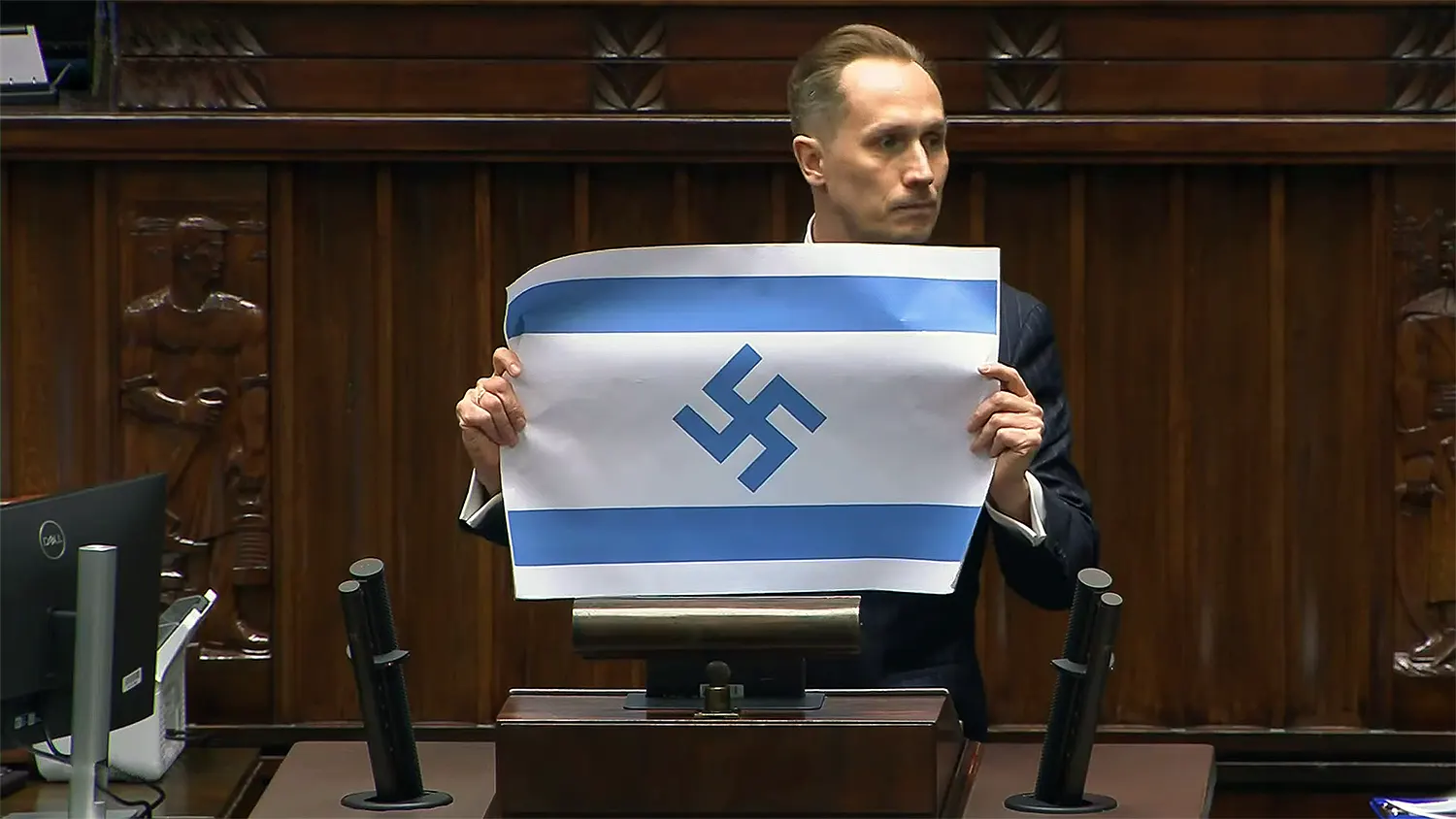
On Tuesday, April 14, 2026, in Warsaw, Polish lawmaker Konrad Berkowicz sparked a diplomatic and domestic crisis after displaying a modified Israeli flag during a Sejm session, prompting immediate condemnation over antisemitic symbolism and genocide related rhetoric.
The incident unfolded during a parliamentary debate on Poland’s Middle East policy inside the Sejm. Berkowicz produced a paper Israeli flag altered with a swastika replacing the Star of David. He accompanied the display with claims that Israel represents “the new Third Reich” and accused it of “genocide of exceptional cruelty” in Gaza, citing alleged use of white phosphorus. But the real shift came when the visual symbolism turned a policy critique into a deliberate provocation inside parliament and an explicit Holocaust referential comparison, intensifying the political fallout.
“A parliamentary chamber tested by symbolic escalation”
The reaction inside the chamber was immediate. Deputy Speaker Włodzimierz Czarzasty halted the proceedings, stating that the display of Nazi imagery in the Sejm could not be justified under any parliamentary context. That intervention marked a formal boundary the shift from political speech to conduct deemed incompatible with parliamentary dignity. What makes this even more urgent is the procedural response now under discussion, including financial penalties and potential disciplinary sanctions.
But the real escalation came from how institutions interpreted intent. Parliamentary authorities signaled that the act may fall under rules governing hate symbolism and chamber dignity violations, rather than protected political expression. That distinction is critical, because it determines whether the case remains political discipline or becomes a matter for prosecutors. The tone inside the Sejm shifted quickly from debate to containment.
International reactions amplified the political shockwave
Outside Poland, responses were swift and unusually direct. The Israeli Embassy in Poland condemned the act as an “antisemitic horror,” arguing that it weaponized Holocaust imagery at a moment of collective remembrance. That timing proved central to the backlash, since the incident occurred on Yom HaShoah and during commemorations tied to Auschwitz-Birkenau.
But the real diplomatic intensity emerged from Washington as well. Thomas Rose, the US ambassador to Poland, publicly denounced the display in stark terms, describing it as “vile” and “appalling.” That statement marked a departure from standard diplomatic phrasing and signaled how quickly the event had moved beyond domestic parliamentary dispute into a broader transatlantic concern about antisemitism in political discourse and the limits of parliamentary provocation.
Legal boundaries and the weight of Polish penal code
That international reaction then fed directly into Poland’s legal debate. Under Polish law, particularly provisions criminalizing the promotion of totalitarian symbols, the use of Nazi imagery in public spaces can carry penalties of up to three years in prison. Prosecutors are now reviewing whether Berkowicz’s actions constitute prohibited promotion of fascist symbolism or unlawful insult to a foreign state’s emblem.
What complicates the legal assessment is intent versus context. Defenders of such acts sometimes argue symbolic use is political expression. But critics point to the explicit framing calling Israel “the new Third Reich” as evidence of intentional ideological equivalence, not abstract commentary. That raises a second question: whether parliamentary immunity shields conduct that crosses into criminally defined hate expression.
A pattern of provocation inside Poland’s parliament
The incident did not occur in isolation. It follows a broader pattern of controversy involving members of Confederation (Konfederacja), a far right political grouping frequently criticized for confrontational parliamentary tactics. Earlier episodes, including a 2023 incident involving the disruption of Hanukkah candle lighting in the Sejm, have already placed parts of the party under scrutiny for repeated symbolic provocations.
That history matters because institutions rarely evaluate such incidents as standalone events. Instead, they assess cumulative behavior. Berkowicz’s critics argue that repeated symbolic escalation signals a strategy of performance based political confrontation rather than isolated protest. That interpretation is now shaping how disciplinary bodies and prosecutors frame the current case.
From parliamentary discipline to possible criminal exposure
Attention is now focused on whether parliamentary sanctions will be followed by criminal proceedings. Early indications suggest internal Sejm mechanisms may impose financial penalties or suspension from parliamentary privileges. But the broader legal review could extend beyond the chamber if prosecutors determine that statutory thresholds for hate symbolism were crossed.
What makes the situation more volatile is the dual track process: political discipline inside parliament and potential prosecution outside it. That creates a situation where Berkowicz faces institutional sanction and criminal exposure simultaneously, a combination that significantly raises the stakes. The outcome will likely depend on how investigators interpret the line between political expression and unlawful symbolic incitement.
A political test that extends beyond one lawmaker
As of now, the case remains under review, but its impact is already broader than a single parliamentary incident. It has intensified debate over how democracies manage extremist symbolism inside legislative spaces, especially when framed as political critique. It also places pressure on party leadership to clarify boundaries around acceptable conduct.
What comes next will depend on whether Polish institutions prioritize parliamentary autonomy or legal accountability. Either path carries consequences: one risks normalizing extreme symbolism in political debate, while the other raises questions about limits on political expression. And that tension now defines the aftermath of an incident that began with a single gesture but expanded into a national and international controversy over speech, symbolism, and democratic boundaries.