A War Moves to the World’s Most Critical Waterway
The war between the United States, Israel, and Iran has entered its most volatile phase and it is now unfolding at sea.
After weeks of sustained conflict, the collapse of high level talks in Islamabad has pushed the confrontation into a direct naval standoff in the Strait of Hormuz. This is not a new crisis emerging, but a decisive escalation of a war already in motion, now centered on one of the most strategically important chokepoints in the global economy.
As a result, the risks are no longer confined to the region they are global.
From Regional War to Maritime Frontline
Since February, the conflict has steadily expanded in scope, intensity, and geography.
What began with coordinated strikes involving the United States and Israel quickly evolved into a broader confrontation with Iran, marked by missile exchanges, proxy engagements, and attacks on infrastructure. Even during periods labeled as “ceasefires,” the reality on the ground was far from stable.
The recent diplomatic effort in Islamabad was never about preventing conflict. It was an attempt to contain an already active war.
When those talks failed, the last remaining buffer between military pressure and direct confrontation disappeared.
Diplomacy Collapses, Blockade Begins
The breakdown of negotiations triggered an immediate and decisive shift from diplomacy to force.
Within hours, Donald Trump ordered the enforcement of a full naval blockade on Iranian ports, placing the operation under U.S. Central Command. American warships moved into position, and the mission expanded beyond deterrence into active enforcement.
The objective is clear: to isolate Iran economically by cutting off its maritime access,
while still attempting to preserve limited passage for neutral shipping.
At the same time, U.S. naval units began clearing sea mines in the Strait of Hormuz, signaling a willingness to operate directly within contested waters.
This was not a symbolic move, it marked the start of a live military confrontation at sea.
Iran’s Response: Expanding the Battlefield
Tehran’s reaction has fundamentally changed the scope of the conflict.
The Islamic Revolutionary Guard Corps quickly denounced the blockade as “maritime piracy,” but more importantly, it introduced a doctrine that raises the stakes far beyond Iran itself.
The message is stark: if Iran is denied access to global trade, then no country in the region will enjoy secure access either.
This approach effectively turns the entire Persian Gulf into a shared risk zone. Major ports operated by U.S. allies are now implicitly within the scope of potential retaliation, not necessarily through direct strikes, but through disruption, sabotage, or denial of safe passage.
In doing so, Iran has transformed the conflict from a bilateral confrontation into a regional and potentially global economic threat.
At Sea: A Battlefield Defined by Uncertainty
The Strait of Hormuz is no longer just a transit route, it is now an active and highly unstable battlefield.
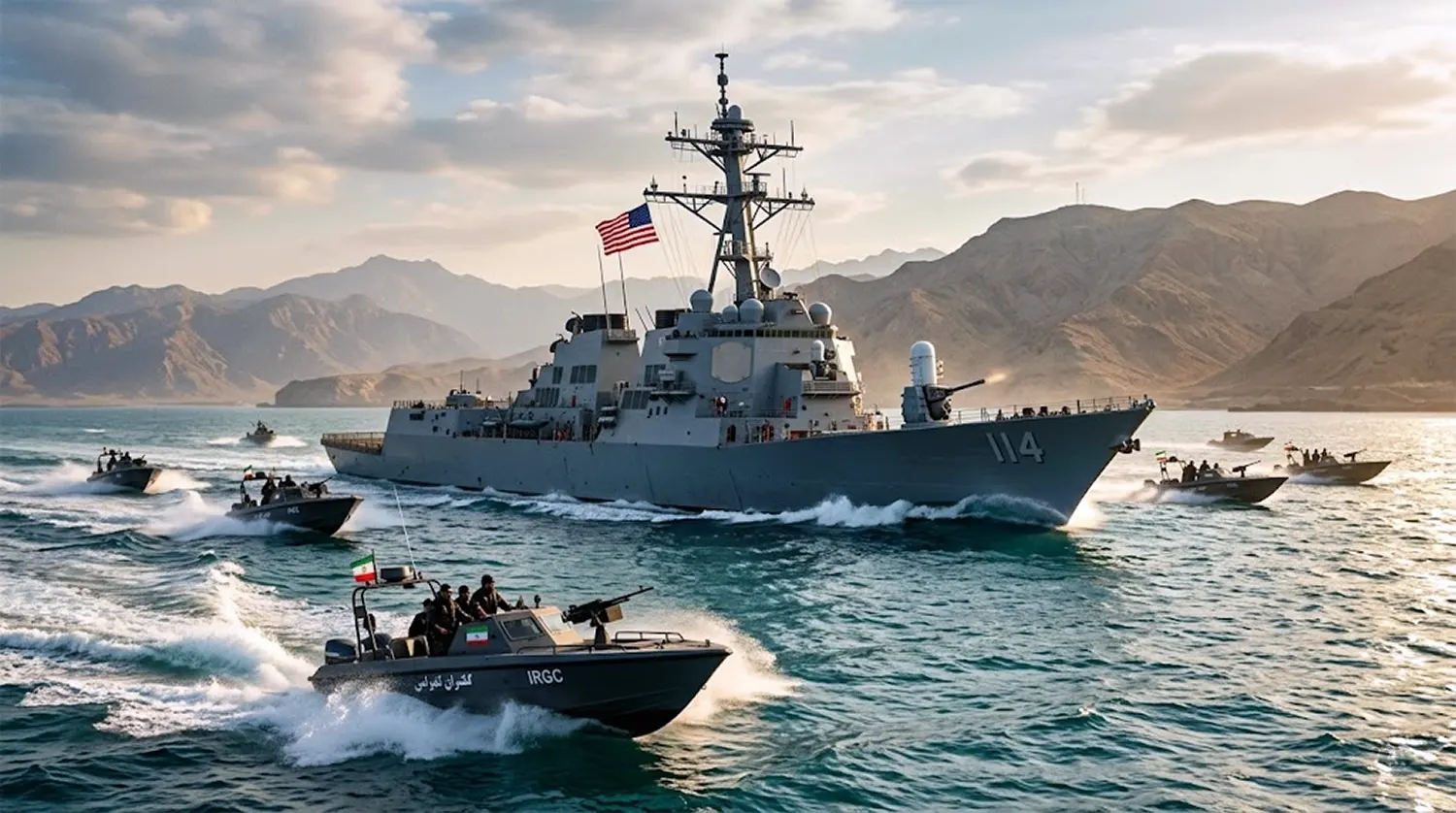
U.S. forces are attempting to secure maritime corridors and maintain limited commercial flow, while Iranian naval units continue to patrol the area, enforce their own claims, and maintain hazardous zones that complicate navigation. Both sides are operating simultaneously, often within close proximity, yet without a shared framework to manage encounters.
This creates a situation where control is contested, communication is limited, and intentions are unclear.
Compounding the risk is the unresolved issue of sea mines. Iran has acknowledged that not all previously deployed mines can be accounted for, leaving parts of the waterway unpredictable. For commercial shipping, this uncertainty is enough to trigger rerouting decisions, even in the absence of direct attacks.
In this environment, perception can escalate tensions just as quickly as reality.
A Conflict Drawing Wider Attention
The escalation in the Strait is rapidly pulling in other global actors, each with their own interests at stake.
Benjamin Netanyahu has confirmed full coordination with Washington, reinforcing the alignment between the United States and Israel in confronting Iran’s position. This support adds another layer of military and political backing to the blockade strategy.
At the same time, other major powers are signaling concern. China has called for restraint, emphasizing the importance of stability in global trade routes, while Sergei Lavrov is engaging in urgent diplomatic efforts, warning that further escalation could severely disrupt global energy markets.
These reactions suggest that the conflict is no longer contained, it is beginning to reshape broader geopolitical alignments.
Economic Shockwaves: A Crisis Felt Beyond the Region
The economic consequences of this escalation are already unfolding in real time.
Energy markets have reacted sharply to the growing instability. Brent Crude Oil prices have surged amid fears that even a limited disruption in the Strait could significantly reduce global supply.
At the same time, shipping companies are facing rising insurance costs and increasing uncertainty about safe passage. Some have already begun rerouting vessels away from the Gulf entirely, despite the added time and expense, simply to avoid the risks associated with operating in an active conflict zone.
This highlights a critical reality: the Strait of Hormuz is not just a regional concern,
it is a central artery of the global economy.
A War That Could Escalate by Accident
The most immediate danger is no longer strategic escalation, it is accidental conflict.
For the first time since the war began, U.S. and Iranian forces are operating in direct proximity while conducting active missions. This creates a highly compressed decision making environment, where reactions must be immediate and often based on incomplete information.
A single incident, a misidentified vessel, a defensive maneuver misinterpreted as aggression, or an unexpected explosion could trigger a rapid and uncontrollable escalation.
Both sides have already made their positions clear. Iran has warned of severe retaliation against any perceived aggression, while the United States has committed to responding with overwhelming force if its assets are threatened.
In such conditions, the margin for error is effectively gone.
A Narrow Path Forward
The conflict now stands at a critical juncture, with limited room for de escalation.
If both sides manage to avoid direct confrontation, the situation could stabilize into a tense but controlled standoff, defined by ongoing pressure rather than open conflict. However, this outcome depends heavily on restraint in an environment where tensions are already high.
More likely is a scenario where a limited incident triggers a contained exchange, one that may not immediately spiral into full scale war but would still carry significant
consequences for global markets and regional stability.
The most dangerous possibility remains a broader escalation, particularly if regional infrastructure or allied ports become targets. Such a development would expand the conflict beyond the Strait and potentially draw in additional actors.
At this stage, the trajectory of the war may depend less on strategy and more on circumstance.
The Big Picture
The Strait of Hormuz has become the focal point of an already active war,
transforming a regional conflict into a global concern.
Diplomatic efforts have stalled, military operations are intensifying, and the risk of escalation is rising with each passing day. What makes this moment particularly dangerous is not just the concentration of forces, but the lack of a clear mechanism to prevent unintended conflict.
Ultimately, this is no longer just a contest over policy or territory, it is a struggle over control of a vital global lifeline.
And in conflicts like this, history offers a clear warning:
It is often not deliberate decisions, but unforeseen incidents, that determine how far escalation will go.