On May 25, 2026, Ferrari will unveil its first fully electric car, the “Luce,” in Rome, marking a decisive shift for the brand long defined by roaring combustion engines.
The moment matters beyond a single model. Ferrari is not just launching an EV,
it is attempting to redefine what an electric supercar feels like while preserving the emotional identity that built its legacy. In a market crowded with fast but often sterile electric vehicles, the Luce aims to prove that performance and soul can coexist.
But the real shift came when Ferrari decided this would not be a typical electric transition.
A design philosophy that rejects the screen heavy future
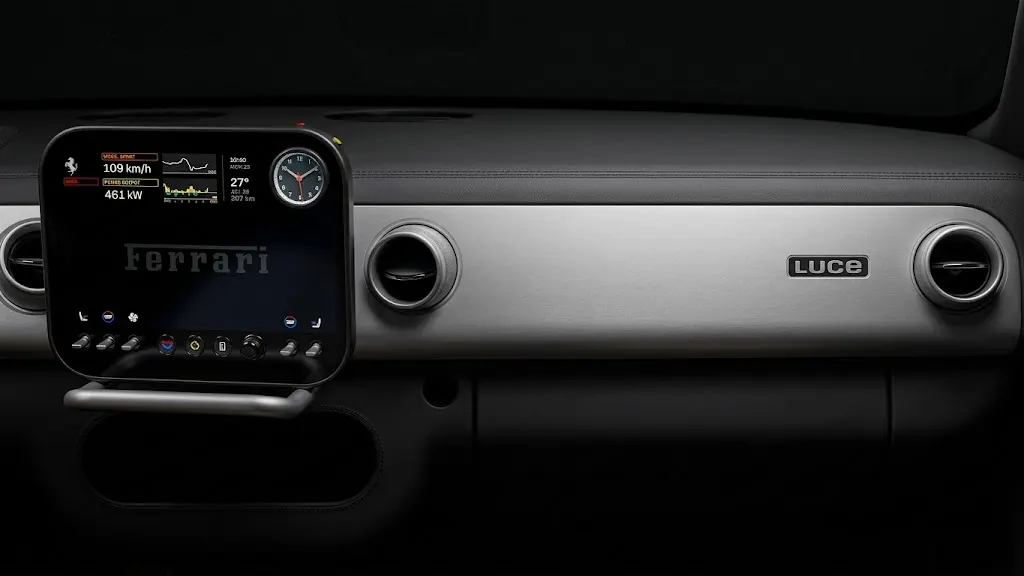
Ferrari’s approach to the Luce begins inside the cabin, where the brand has deliberately moved away from the screen dominated interiors popularized by Tesla and other EV makers. Instead, it leans into tactile design.
Working with LoveFrom, the firm led by Jony Ive, Ferrari has created what it calls
a “neo retro” cockpit. Drivers will find physical buttons, knobs, and analog inspired digital dials, designed to restore a sense of mechanical connection.
At the center of this experience is a ritual. To start the car, drivers insert a glass key that changes color as power flows to the motors. It is a symbolic act, part theater, part engineering that replaces the silent, buttonless startup common in modern EVs.
This design choice signals something deeper. Ferrari is not chasing minimalism. It is trying to preserve driver engagement in an electric age.
And that philosophy extends directly into how the car performs.
Power meets precision in a quad motor architecture
Underneath its sculpted body, the Luce is built around a quad motor system producing over 1,100 horsepower, placing it firmly in hypercar territory. Each wheel is powered independently, allowing precise control of torque and traction.
Acceleration is expected to reach 0–100 km/h in 2.5 seconds, with a top speed capped at 310 km/h. But Ferrari’s engineers have emphasized that straight line speed is only part of the story.
Instead, the focus is on what they call “dominion over lateral forces” how the car behaves in corners, under braking, and at the limit of grip. In “Range” mode, the front motors can disengage entirely, turning the car into a rear wheel drive cruiser. Switch to performance settings, and it becomes an all wheel drive machine built for aggressive driving.
Yet performance alone does not define a Ferrari. The challenge for the Luce is delivering something electric cars often lack: sensation.
Engineering a new kind of Ferrari “sound”
Electric vehicles are famously quiet. For Ferrari, that silence posed a problem.
Rather than simulate a traditional engine note, the company developed an “authentic sound” system that amplifies real mechanical frequencies from the motors and drivetrain. Sensors capture vibrations and transform them into a dynamic acoustic signature.
The result is not an imitation of a V12. It is a high pitched, evolving soundscape tied directly to speed and load, designed to give drivers feedback similar to a combustion engine.
This approach reflects Ferrari’s broader strategy. The goal is not nostalgia, it is translation. The brand is attempting to convert emotional cues from gasoline engines into an electric language.
But delivering that experience requires more than sound. It depends on how the car handles its greatest challenge: weight.
Solving the EV weight problem without sacrificing agility
Electric vehicles are inherently heavy due to large battery packs. Ferrari has tackled this issue through lightweight materials and advanced chassis engineering, keeping the Luce just under 5,100 pounds.
The battery sits low in the chassis, creating a center of gravity 80mm lower than a V12 Ferrari. Weight distribution is carefully balanced at 47% front and 53% rear, enhancing stability and responsiveness.
To further sharpen handling, the Luce uses third generation 48V active suspension and four wheel steering. The rear wheels can turn slightly, improving agility in tight corners while maintaining stability at high speeds.
These systems work together to counteract mass and deliver what Ferrari promises will feel like a lighter, more responsive car than its weight suggests.
But engineering performance is only part of the equation. The Luce must also compete in a rapidly evolving market.
Entering a crowded field at the very top of the EV market
Ferrari is not targeting mainstream electric vehicles. The Luce is positioned against elite competitors like the Porsche Taycan Turbo S and the Rimac Nevera.
With an estimated price exceeding $500,000, it will rank among the most expensive production EVs available. Yet Ferrari is betting that buyers are not just paying for speed,
but for brand heritage, design, and emotional experience.
The Luce also arrives as part of a broader strategy. In 2026, Ferrari is launching multiple models, including hybrids and V12-powered cars, signaling that electrification will complement not replace, its traditional lineup.
That balance reflects a careful transition. Ferrari is moving forward without abandoning its past.
And that raises a broader question about what this car represents.
A defining moment for Ferrari’s electric future
The Luce is more than a product launch. It is a statement about how a legacy brand adapts to a changing industry.
By focusing on driver engagement, sensory feedback, and design ritual, Ferrari is attempting to differentiate itself in a segment where raw performance is no longer enough.
The risk is clear. If the experience feels artificial, it could alienate loyal enthusiasts. But if it succeeds, the Luce could redefine expectations for what an electric supercar can be.
As the Rome debut approaches, the stakes extend beyond Ferrari. The Luce will test whether the emotional core of performance driving can survive the shift to electricity.
And in doing so, it may answer a question that has lingered over the industry for years:
can an electric car still feel like a Ferrari?