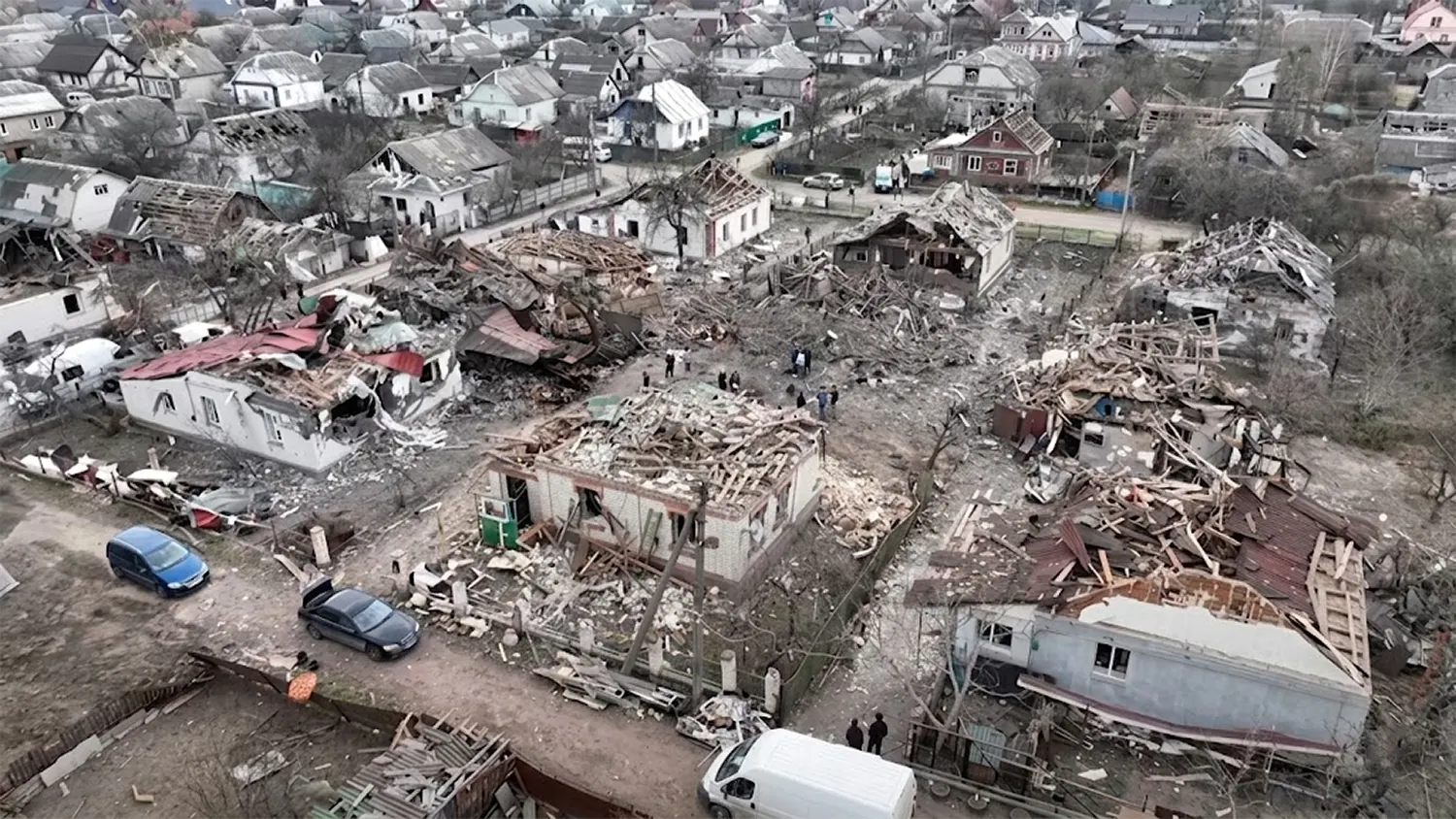
On April 3–4, 2026, Russia launched a sweeping wave of missile and drone strikes across Ukraine, hitting civilian infrastructure nationwide. The town of Korosten in the Zhytomyr region was among the hardest hit, officials said.
The attacks unfolded as Ukraine sought a temporary ceasefire for Orthodox Easter, a move President Volodymyr Zelenskyy described as a test of whether diplomacy could still work. Instead, the strikes signaled a sharp escalation.
The contrast is stark. Kyiv proposed a pause in fighting tied to a major religious holiday. Moscow responded with one of the largest aerial assaults of the year. That gap between diplomacy and battlefield reality now defines the conflict’s latest phase.
But the real shift came not just in scale, but in how the attacks were carried out.
Daylight strikes mark a deliberate and dangerous tactical shift
Korosten bore the brunt of a rare daytime barrage involving hundreds of drones and missiles, a departure from the nighttime raids that have defined much of the war. Ukrainian officials say the change is intentional.
At least one woman, born in 1956, was killed in the Korosten district. Seven others were injured. Local authorities reported that up to 200 homes were damaged or destroyed, leaving entire neighborhoods in ruins.
Prime Minister Yulia Svyrydenko said the timing was no accident. Daytime strikes, she argued, are “deliberately trying to increase civilian casualties” by hitting when streets, shops, and homes are occupied.
That shift reflects a broader recalibration of Russian tactics, according to Ukrainian military officials.
Air Force spokesman Yurii Ihnat said Moscow is using new flight routes and modernized drones to evade air defenses. The volume alone is striking: more than 540 drones and over 30 missiles launched in roughly 24 hours.
Yet even that scale tells only part of the story. The wider offensive reveals how deeply the escalation has spread.
A nationwide barrage leaves civilian targets and symbolic towns exposed
Across Ukraine, the same 24 hour period left at least eight people dead and many more injured. The strikes extended far beyond Korosten, hitting multiple regions with varying tactics.
In the Kyiv region, attacks struck satellite towns including Bucha, Fastiv, and Obukhiv. One person was killed and eight injured. A veterinary clinic was also hit, killing around 20 animals, an incident that has become a symbol of the strikes’ indiscriminate nature.
Further north, in the Sumy region, a guided aerial bomb hit an apartment building, killing a 59 year old woman. In the east, a similar strike in Kramatorsk killed three people. These weapons are particularly difficult to intercept and carry significant destructive power in urban areas.
Despite the intensity, Ukraine’s air defenses intercepted a large share of incoming threats. The Air Force reported shooting down 515 of 542 drones and 26 of 37 missiles. But even a small number of breakthroughs can cause severe damage.
What makes this even more urgent is not just the destruction itself, but the timing.
An Easter ceasefire proposal meets a surge in violence
The escalation comes days after Kyiv floated a proposal for a temporary ceasefire during Orthodox Easter, which falls on April 12 this year. The initiative was meant to test whether limited humanitarian pauses could open the door to broader negotiations.
Zelenskyy framed the proposal as a chance to show that “diplomacy can succeed,” even in a protracted war. The idea was simple: silence in the skies, even briefly, could build trust.
The effort also had international backing. Pope Leo XIV held a call with Zelenskyy on Good Friday, supporting humanitarian measures and a halt to hostilities.
But Moscow rejected the proposal outright.
Kremlin spokesperson Dmitry Peskov dismissed it as a “PR stunt,” arguing that Russia is not interested in temporary pauses. Instead, he reiterated that any peace must come through a “lasting settlement” on Russian terms.
That response was not just rhetorical. It was reinforced on the battlefield.
Back channel diplomacy falters as military pressure intensifies
Behind the scenes, Ukraine had tried a less conventional diplomatic route. Earlier in the week, Zelenskyy engaged with U.S. intermediaries, including Steve Witkoff and Jared Kushner, in an effort to advance the ceasefire proposal.
The outreach reflected a broader strategy: use informal or “back channel” figures to break the deadlock where formal negotiations have stalled. Senator Lindsey Graham also played a role in bridging communication.
Kyiv’s goal was modest but strategic. A short term humanitarian pause could pave
the way for discussions on security guarantees and a longer term settlement.
Russia’s response suggests a different calculation. By launching hundreds of drones and missiles in rapid succession, Moscow signaled that it currently views military pressure
not compromise as its primary leverage.
The contrast is stark. Ukraine pushes for incremental trust building measures. Russia demands sweeping concessions, including a Ukrainian withdrawal from contested regions.
That divergence has produced a deep strategic deadlock.
A widening gap between negotiation and reality on the ground
The latest escalation underscores a fundamental mismatch in objectives. Ukraine is seeking limited, symbolic steps toward de escalation. Russia is pressing for a comprehensive settlement on its own terms.
This gap is visible in both rhetoric and action. While Kyiv speaks of “silence in the skies,” Moscow has intensified what some analysts describe as “coercive state degradation” targeting infrastructure and civilian life to weaken resilience.
The result is a cycle where diplomatic gestures are quickly overshadowed by battlefield developments. Each new strike makes trust harder to build and negotiations more remote.
And yet, the stakes extend beyond immediate casualties.
The attacks on towns like Korosten are not only tactical operations. They are also signals about intent, leverage, and the direction of the war.
As Orthodox Easter approaches, the hoped for pause in violence appears increasingly unlikely. Instead, the conflict is entering a phase defined by higher intensity, broader targeting, and fewer diplomatic openings.
In that sense, the events of April 3–4 may mark more than a single escalation. They may foreshadow a spring in which the war grows louder, not quieter despite calls for peace timed to one of the most solemn moments in the religious calendar.