On a factory floor in China, something quietly historic just happened.
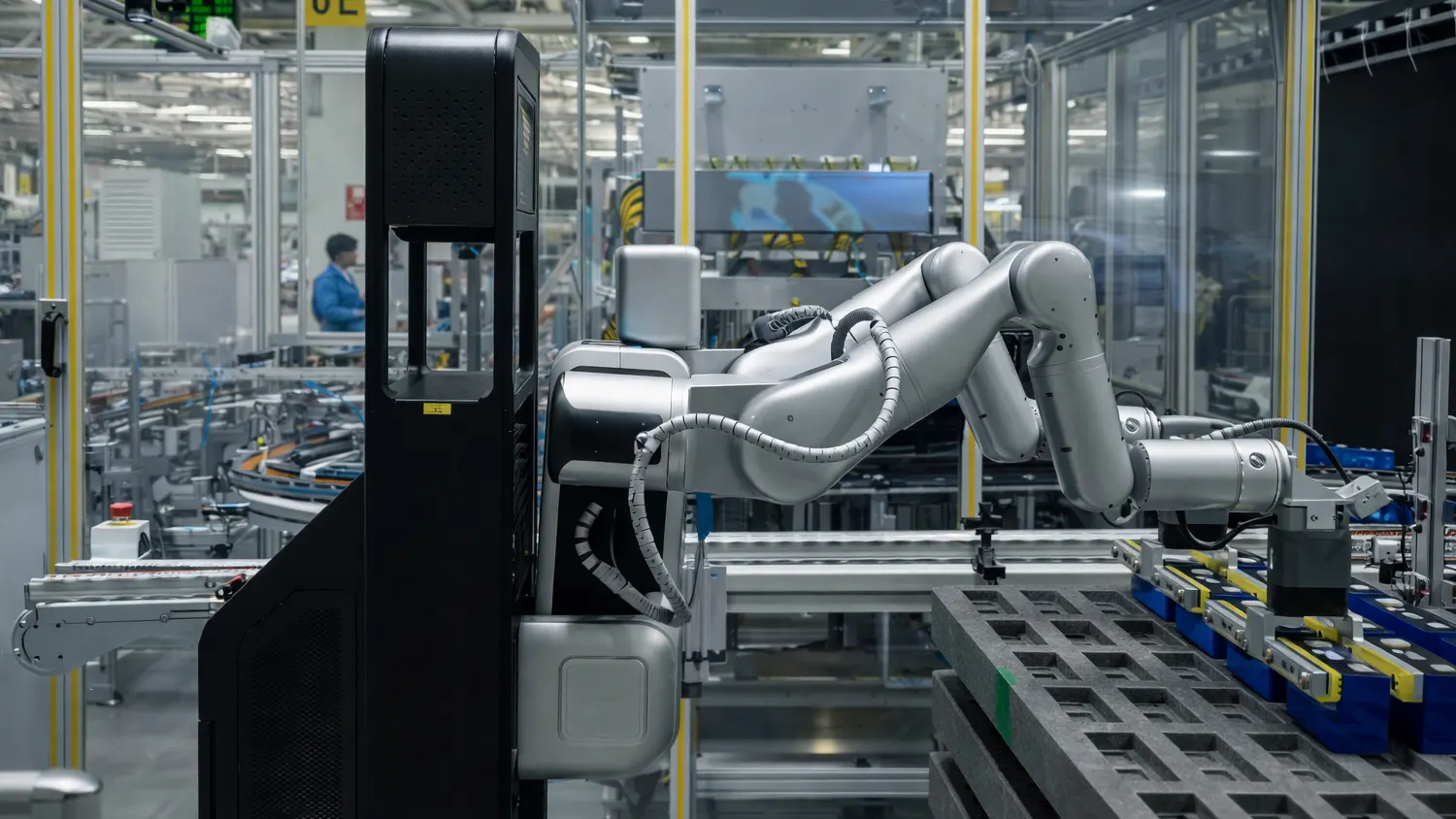
A humanoid robot showed up for work not as a demo, not as a test, but as a full time assembly line worker. It didn’t wave or speak. It simply started doing its job, every two seconds, with near perfect precision.
This isn’t a glimpse of the future anymore. It’s already part of the production line.
A Robot That Doesn’t Just Assist, It Replaces a Job
The robot is called “Nengzai No. 1.” It was deployed by automaker SAIC-GM on the battery line for the Buick Electra E7.
What makes this moment different is simple:
this robot isn’t helping humans, it’s taking over a specific role entirely.
Its job is to:
- Pick up battery cells
- Position them precisely
- Load them into battery packs
That might sound routine. It’s not.
Battery assembly is one of the most delicate and dangerous steps in electric vehicle manufacturing. A tiny misalignment can lead to overheating or even fire.
And yet, this robot handles it with:
- ±0.1 millimeter accuracy (thinner than a human hair)
- A steady pace of one task every two seconds
That’s not faster than humans.
It’s exactly as fast and far more consistent.
Why “Two Seconds” Changes Everything
In manufacturing, there’s a concept called “takt time.”
Think of it as the rhythm of a factory, the exact pace needed to meet demand.
If one part of the line is slower, everything backs up.
If it’s faster, it creates chaos.
What’s remarkable here is that:
Nengzai doesn’t disrupt the system, it fits into it perfectly.
- It matches human speed
- It doesn’t require redesigning the factory
- It avoids becoming a bottleneck
For decades, robots were either too rigid or too isolated, locked inside cages, repeating fixed motions.
This one works alongside the flow of the line, adapting in real time.
The Breakthrough: A Robot That Can “See” and Adjust
Traditional factory robots are essentially blind. They follow pre-programmed paths and expect everything to be in the exact same place, every time.
This robot is different.
It uses what engineers call “embodied AI”, a system that combines:
- Vision (cameras and sensors)
- Movement (arms and mobility)
- Decision making (AI models that adapt on the fly)
In simple terms:
It doesn’t just move, it understands what it’s doing.
If a battery cell arrives slightly tilted:
- The robot detects the angle instantly
- Adjusts its grip
- Continues working without stopping
No pause. No reset. No human intervention.
That ability to react in real time is what finally allows robots to leave their cages and
work in open environments.
The $55,000 Price Tag That Unlocks Mass Adoption
For all the technical sophistication, the most important number might be this:
$55,000
That’s roughly what it costs to deploy one of these industrial humanoid robots.
And in the world of manufacturing, that’s a tipping point.
Here’s why:
- At that price, the robot can pay for itself in 2–3 years
- It replaces high risk labor (reducing insurance and safety costs)
- It works continuously, without fatigue
Even more importantly:
It fits the economic model factories are already built around.
Cheaper robots exist. More advanced ones exist.
But this price performance balance is what makes companies say:
“This is worth deploying at scale.”
Factories That Don’t Need Lights Anymore
Once you have robots that can see without human vision, something strange becomes possible:
You can turn the lights off.
This is known as “lights out manufacturing”, factories that operate in complete darkness.
It works because robots don’t rely on human sight. Instead, they use:
- LiDAR (laser based mapping systems)
- Infrared sensors (to detect heat and shapes)
- Force sensors (to “feel” objects through touch)
In fact:
These robots often perform better in controlled, dark environments than humans do in bright ones.
The benefits stack up quickly:
- No lighting costs
- No climate control needed for comfort
- Fewer safety requirements
And with automated battery swapping, robots can run nearly nonstop pausing for just a few minutes before returning to work.
The Human Role Isn’t Disappearing, It’s Changing
Despite the automation, humans aren’t gone from the picture.
They’ve just moved… off the factory floor.
Instead of performing repetitive tasks, workers are becoming:
- Supervisors of robot fleets
- Remote operators who step in when something goes wrong
- Technicians who manage maintenance and exceptions
Because here’s the catch:
These systems are smart but not perfect.
If something unexpected happens, a damaged part, a chemical leak, an unfamiliar object the robot will stop and call for help.
Sometimes, that help comes from:
- A control room
- Or even someone working remotely
The factory may be dark but it’s still being watched.
A Quiet Shift With Big Consequences
It’s easy to focus on the spectacle of a humanoid robot on an assembly line.
But the bigger story is more subtle.
This isn’t about one machine.
It’s about a threshold being crossed.
- Robots are no longer isolated tools
- They’re becoming integrated workers
- And they’re now economically viable at scale
Somewhere right now, in a quiet factory, a robot is placing battery cells into a car
perfectly, endlessly, without pause.
And in the time it took you to read this sentence ?
It probably did it twice.