The Explosion No One Could Outrun
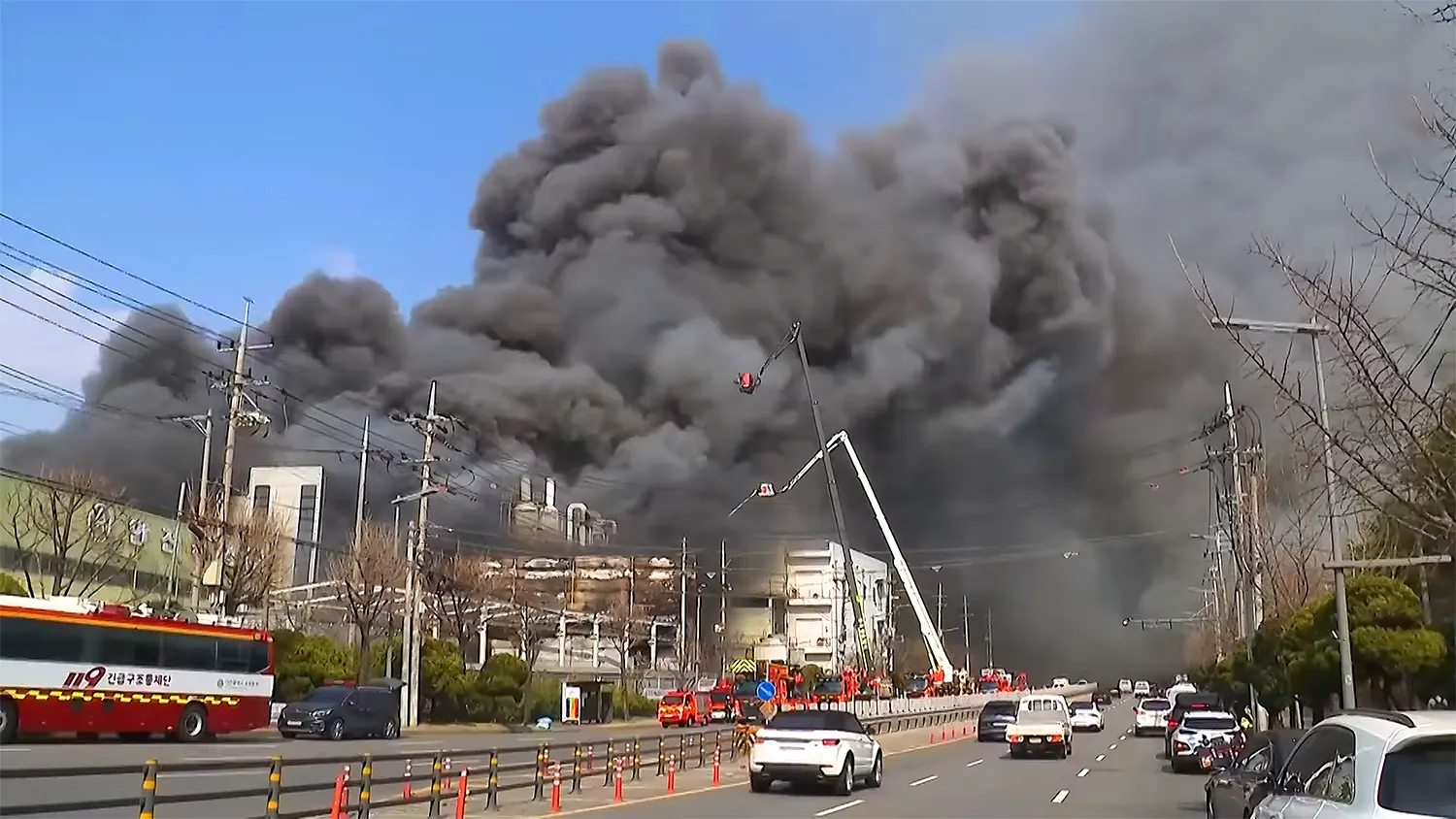
At 1:17 PM on a Friday, the factory did not catch fire, it detonated.
Workers inside the east wing of Anjeon Industrial would later describe it not as a blaze, but as a rupture. A pressure wave. A sound that arrived before comprehension. One moment, the steady rhythm of machining engine valves for Hyundai and Kia the next, a “massive explosion” that seemed to lift the building from within.
By the time anyone understood what had happened, the fire was already moving faster than thought.
A Building Designed to Burn Fast
The east wing stood three stories high, a steel-framed, prefabricated structure efficient, economical, and, under the wrong conditions, unforgiving. Fire officials would later describe the spread as “explosive,” a term that blurred the line between cause and consequence.
Flames did not crawl along surfaces, they leapt. They threaded through hollow spaces, raced up stairwells, and consumed oxygen in violent gulps. The kind of fire that doesn’t allow for decisions, only reactions.
On the first floor, where the explosion is believed to have ignited, flammable industrial materials used in valve production became accelerants. Above, workers began to move not toward exits, but away from heat, away from smoke, away from something they could not yet see.
Some ran upward.
The Floors Without Water
In theory, fire has a counterweight: time. Minutes to detect, to suppress, to evacuate.
In the east wing, those minutes were never available.
A later investigation would confirm a critical absence: no sprinkler systems on the first and second floors. The facility’s classification handling hazardous materials placed it in a regulatory category that, paradoxically, excluded traditional water-based suppression systems.
There was no automatic intervention. No ceiling mounted release of water to slow the burn. No barrier between ignition and catastrophe.
What remained was human instinct, and instinct, in a fire, is often tragically misdirected.
The Place Meant for Rest
They found many of them there.
By Saturday afternoon, as rescue crews tore through warped steel and collapsed concrete, the third floor employee welfare center a multipurpose space that included a gym and a small library had become a focal point. Not because it was safe, but because it felt safe in the moment. A place removed from machinery, from chemicals, from the origin of the blast.
A place above the fire.
It was a fatal miscalculation.
Smoke rises. Heat follows. In enclosed structures, upper floors can become traps, filling with toxic gases long before flames arrive. The workers who fled upward likely believed they were buying time.
Instead, they entered a space where time had already run out.
By March 21, the confirmed death toll reached 11, with multiple victims recovered from that welfare center. Others were discovered in second floor break rooms, areas that had offered familiarity but no protection.
The Metal That Stopped the Water
Outside, firefighters arrived to a problem that defied instinct.
Water, the most basic tool against fire was suddenly unusable.
Inside the building sat approximately 200 kilograms of metallic sodium, a substance that reacts violently upon contact with water. Not just ineffective, dangerous. The wrong application could trigger further explosions, intensify the fire, or injure responders.
The presence of sodium transformed the response into something slower, more cautious, and more technologically mediated.
Firefighters deployed unmanned firefighting robots. They used dry chemical agents instead of water. They waited because entering too soon could mean adding casualties rather than saving lives.
Those delays were measured not just in minutes, but in human outcomes.
By the time crews could safely penetrate deeper into the structure, many of those trapped inside had already succumbed.
Voices From Inside the Blast
Survivors speak in fragments.
A bang. A wall shaking. Lights gone or flickering. Someone shouting to run. The smell sharp, chemical, immediate. The heat arriving like a second presence in the room.
One worker described it as if “the air itself caught fire.”
Another remembered turning toward an exit that was already obscured, the path erased by smoke thick enough to disorient, to blind, to choke.
There is a moment in every disaster when escape narrows to a single decision point. In Daejeon, that moment came too quickly, and for many, in the wrong direction.
A Search Through Warped Steel
By Saturday, the factory was no longer a building but a collapsed geometry of metal and ash.
Rescue teams moved methodically through the remains, using heavy machinery and trained dogs to locate the missing. The work was slow, deliberate, and punctuated by discovery.
Another body, recovered from a restroom in the east wing, pushed the count higher. Eleven dead. Fifty nine injured. Twenty five in serious condition. Three still missing.
Each number represented not just a loss, but a delay, a person who had been unreachable when it mattered most.
The structure itself resisted the search. Steel beams, bent by heat, created unstable voids. Floors had partially collapsed into one another. Every movement risked further collapse.
Even in silence, the building remained dangerous.
The Scale of the Response
The disaster quickly drew national attention.
President Lee Jae Myung ordered the “full mobilization” of resources, elevating the site to a national priority. A 131 member police and forensic team began the work of reconstructing the event what ignited, what failed, what could have been prevented.
For the families, however, the investigation is secondary to identification.
In many cases, traditional recognition is impossible. Authorities are relying on DNA and fingerprint analysis, assigning dedicated officials to each family, an administrative gesture that underscores the scale of the loss.
Waiting becomes its own form of trauma.
The Architecture of Failure
Industrial disasters rarely hinge on a single cause. They are systems failures, layers of vulnerability aligning in the worst possible way.
In Daejeon, those layers are becoming visible:
A probable ignition source among flammable materials.
A structure that enabled rapid fire spread.
The absence of sprinklers where they might have mattered most.
The presence of a chemical that neutralized the most basic firefighting tool.
Each factor alone is manageable. Together, they form a chain that is almost impossible to break once set in motion.
What the Fire Left Behind
By the end of Saturday, the fire itself was no longer the central force in Daejeon. It had already done its work.
What remained was a site of extraction of bodies, of evidence, of meaning.
The search continues for the three workers still missing, their absence extending the timeline of the disaster beyond the moment of explosion. Each hour without resolution deepens the sense that the event is not over, only unfolding more slowly.
Factories like Anjeon Industrial are designed for precision, repetition, control. On Friday afternoon, all of that gave way to something uncontrollable.
A reaction chain. A building that burned too fast. A system that failed in exactly the wrong ways.
And at its center, a single, irreversible moment: 1:17 PM, when the ordinary structure of a workday collapsed into catastrophe.