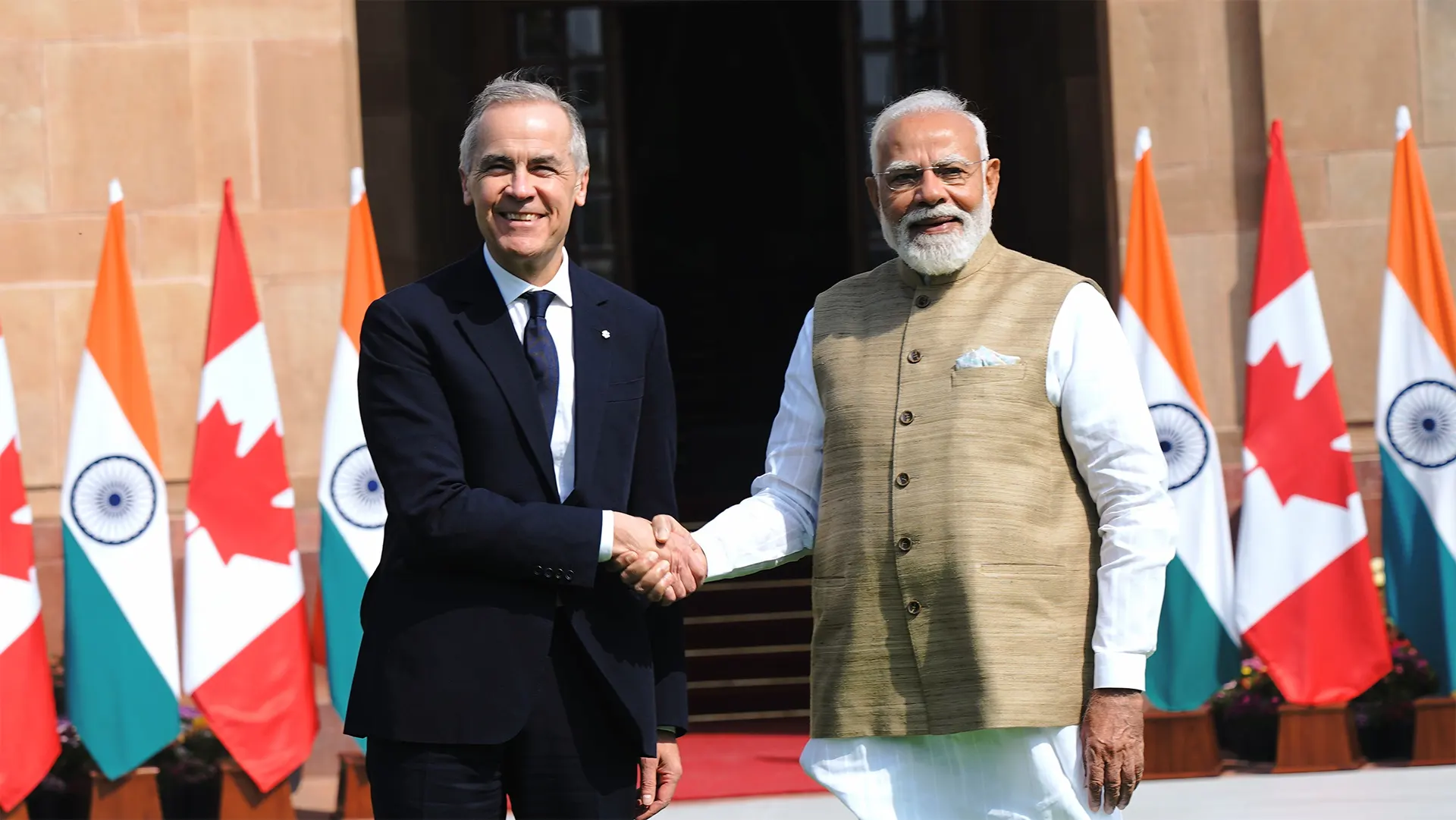
The 4 day visit of Mark Carney to India from February 27 to March 2, 2026, marks one of the most consequential diplomatic shifts of the year. More than a routine state visit, it represents a structural reset of
India–Canada relations moving beyond the tensions of 2023–2024
and toward a pragmatic, economics first partnership.
At its core lies a landmark nuclear agreement. But the visit also delivered a bold trade target, a critical minerals alliance, a formalized defense dialogue, and a deep expansion of education and innovation ties.
The Uranium Deal: The Linchpin of the Reset
The centerpiece agreement was signed between India’s Department of Atomic Energy and Cameco, one of the world’s largest uranium suppliers.
Scope and Valuation
- Nearly 22 million pounds of uranium ore concentrate (U₃O₈)
- Nine-year contract (2027–2035)
- Valued at approximately $2.6 billion USD (CAD 3.5 billion) at current market rates
Some international reports have cited figures closer to $1.9 billion USD, reflecting market price assumptions at different points in time. The official Canadian valuation stands at CAD 3.5 billion, underscoring the scale of the commitment.
This agreement is nearly ten times larger than the 2015 pact and is central to India’s plan to expand nuclear power capacity to 100 gigawatts by 2047. With 24 reactors currently operational and dozens more planned, securing reliable uranium supply is essential.
This is not merely a fuel contract, it is a long term strategic energy guarantee.
The “Triple-M” Moment
In New Delhi, analysts have dubbed the signing the “Modi–Moe–Mark” pact, highlighting the presence of Scott Moe alongside Prime Minister Narendra Modi and Carney.
Saskatchewan is the heart of Canada’s uranium industry, and Moe’s attendance reinforced a “Team Canada” approach aligning federal, provincial, and corporate interests behind the deal.
Beyond Fuel: Advanced Nuclear Collaboration
The partnership goes further than raw material supply.
Both countries committed to:
- Co developing Small Modular Reactors (SMRs)
- Advancing next generation reactor safety systems
- Collaborating on thorium fuel cycles
- Leveraging Canada’s CANDU reactor expertise
SMRs typically between 30 and 300 MWe offer flexible, factory built nuclear solutions suitable for remote areas and industrial clusters.
For India, they align with domestic manufacturing goals.
For Canada, they reinforce technological leadership.
This signals a shift from transactional trade to high technology co development.
The $50 Billion Trade Target by 2030
Energy cooperation anchors the reset, but trade expansion defines its ambition.
Modi and Carney set a joint objective to grow bilateral trade to $50 billion by 2030, up from current estimates ranging between $13 billion and $30 billion, depending on services inclusion.
CEPA Back on Track
Both sides finalized the Terms of Reference for a Comprehensive Economic Partnership Agreement (CEPA) and directed negotiators to conclude talks by the end of 2026.
A successful CEPA would:
- Lower tariffs
- Expand digital and services trade
- Improve regulatory predictability
- Strengthen investment protections
Canadian pension funds have already invested approximately $100 billion in India, a figure repeatedly cited during Carney’s meetings in Mumbai. That capital depth provides a strong foundation for expanded trade flows.
Critical Minerals: Securing the Green Transition
A Memorandum of Understanding on Critical Minerals Value Chains positions both countries to reduce reliance on China dominated supply chains.
Strategic Focus
The partnership targets:
- Lithium
- Cobalt
- Nickel
- Graphite
- Rare Earth Elements
- Helium
A technical exchange between the Saskatchewan Research Council and India’s Nonferrous Materials Technology Development Centre will focus on downstream processing and beneficiation.
Canada home to 40% of the world’s listed mining companies will facilitate Indian investment in major projects in Ontario and Quebec.
Together, the two countries are positioning themselves as architects of secure EV and battery supply chains.
Defense & Security: Institutionalizing Cooperation
The launch of the India–Canada Defence Dialogue marks a structural change in bilateral security ties.
Unlike past ad hoc engagements, this dialogue will be:
- An annual event
- Chaired at the Deputy Minister/Secretary level
- Designed to ensure continuity and policy momentum
Key areas of cooperation include:
- Maritime Domain Awareness in the Indo Pacific
- Intelligence sharing on vessel tracking
- Bilateral naval activities
- Interoperability between armed forces
- Counter terrorism coordination
- Disruption of fentanyl precursor flows and transnational criminal networks
Institutionalization ensures this cooperation does not stall after headline announcements fade.
🎓 Education & Innovation: Rebuilding the Human Bridge
Education has emerged as a central pillar of the reset.
Expanded partnerships include major initiatives from:
- University of Toronto
- McGill University
- Dalhousie University
Key highlights:
- $100 million in fully funded scholarships from the University of Toronto
- 300 new funded research positions under MITACS Globalink
- AI focused Centres of Excellence in India
- Dalhousie’s Innovation Campus partnership with IIT Tirupati
- AI for healthcare collaboration with the Indian Institute of Science
These initiatives reposition education as a strategic, innovation driven bridge between the two countries.
Pulse Protein: Moving Up the Value Chain
Agriculture remains foundational to the relationship.
India announced the creation of the India–Canada Pulse Protein Centre of Excellence, reinforcing Canada’s status as India’s largest supplier of lentils and pulses.
Crucially, the focus is on value added processing transforming
raw pulses into protein based food products within India rather than merely exporting bulk lentils.
This shift from commodity trade to processed food innovation reflects the broader economic evolution of the partnership.
The Itinerary: Business Heavy, Results Focused
Mumbai (Feb 27–28)
Carney met CEOs, pension fund leaders, educators, and innovation hubs. Discussions centered on capital flows, AI partnerships, and long term institutional investment.
New Delhi (March 1–2)
At Hyderabad House, delegation level talks produced:
- The uranium agreement
- The $50 billion trade target
- CEPA negotiation framework
- Defense dialogue launch
The visit concluded with the India–Canada CEOs’ Forum before Carney departed for Australia.
The Larger Strategy: A Middle Power Web
India was the opening act of a broader Indo Pacific tour.
From New Delhi, Carney traveled to Sydney for meetings with Prime Minister Anthony Albanese, focusing on defense technology and critical minerals coordination. The tour concludes in Tokyo with Prime Minister Sanae Takaichi, where energy security, manufacturing, and food resilience will dominate discussions.
The strategy is clear: build a dense web of partnerships among stable middle powers.
Why This Reset Matters
This was the first Canadian prime ministerial visit to India since 2018
and it effectively closes the chapter on the diplomatic freeze triggered by the 2023 Nijjar controversy.
Instead of revisiting past disputes, both governments chose to prioritize:
- Energy security
- Trade expansion
- Mineral supply chain resilience
- Indo Pacific security
- Education and innovation
The India–Canada Reset is not symbolic, it is institutional, strategic, and economically grounded.
For global markets and policymakers alike, it signals the emergence of a next level partnership, one built on long term alignment rather than
short term diplomacy.