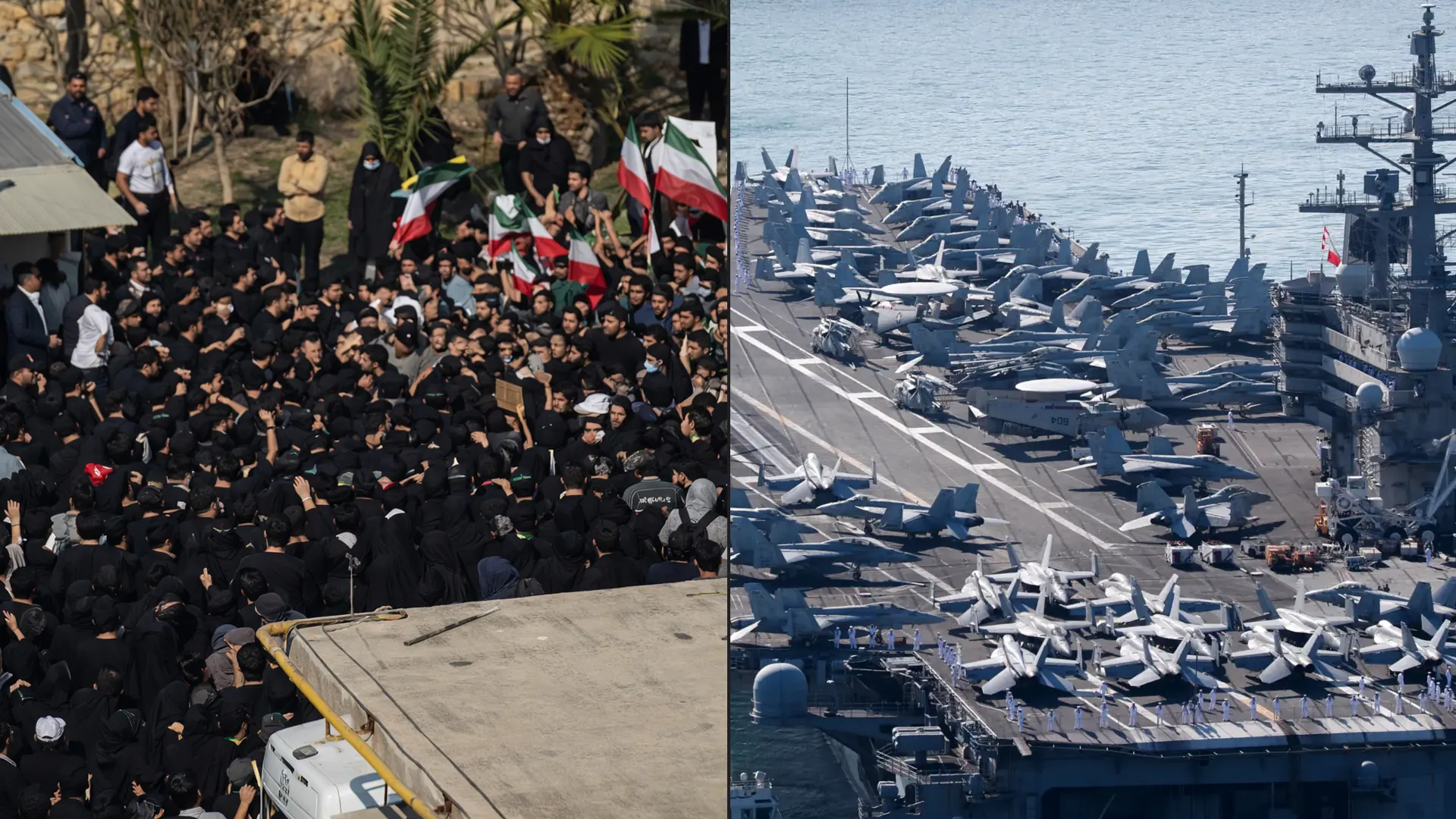
The aircraft carriers arrived quietly.
By the third week of February 2026, two U.S. carrier strike groups were operating within range of Iran. Long range bombers rotated through regional bases. Missile defense systems shifted into forward positions. Officially, it was a deterrent posture. Unofficially, it looked like preparation.
At the same time, diplomats from Tehran and Washington prepared for another round of Geneva negotiations. The contradiction defines the current Iran–U.S. crisis: both sides are talking and both are preparing for the possibility that talks fail.
And now there is an added layer of volatility. Leaks from the West Wing suggest President Donald Trump has been “mulling” a limited strike as early as Monday or Tuesday, a calibrated show of force intended, in the administration’s view, to “set the stage” for Thursday’s negotiations. Whether that reflects genuine intent or negotiating theater, it reinforces what one regional diplomat called “a very tight fuse.”
The stakes are not abstract. They run through global oil markets, through Iran’s streets filled with protesters, and through the future political stability of the Islamic Republic itself.
Iran–U.S. Crisis in Historical Context
The confrontation did not begin this month.
For more than two decades, the core dispute has centered on Iran’s nuclear program, regional influence, and U.S.-imposed sanctions.
The 2015 nuclear agreement temporarily froze enrichment levels in exchange for sanctions relief. Its collapse reignited mistrust. Since then, both sides have tested each other’s thresholds.
What makes 2026 different is convergence.
Iran faces sustained Iran protests at home. Washington has escalated its U.S. military buildup to levels not seen in years. And energy markets remain acutely sensitive to disruptions in the Strait of Hormuz, the maritime corridor through which roughly 20 percent of global oil passes.
This is no longer just a nuclear dispute. It is a multi layered power contest unfolding simultaneously on diplomatic, military, and domestic fronts.
Key Players and Their Calculus
United States
Washington frames its posture as deterrence and enforcement. Officials argue that military positioning strengthens diplomatic leverage. The rumored limited strike option, if executed would likely target specific facilities rather than trigger full scale war.
The administration’s logic reflects a familiar doctrine: coercive diplomacy backed by credible force.
But there is risk in theatrical escalation. Even a limited strike could provoke asymmetric retaliation attacks on regional bases, cyber operations, or proxy actions widening the crisis beyond its intended bounds.
Iran
Tehran’s public line remains firm: its nuclear program is peaceful, its sovereignty non negotiable.
But internally, the regime looks brittle. University campuses have become centers of dissent. Protesters have openly challenged the leadership, chanting slogans once unthinkable in public. The unrest reflects inflation, youth unemployment, and political repression.
Today, government spokeswoman Fatemeh Mohajerani attempted a calibrated response. She acknowledged the “wounds in the hearts” of students but warned that burning the national flag is a “red line” that will be met with force.
That phrasing matters. It signals limited rhetorical accommodation paired with a readiness for repression. In other words: sympathy without concession.
Complicating matters further is the succession question. The Supreme Leader is aging, and elite jockeying among loyalists including figures associated with his family has intensified. A fragile transition looms.
That reality creates what analysts describe as “defensive overreaction risk”: regimes under internal strain often respond more aggressively to external pressure.
Regional and Global Actors
Gulf states fear instability above all. They depend on open shipping lanes and steady oil exports. Europe, still sensitive to energy shocks after the Ukraine war, urges restraint. China and Russia emphasize diplomatic channels, wary of another Middle Eastern conflict that could disrupt trade corridors.
No major power wants open war. But deterrence systems can misfire.
The Strait of Hormuz: A Pressure Valve for the World Economy
The Strait of Hormuz is only 21 miles wide at its narrowest navigable point.
It is also one of the most economically consequential waterways on earth.
Iran has periodically threatened to disrupt traffic there in response to sanctions or military pressure. Even without physical closure, insurance premiums spike when tensions rise. Oil futures react instantly.
This illustrates one of the crisis’s core truths: perception can move markets faster than missiles.
A rumor of confrontation can add dollars to a barrel of crude overnight. That translates into higher gasoline prices in the United States, increased transport costs in India, and inflationary pressure across Europe.
Geopolitics rarely stays confined to diplomats.
Diplomacy Under the Shadow of Force
The Geneva negotiations now unfold under extraordinary pressure.
Tehran is reportedly drafting a proposal that would cap enrichment in exchange for phased sanctions relief. Washington insists on stricter verification and rollback measures.
Yet the rumored “Monday/Tuesday strike window” hangs over the talks.
If the United States strikes first, even in limited fashion, Tehran may walk away entirely. Conversely, if Washington refrains, critics may argue it squandered leverage.
This creates what might be called “negotiation by brinkmanship.” Each side tests how close it can approach confrontation without crossing into it.
History offers mixed lessons. Sometimes brinkmanship forces compromise. Sometimes it produces miscalculation.
The Stakes for Ordinary People
For Iranians, sanctions and instability have already reshaped daily life. Currency volatility erodes savings. Imported goods become luxuries. Young graduates see limited opportunity at home.
For Americans, escalation could mean higher fuel costs and deeper entanglement in Middle Eastern security commitments.
For the wider world:
- Energy prices affect food production and transportation.
- Shipping disruptions alter global supply chains.
- Refugee flows could strain neighboring countries if unrest deepens.
In short, strategic rivalry becomes kitchen-table economics.
Three Possible Futures
1. Managed De escalation
Diplomats reach a narrow interim deal. Enrichment pauses. Sanctions relief begins gradually. Military assets remain but step back from immediate strike posture.
This would reflect mutual exhaustion rather than trust but stability could return.
2. Prolonged Standoff
No deal, no strike. Forces remain deployed. Oil markets stay volatile. Protests simmer inside Iran. The regime tightens control while avoiding direct confrontation.
This may be the most plausible outcome: a frozen crisis punctuated by periodic scares.
3. Controlled Escalation That Spirals
A limited strike triggers retaliation. Proxy groups act. Shipping incidents multiply in the Strait of Hormuz. Energy markets surge.
Neither side seeks full scale war. Yet escalation develops momentum of its own.
That is the danger of compressed decision timelines under domestic pressure.
Conclusion: The Uncertain Path of Iran–U.S. Relations
The current Iran–U.S. confrontation is not merely a replay of past nuclear standoffs. It is a convergence of external deterrence, internal unrest, economic coercion, and leadership uncertainty.
At its core lies a sobering dynamic: a regime under domestic strain is negotiating under the shadow of force, while a superpower tests how much pressure produces compliance without explosion.
The coming days whether a strike materializes, whether talks advance
will shape more than bilateral relations. They will influence global energy stability, regional security architecture, and the political trajectory of Iran itself.
Brinkmanship can produce breakthroughs.
It can also produce accidents.
In 2026, the fuse between Tehran and Washington is short. The question is whether both sides step back or gamble that the other will blink first.