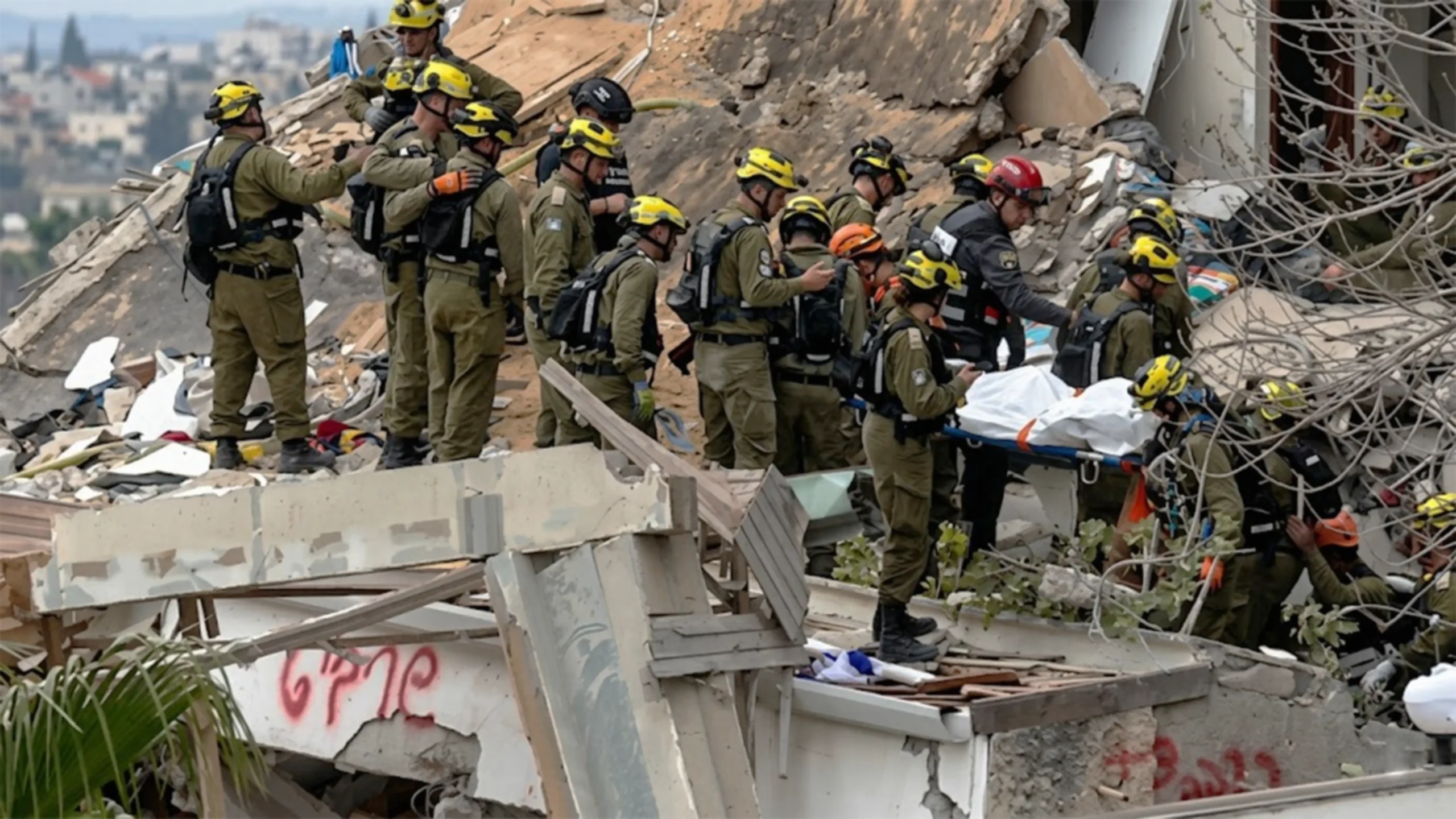
A residential building in Haifa was destroyed by an Iranian ballistic missile late Sunday, killing four civilians. On Monday, April 6, 2026, Israeli rescue teams ended a 24 hour search operation with no survivors found among the missing.
The outcome underscores the human cost of a rapidly escalating conflict. What began as another exchange of long range strikes has now resulted in civilian deaths inside a major Israeli city, raising urgent questions about protection, preparedness, and the limits of missile defense.
But the tragedy in Haifa is not an isolated incident. It is part of a broader confrontation that is intensifying by the day, with both regional and global consequences.
A family lost beneath the rubble after a direct hit
Rescue teams described a scene of near total destruction. The missile strike caused the multi-story building to collapse inward, floor by floor, trapping residents deep inside.
The victims were identified as an elderly couple in their 80s, their son in his 40s, and his 35 year old partner. All four were found in an interior room that was not a fortified safe space, known in Israel as a “Mamad.”
Earlier in the operation, rescuers pulled an 82 year old man from the debris with serious injuries. He underwent emergency surgery and remains in stable condition. Others nearby suffered lighter injuries, including a 10 month old baby hit by shrapnel.
But the scale of destruction made survival unlikely for those closest to the impact.
And that raises a critical question: how did the missile evade interception in one of the world’s most advanced air defense environments?
When missile defense fails under unpredictable conditions
Initial findings from the Israeli Air Force point to a rare but critical failure scenario.
The incoming ballistic missile broke apart mid air during its final descent, altering its trajectory in real time.
Israel’s defense systems such as Arrow and David’s Sling are designed to track and intercept a single, predictable object. In this case, the fragmentation created multiple unpredictable paths, confusing tracking systems calibrated for a unified target.
The result was devastating. While debris scattered across more than 20 locations in northern and central Israel, the missile’s heaviest component, the warhead continued on course, striking the Haifa building directly.
Investigators noted another crucial detail: the warhead did not fully detonate on impact, yet still caused catastrophic structural failure. The building effectively “pancaked,” leaving little chance for those inside.
What makes this even more concerning is the implication that even advanced systems can be bypassed under certain conditions especially in large scale barrages involving complex trajectories.
Rescue teams faced danger even after the strike
The operation itself was described as one of the most complex in the current conflict, lasting more than 24 hours under hazardous conditions.
One of the biggest challenges was the presence of unexploded missile components within the wreckage. Bomb disposal experts had to work alongside rescue crews to prevent a secondary explosion while searching for survivors.
This slowed progress significantly. Teams were forced to proceed cautiously, often pausing operations to neutralize threats hidden beneath the debris.
Despite these risks, the mission continued through the night. But by Monday morning, officials confirmed what many feared: all four missing individuals had died.
That outcome has intensified scrutiny not only of the strike itself, but also of the broader escalation now unfolding across the region.
A widening conflict with global stakes
In Washington, President Donald Trump has issued a stark warning. Iran has until April 7 to reopen the Strait of Hormuz, a critical global shipping route. If it does not, the United States has threatened a campaign targeting “power plants and bridges” inside Iran.
At the same time, Israeli forces confirmed a precision strike in Tehran that killed Asghar Bagheri, a senior commander in the Quds Force’s special operations unit.
These developments signal a shift from indirect confrontation to direct, high level targeting, increasing the risk of broader regional war.
But the danger is not limited to military targets. It now extends to critical infrastructure
and potentially to nuclear facilities.
Fears grow over strikes near sensitive nuclear sites
The International Atomic Energy Agency (IAEA) has issued an urgent warning after a recent strike landed just 75 meters from Iran’s Bushehr nuclear power plant.
While the facility itself was not damaged, the agency described the situation as a “very real danger” of a radiological incident if strikes continue in such proximity.
This adds a new layer of risk to an already volatile situation. A miscalculation could trigger not only military escalation, but also an environmental and humanitarian crisis.
Meanwhile, in Israel, key infrastructure is also under threat. Reports indicate that Haifa’s oil refineries were targeted in the same wave of attacks, causing localized fires and tightening security around the port.
All of this points to a conflict expanding in both scope and consequence far beyond isolated military exchanges.
A city mourns while bracing for what comes next
In Haifa, the immediate focus remains on mourning and recovery. Local officials, including Mayor Yona Yahav, have urged residents to strictly follow Home Front Command guidelines, emphasizing the importance of staying near fortified shelters.
Sirens continue to sound across northern Israel. Authorities warn that further strikes could come at any time, particularly following the killing of senior Iranian figures.
For residents, the message is clear: vigilance is now a daily necessity.
But beyond the immediate fear lies a deeper reality. The strike on a single residential building has come to symbolize a broader shift, one in which civilian areas are
increasingly exposed, and the line between battlefield and home front continues to blur.
As the conflict moves into a more dangerous phase, the events in Haifa offer a stark reminder of what is at stake not just in strategic terms, but in human lives.