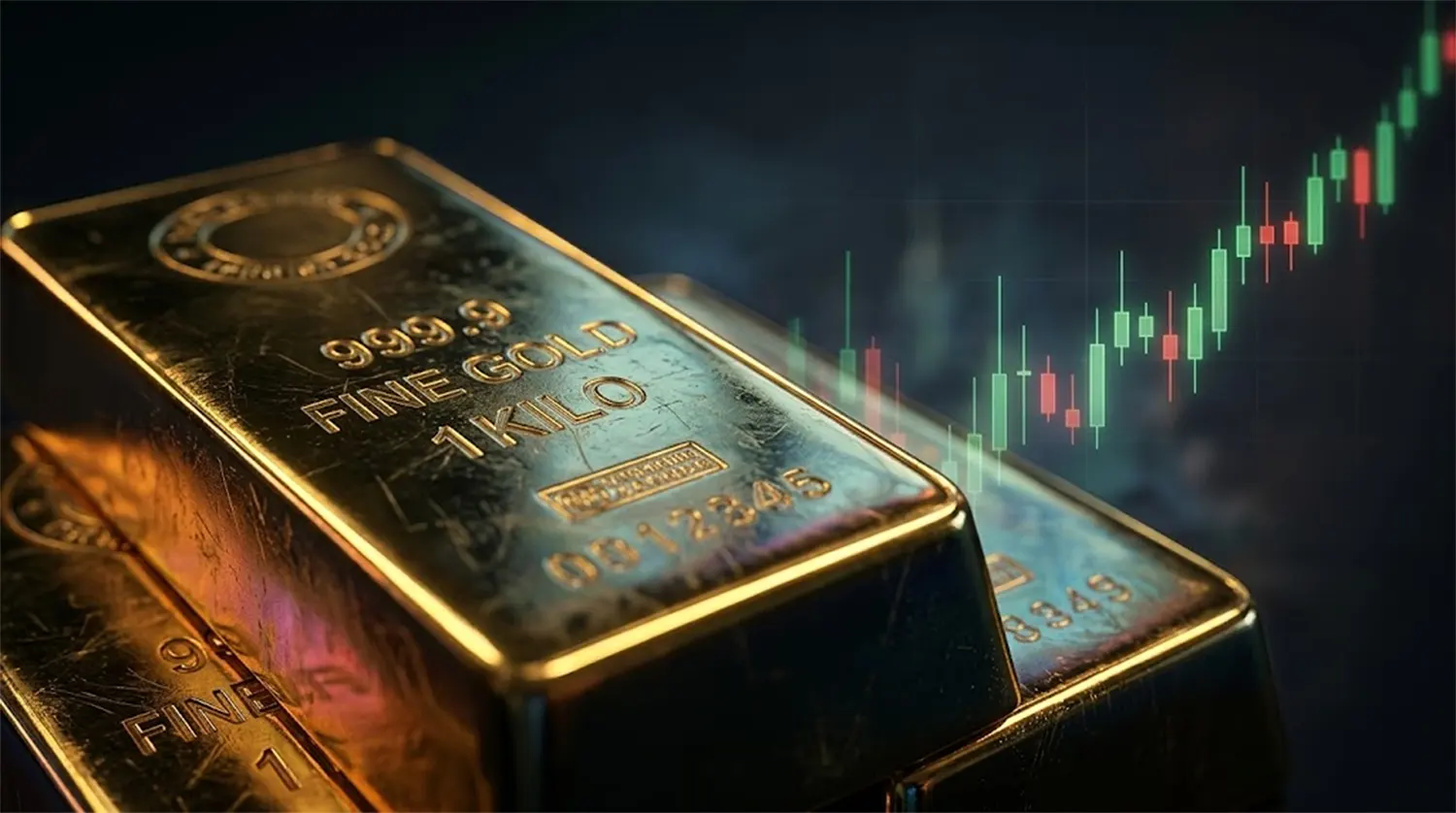
Gold prices are hovering near record levels on April 6, 2026, as investors brace for a critical geopolitical deadline. Markets are locked in a high stakes “wait and see” mode, with gold emerging as the clearest signal of global fear.
At the center of this tension is a simple reality: what happens in the next 24 hours could determine whether gold surges past $5,000 or drops sharply.
A Market Frozen in Time Ahead of a Binary Outcome
Right now, gold is trading in a tight range, but that calm is misleading. Analysts describe the market as a “coiled spring,” ready to snap in either direction depending on the outcome of the April 7 ultimatum.
On one hand, if tensions escalate and military strikes begin, gold is expected to rally aggressively. A break above the $4,750 resistance level could trigger a rapid move toward $5,000, a price never seen before in history.
On the other hand, if a last minute diplomatic agreement such as the rumored
“Islamabad Accord” is reached, the reaction could be just as dramatic. Gold may fall toward the $4,400–$4,550 range as investors pull money out of safe haven assets.
This creates a rare situation where the market is not reacting to data but to a single, ticking clock.
Why $5,000 Is More Than Just a Number
While price targets often come and go, the $5,000 level carries unique psychological
and technical importance.
First, it represents a historic milestone. Gold has never traded at this level before, meaning a breakout could trigger massive algorithmic buying and momentum driven trades.
Second, key technical levels are already in focus. $4,747 is seen as major resistance, based on analyst consensus, while $4,600 has acted as strong support throughout recent volatility.
Because of this setup, any move above resistance is unlikely to be gradual. Short sellers may be forced to exit positions quickly, creating a sharp, vertical price spike.
But the short term drama is only part of the story.
The “Triple Five” Scenario That Could Shake Global Markets
If the situation escalates, analysts are not just watching gold. They are tracking what some call the “Triple Five” scenario, a synchronized surge across key markets.
In this case:
- Gold could hit $5,000 per ounce
- Oil could climb toward $150 per barrel
- The VIX volatility index could spike above 50
Together, these moves would signal extreme market panic and a full scale flight to safety.
Because of this, gold is no longer acting in isolation. Instead, it is part of a broader reaction across commodities, equities, and global risk sentiment.
However, the opposite scenario could unfold just as quickly.
A Relief Rally Could Pull Gold Back Down
If a ceasefire agreement is reached, markets are likely to shift into “risk on” mode. Investors would move money out of gold and into assets like stocks, crypto, and emerging markets.
This kind of capital rotation is common after geopolitical scares. Safe haven assets tend to fall as confidence returns, even if the underlying risks have not fully disappeared.
In this scenario, a drop toward $4,400 may seem sharp, but it would align with long term technical support. Many institutional investors are actually waiting for this pullback as a chance to buy gold at more attractive levels.
Because of this, even a short term decline may not change the bigger picture.
Why Analysts Still See Gold Above $5,000 Long Term
Beyond the immediate crisis, major financial institutions believe gold’s rise is part of a deeper structural shift in the global economy.
J.P. Morgan, for example, has raised its year end 2026 forecast to $5,055 per ounce, with some models suggesting prices could reach as high as $6,300.
This outlook is not driven by war alone. Instead, it reflects long term changes in how money, reserves, and risk are managed worldwide.
And those changes are already underway.
The Quiet Shift: Gold Replacing the Euro in Global Reserves
One of the most important developments happened in 2025. Gold officially overtook the euro to become the world’s second largest reserve asset, according to central bank data.
This shift was led by countries like China, India, and Turkey, which have been buying gold at record levels over 1,000 tonnes annually.
The reason is simple. Gold carries no counterparty risk and cannot be frozen or sanctioned, unlike foreign currency reserves.
Because of this, many countries now see gold as a safer long term store of value in an increasingly uncertain world.
But central banks are not the only players changing their approach.
A Regulatory Change That Reshaped Institutional Demand
In July 2025, a major regulatory update quietly transformed gold’s role in the financial system.
Under the Basel III “Endgame” reforms, physical gold was reclassified as a Tier 1, risk free asset, the same category as cash and top government bonds.
This change allows banks to count gold at 100% of its value when meeting liquidity requirements, making it far more attractive to hold.
As a result, institutional portfolios have begun increasing their gold exposure from around 2% to nearly 5%.
Importantly, this demand is focused on physical gold, not paper based products like ETFs, creating additional pressure on supply.
And this leads directly to another key factor supporting prices.
Inflation Isn’t Going Away And Gold Is the Hedge
Even if geopolitical tensions ease, the economic impact of recent events will remain.
Energy prices have already pushed costs higher across global supply chains, creating what analysts call “sticky inflation.” This means inflation is likely to stay elevated, even if conditions stabilize.
In the past, gold tended to rise when interest rates were low. But that relationship is changing. Gold is now reacting more to currency devaluation than to interest rate movements.
In other words, investors are not just hedging against inflation, they are hedging against the long term erosion of fiat currencies.
What Investors Should Watch in the Next 12 Hours
With so much at stake, the next few hours are critical.
First, attention will turn to Asian markets. If gold starts moving toward $4,720 before U.S. markets open, it may signal that traders expect escalation.
Second, any update from the White House could trigger immediate volatility. Even small changes in tone can move gold prices by $50 to $100 within minutes.
This level of sensitivity highlights just how fragile the current market environment has become.
A New Era for Gold Is Already Taking Shape
Whether gold spikes or dips in the short term, the bigger trend is clear. Gold is no longer just a commodity, it is becoming a core pillar of the global financial system.
The events of this week may determine the next price move. But the forces driving gold higher central bank demand, regulatory shifts, and persistent inflation are already firmly in place.
And as uncertainty continues to shape global markets, gold’s role as the ultimate “fear gauge” may be stronger than ever.