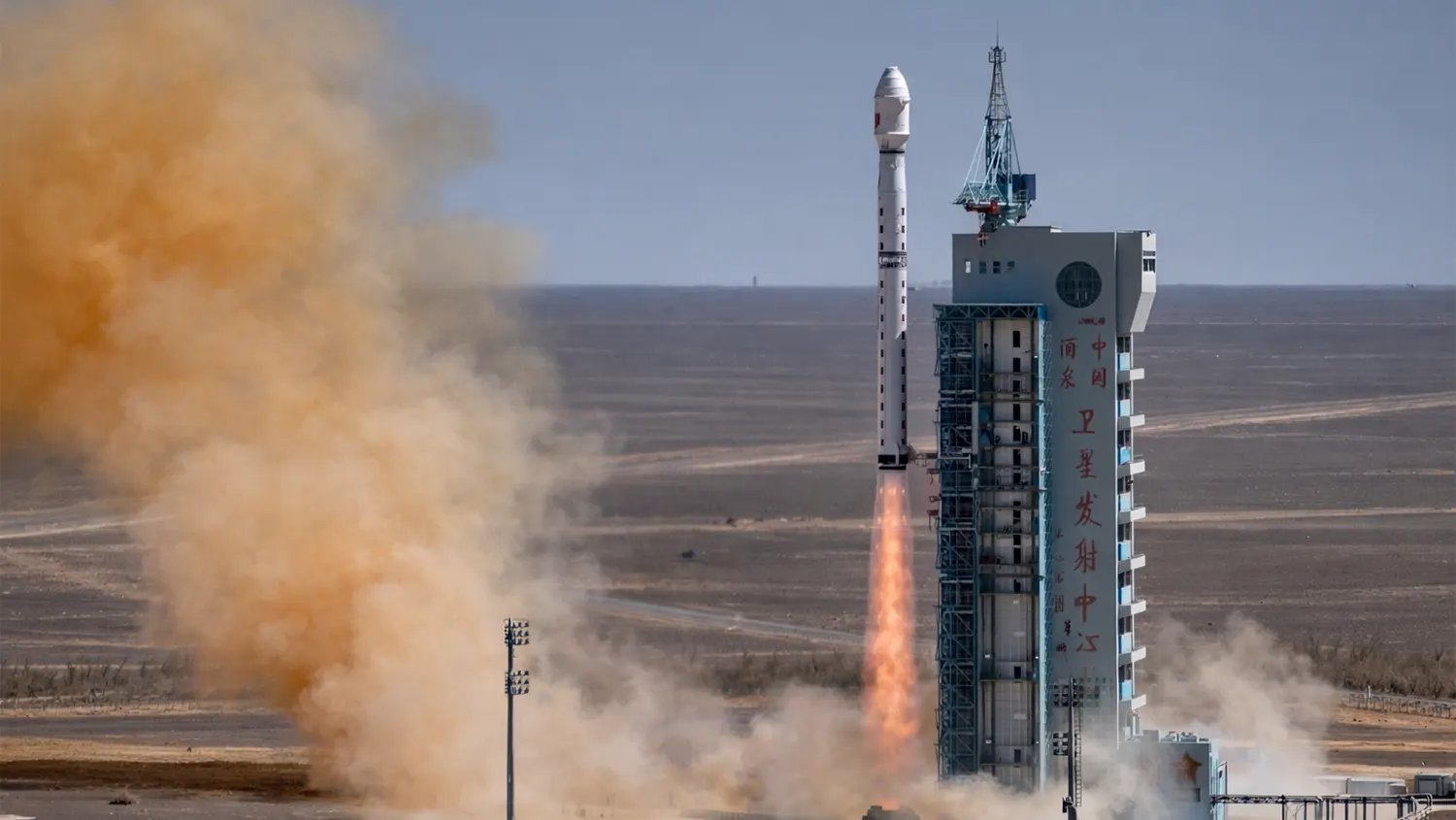
A rocket launch that could change how we track climate change
What if we could see pollution as it leaves Earth’s surface in real time?
That question is no longer theoretical. On Friday, April 17, 2026, China launched a new satellite designed to do exactly that track greenhouse gases like carbon dioxide and methane with unprecedented precision.
Launched aboard the Long March-4C rocket from the Jiuquan Satellite Launch Center, this mission marks a major leap in global climate monitoring.
And its impact could reach far beyond China’s borders.
A satellite designed to “watch” Earth breathe
At the heart of the mission is a new greenhouse gas monitoring satellite, built to measure emissions that drive global warming.
Its job sounds simple, but it is technically complex:
detect invisible gases in Earth’s atmosphere and map where they come from.
Unlike traditional monitoring tools, this satellite can track:
- Carbon dioxide (CO₂)
- Methane (CH₄)
These gases are responsible for most human driven warming but they are invisible to the naked eye.
So how does a machine in space “see” something invisible?
The answer lies in light.
How the satellite “reads” invisible gases in the atmosphere
The satellite uses a clever trick: it studies how sunlight changes as it passes through Earth’s air.
Here’s the idea in simple terms:
When sunlight travels through the atmosphere, greenhouse gases absorb specific colors of light.
That means some wavelengths disappear before the light reaches the sensor.
By measuring what light is missing, scientists can calculate exactly how much gas is present.
But this satellite goes a step further.
It also uses a laser system that sends its own light beam toward Earth.
That matters because it allows the satellite to:
- Work at night
- See through thin clouds
- Fill gaps older satellites could not measure
In short: it doesn’t just observe Earth, it actively interrogates it with light.
Why orbit matters: the “same time every day” advantage
To understand why this satellite is powerful, you need to understand where it flies.
It travels in a sun synchronous orbit, circling Earth at roughly 700 kilometers above the surface.
That sounds technical, but the idea is simple:
The satellite passes over the same location at the same local time every day.
Why does that matter?
Because lighting consistency is everything in climate science.
If a city is observed at the same time daily:
- Shadows stay similar
- Sunlight conditions remain stable
- Changes in gas levels become easier to detect
This consistency removes one of the biggest sources of error in Earth observation.
It is, in effect, a daily climate snapshot taken under identical conditions.
Not just looking down but also looking sideways
Most satellites only look straight down at Earth.
This one is different.
It can also look sideways along the edge of the atmosphere, a view scientists call “limb observation.”
That dual perspective allows it to:
- Map pollution sources on the ground
- Track how gases are layered vertically in the sky
This means scientists can now study not just where emissions are but how they move upward and spread globally.
It turns a flat map into a three dimensional view of Earth’s atmosphere.
A global system, not just a national tool
Although developed by China’s space program, the satellite is not limited to observing China.
Because it follows a polar orbit, it gradually scans the entire planet.
Over time, it builds a full global map every ~16 days, creating something like a repeating climate “time lapse.”
That means it can detect:
- Methane leaks from oil fields
- Emissions from coal power plants
- Forest fires and deforestation
- Carbon movement over oceans
In effect, it becomes a global emissions auditor in space.
Why this matters for the world
The importance of this mission extends far beyond engineering.
Greenhouse gases do not respect borders. Carbon dioxide released in one continent can circulate globally within days.
That creates a major problem for climate policy: trust.
Countries often debate:
- Who is reducing emissions
- Who is exceeding targets
- Who is underreporting pollution
A satellite that independently measures emissions could change that conversation.
It also provides data over areas where ground sensors don’t exist especially oceans, which absorb vast amounts of carbon dioxide but are difficult to monitor directly.
Part of a larger space strategy
This launch is part of a broader 2026 agenda by the China National Space Administration (CNSA), which includes:
- An asteroid exploration and sample return mission
- New crewed flights to the Tiangong space station
- Tests of reusable rocket technology
Together, these projects signal a long-term push toward advanced space based Earth observation and exploration.
A long mission with long term consequences
This satellite is expected to operate for 5 to 8 years, circling Earth about 14 times per day.
Over time, it will create something new:
a continuous, global record of how Earth’s atmosphere is changing.
That record could help answer some of the most important questions in climate science:
- Are emissions truly declining?
- Where are hidden sources of pollution?
- How fast is the planet actually changing?
The bigger picture: a new way of seeing Earth
For decades, climate data has been fragmented collected by scattered sensors, national reports, and limited satellite coverage.
This mission moves toward something different.
A single system watching the entire planet, continuously, in high detail.
And that shift could reshape not just climate science, but also how nations negotiate responsibility for global emissions.
Because when the data becomes clearer, the debate becomes harder to blur.
The bottom line
China’s new greenhouse gas satellite is more than a technological milestone, it is a step toward real time global climate transparency.
By tracking emissions from space with unprecedented precision, it introduces a powerful new tool for understanding and potentially verifying how the world is responding to climate change.
And in the long run, it may change not just what we know about the planet…
but how we hold ourselves accountable to it.