
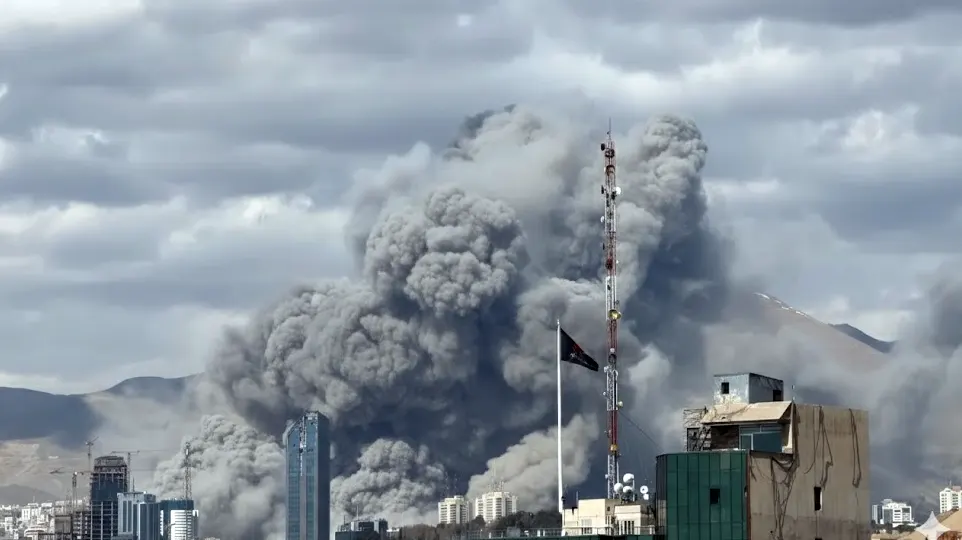
The joint U.S.–Israeli military campaign against Iran has entered its fifth day, and the conflict is rapidly expanding geographically, politically, and economically. What began as a coordinated strike on Iran’s leadership has evolved into a widening regional war with global consequences.
The Death of Ali Khamenei and the Struggle for Power in Tehran
Iranian state media has confirmed that Ali Khamenei was killed during the opening strikes on February 28. His death marks the most dramatic rupture in Iran’s political system in decades.
A 3 day state funeral begins tonight at 10:00 PM at Tehran’s Grand Mosalla. In the meantime, a transitional council is overseeing state affairs.
While Mohammad Mokhber has emerged publicly as a senior voice of continuity, multiple reports suggest that Ali Larijani is also playing a central role in shaping the interim power structure. Discussions around Mojtaba Khamenei as a potential successor continue, though no formal appointment has been announced.
Iran’s interim leadership has vowed to continue the war indefinitely, rejecting any possibility of negotiation.
Internally, unrest appears to be growing. Civil clashes between protesters and remaining Basij paramilitary forces have been reported in several provinces, as the regime attempts to project stability while absorbing significant military losses.
Massive Air Combat Over Tehran
The Israeli campaign dubbed Operation Roaring Lion intensified
overnight with a tenth wave of strikes on Tehran.
Targets reportedly included:
- The presidential bureau
- The Supreme National Security Council headquarters
- Multiple Basij paramilitary facilities
A Historic First in Modern Air Warfare
In a landmark moment, an Israeli F-35I “Adir” shot down an Iranian
YAK-130 over Tehran. This is believed to be the first confirmed instance of an F-35 downing a manned aircraft, and the first Israeli manned
air to air engagement in roughly four decades.
Since the start of the operation, the IDF reports dropping more than 600 bombs on Tehran alone.
The humanitarian toll continues to rise. The Iranian Red Crescent confirms at least 787 deaths nationwide, though unofficial estimates suggest the number could be far higher. UN officials expressed shock following reports of a strike on a primary school in Minab that killed dozens of schoolgirls.
Lebanon: The Conflict Spreads North
Lebanon is now fully engulfed in the conflict.
Israeli strikes have hit Hazmieh near Beirut’s presidential palace, residential neighborhoods in Baalbeck, and the southern suburb of Haret Hreik. Lebanon’s Ministry of Health reports:
- At least 60 deaths
- More than 150 injuries
- Over 29,000 displaced within 48 hours
The IDF has issued warnings to “representatives of the Iranian regime”
to leave Lebanon within 24 hours, signaling a possible expansion of operations.
The Expanding Naval Front
The United States has launched its largest regional naval mobilization since the 2003 Iraq War.
Two carrier strike groups are now central to operations:
- USS Abraham Lincoln, operating in the Arabian Sea.
- USS Gerald R. Ford, positioned in the Eastern Mediterranean and North Arabian Sea.
Arleigh Burke class destroyers are operating inside the Persian Gulf, conducting ballistic missile defense and maintaining strike readiness.
U.S. Central Command claims 17 Iranian vessels including one submarine have been destroyed since hostilities began.
Economic Shockwaves: Oil, Insurance, and the Strait of Hormuz
The strategic importance of the Strait of Hormuz has placed global energy markets on edge. Iran claims it has “complete control” of the waterway, while the United States disputes that assertion.
Brent crude has surged past $82 per barrel amid fears of supply disruption.
In a significant move to stabilize maritime traffic, Donald Trump ordered the U.S. International Development Finance Corporation to provide political risk insurance for oil tankers operating in the region.
The directive aims to offset the withdrawal of private insurers unwilling to cover vessels entering a declared war zone.
Trump has also authorized active naval escorts for commercial tankers
if traffic does not resume voluntarily.
The French Factor
The conflict’s global dimension expanded further today when Emmanuel Macron ordered France’s nuclear powered aircraft carrier,
Charles de Gaulle, to deploy to the Mediterranean in support of allied naval assets.
The move underscores that the confrontation is no longer a strictly bilateral or regional matter, it is drawing in major NATO powers.
U.S. Casualties and Political Crosscurrents
The Pentagon has confirmed 6 U.S. service members killed in a drone strike on a tactical operations center in Port Shuaiba, Kuwait. Eighteen others were seriously wounded.
The strike has sparked intense debate in Washington. While some lawmakers argue the operation is necessary to prevent a nuclear Iran, others question the long term strategy and defensive preparedness.
President Trump acknowledged the likelihood of further casualties, stating that “there will likely be more” before the war concludes.
Midterm Primaries Begin
Complicating the political landscape, midterm primary elections officially began today in Texas, North Carolina, and Arkansas. The timing creates a high stakes domestic backdrop for Trump’s wartime presidency, as voters head to the polls while U.S. forces are engaged in active combat overseas.
The war is now not only a military campaign but a defining political test.
Human Toll Across the Region
Confirmed fatalities so far:
- Iran: 787+
- Lebanon: 60+
- Israel: 12–13
- United States: 6
Israel’s deadliest single incident occurred in Beit Shemesh, where nine civilians were killed in a missile strike on a residential area.
The United Nations Human Rights Office reports that hostilities have now affected at least 12 countries through missile debris, drone strikes, or infrastructure damage.
A War Without Clear Limits
Five days in, the conflict has already reshaped the Middle East:
- Iran’s Supreme Leader is dead.
- Tehran remains under sustained bombardment.
- Lebanon has become an active battlefield.
- Global oil markets are volatile.
- Major powers, including France, are repositioning naval assets.
- The United States is navigating both military escalation and domestic political pressure.
What began as a targeted operation has become a rapidly expanding regional war with global economic consequences and no clearly defined endgame.