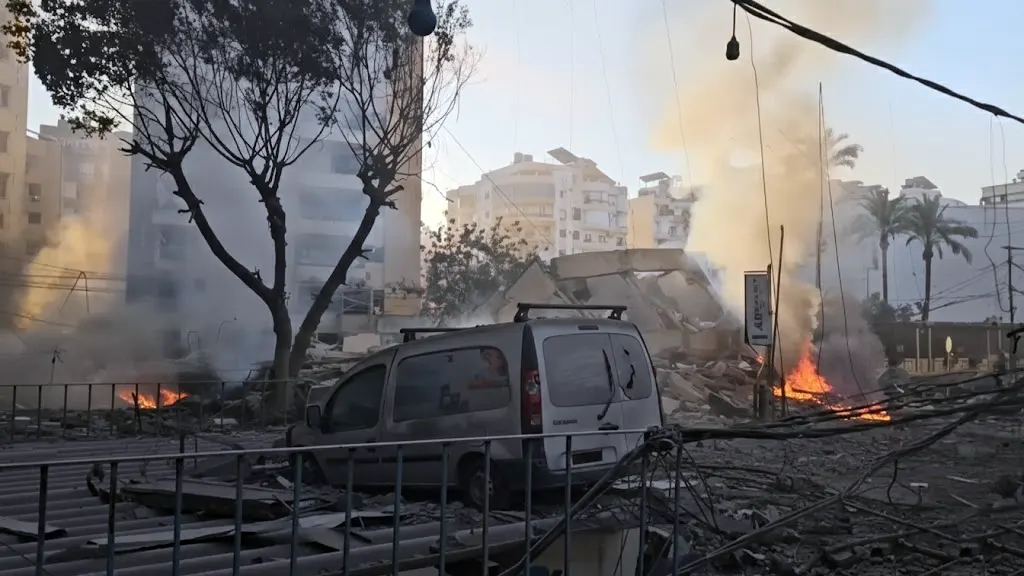
Southern Lebanon is once again at the center of a rapidly expanding conflict. What began as cross border exchanges between Israel and Hezbollah has escalated into a ground incursion, a mass displacement crisis, and an unprecedented political confrontation inside Lebanon itself.
As of March 4, 2026, the country faces the most serious security test since the 2006 war.
Israeli Ground Forces Enter Southern Lebanon
On March 3, the Israel Defense Forces (IDF) launched ground operations inside Lebanese territory. Israeli officials describe the move as a “forward defense operation” designed to establish an additional “security layer” along the border.
Troops from the 91st “Galilee” Division have reportedly advanced into border towns such as Kfarkela and Qouzah, pushing several hundred meters to a few kilometers beyond the Blue Line.
Israeli leadership insists the operation is limited and defensive.
The stated objective is to prevent Hezbollah rocket fire and cross border raids while Israel fights a broader conflict linked to Iran.
However, Analyst inside Lebanon and abroad see the move differently warning that a temporary “security layer” could become a long term
buffer zone.
30,000 Displaced in 24 Hours
The humanitarian impact has been immediate.
According to the United Nations High Commissioner for Refugees, more than 31,000 people were registered in shelters within the first 24 hours of escalation. That figure does not include thousands staying with relatives or stranded on highways.
Many families fled:
- Southern Lebanon
- The Bekaa Valley
- The southern suburbs of Beirut
Government run schools and parish centers have been converted into emergency shelters, but most reached capacity within hours.
In a grim reversal of history, over 11,000 people including Syrian refugees who had once fled to Lebanon for safety have crossed back into Syria since Monday to escape the bombardment.
The crisis is expanding faster than aid agencies can respond.
The Lebanese Army Pulls Back
The Lebanese Armed Forces (LAF) have repositioned away from at least seven forward sites along the border.
Defense officials characterize a direct confrontation with Israeli forces as “suicidal,” choosing instead to preserve the army as the final guarantor of internal order.
Rather than fighting Israel directly, the LAF has shifted to:
- Secondary defensive lines
- Civilian protection
- Managing displacement
- Coordinating with the United Nations Interim Force in Lebanon (UNIFIL)
This is a strategic recalculation. The army is prioritizing national stability over symbolic resistance.
A Political Earthquake: The “Total Ban” on Hezbollah
The most dramatic development may not be military but political.
Prime Minister Nawaf Salam has officially banned all unauthorized military and security activities by Hezbollah.
The decree reportedly orders the arrest of anyone carrying out “resistance” operations outside state command.
This is not just criticism. It is an attempt at legal disarmament
a declaration that decisions of war and peace belong solely to the Lebanese state.
If enforced, it would amount to a direct challenge to Hezbollah’s military autonomy.
But enforcement carries enormous risk. Forcing disarmament could spark internal armed confrontation, especially north of the Litani River.
Lebanon now faces a dangerous dilemma:
- If the government does nothing, it loses sovereignty.
- If it acts forcefully, it risks civil conflict.
The UNIFIL Deadline Changes Everything
Another critical factor shaping events is the scheduled end of UNIFIL’s mandate on December 31, 2026.
The international peacekeeping mission has monitored the border since 2006. Once it withdraws, there will be no neutral buffer between Israeli and Hezbollah positions.
Israel appears to be acting now to pre empt what it views as an inevitable security vacuum.
From the Israeli perspective, waiting could allow Hezbollah to entrench further. From Lebanon’s perspective, acting now risks transforming a temporary incursion into a permanent shift in territorial control.
The clock is influencing strategy on all sides.
A Multi Front Conflict
This escalation is not isolated. It is unfolding within a broader regional war involving Iran and its allies.
Hezbollah entered the conflict following Israeli strikes linked to the wider confrontation. Israel argues it cannot fight a major war while Hezbollah remains entrenched along its northern border.
The result: two interconnected theaters one long range and strategic,
the other immediate and territorial.
What Happens Next ?
The situation remains fluid.
Key variables include:
- Whether Israeli forces expand beyond current positions
- Whether Hezbollah escalates ground operations
- Whether the Lebanese government attempts to enforce its ban
- How quickly displacement numbers rise
- What diplomatic efforts emerge to restore a ceasefire
Lebanon now stands at a structural crossroads.
This could remain a limited military episode.
Or it could reshape Lebanon’s political order, border realities, and internal balance of power for years to come.