
Iraq has once again become the central pressure point in a widening regional war. As the Iran–US–Israel conflict intensifies following the February 28 strikes and the confirmed death of Ayatollah Ali Khamenei, Iraqi territory is now functioning both as a launch platform for militia attacks and as an active battlespace for U.S. counter force operations.
The Iraqi state is attempting containment. The militias are mobilizing for escalation. The street is demanding vengeance. And Washington has made clear that operational patience is narrowing.
Drone and Rocket Fire: U.S. Bases Under Siege
Pro Iranian armed factions operating under the banner of the
“Islamic Resistance in Iraq” have entered full mobilization mode.
Baghdad – Victoria Base
Two suicide drones targeted the U.S. Victoria Base near Baghdad International Airport. Iraqi air defenses intercepted one drone, but the second penetrated the perimeter before crashing inside the compound.
While the drone breached the base perimeter, CENTCOM confirms that the three U.S. service members killed in “Operation Epic Fury” were stationed in Kuwait, not Iraq. However, the threat level in Baghdad remains classified as “Extreme.”
The airport itself is effectively operating as a military installation, with access roads frequently blocked by militia checkpoints.
Erbil – Kurdish Region
The group Saraya Awliya al-Dam claimed responsibility for a major drone strike on Erbil International Airport, which hosts U.S. led coalition forces. Local accounts describe “shaking explosions” that temporarily grounded diplomatic operations.
The Kurdish Regional Government has heightened internal security, anticipating sustained targeting.
Al-Asad Airbase – Western Iraq
Al-Asad Airbase has been under near continuous rocket fire for 48 hours. Thousands of U.S. personnel remain in hardened shelters.
Military analysts now characterize Iraq not as a peripheral arena, but as the “western flank” of Iran’s strategic defense posture.
U.S. “Shaping” Strikes and the Western Front Doctrine
Prior to launching “Operation Epic Fury” inside Iran, U.S. forces conducted shaping strikes inside Iraq to degrade militia command structures.
Jurf al-Sakhar, a long established Kataib Hezbollah stronghold south of Baghdad was among the first sites targeted on February 28.
The Pentagon confirmed significant casualties among militia leadership.
This reflects a doctrinal shift: Iraq is now treated as an operational extension of the Iranian battlespace.
Airspace Closure and a Sovereignty Crisis
Iraq has extended its full airspace closure for at least another 48 hours.
In a sign of how congested and volatile the skies have become, Iraqi authorities reported intercepting Iranian missiles transiting Iraqi airspace toward Israel.
At the same time, the United States is confronting its own “fog of war” crisis. Kuwaiti air defenses mistakenly shot down three U.S. F-15E fighter jets overnight in what officials are describing as a catastrophic identification failure.
The incident underscores the dangers of operating in a saturated regional airspace filled with coalition aircraft, Iranian projectiles, and defensive interceptors.
This explains Washington’s increasing pressure on Baghdad,
the United States cannot afford further “accidental escalations” in an already crowded theater.
The Green Zone Under Siege
Baghdad is now the epicenter of internal unrest.
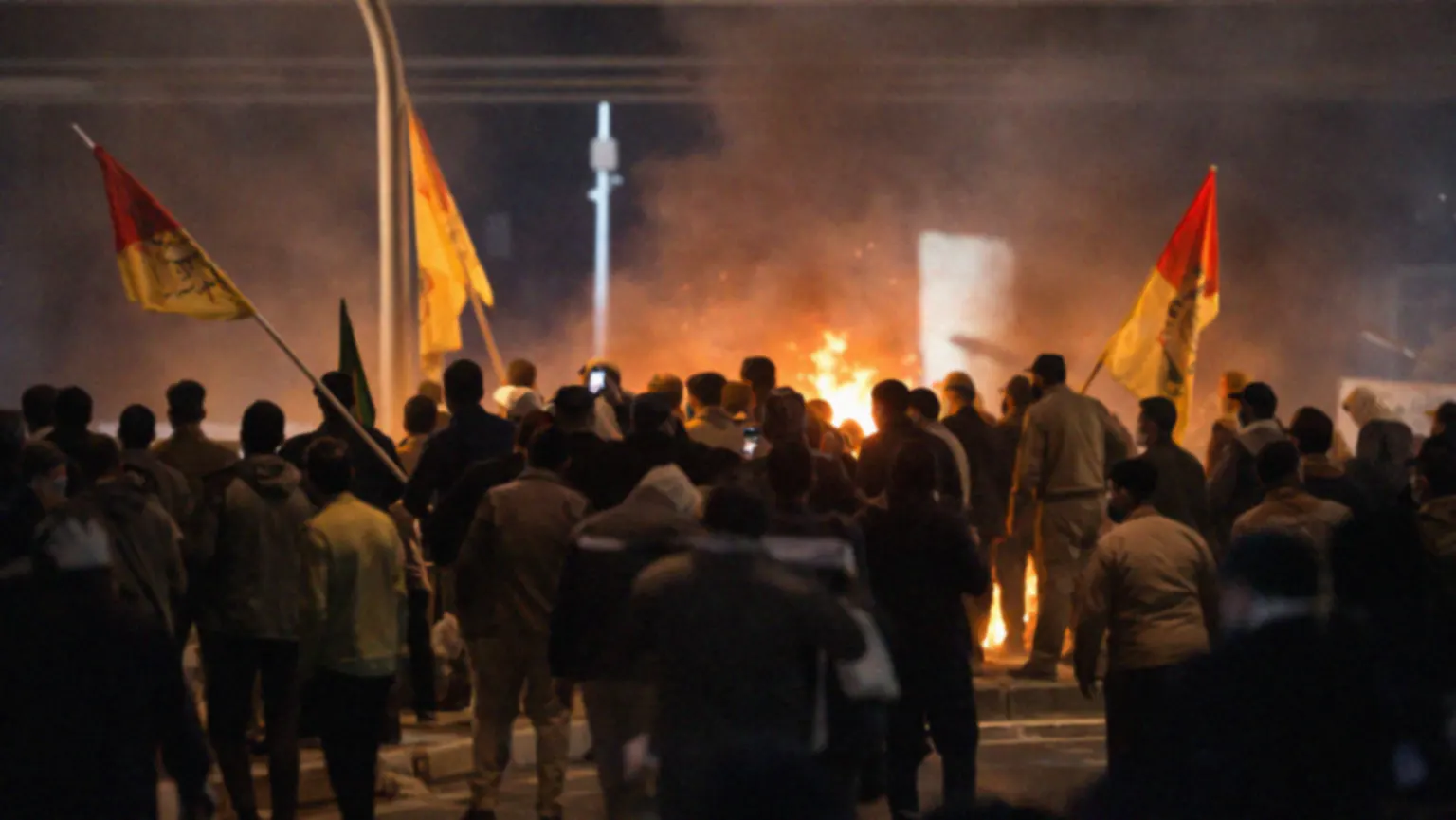
Hundreds of pro Iranian protesters attempted to breach the Green Zone perimeter for a second consecutive wave of demonstrations.
Initially, Iraqi riot police deployed tear gas and water cannons.
However, reports from March 2 confirm that security forces were forced to use live ammunition to push back advancing crowds attempting to overrun outer barriers.
Ambulances have been transporting injured demonstrators, with confirmed suffocation cases from heavy tear gas exposure and multiple gunshot injuries reported.
Militia flags including Kataib Hezbollah and Asa’ib Ahl al-Haq were prominently displayed. Calls for the immediate expulsion of U.S. led coalition forces dominated loudspeaker broadcasts.
The line between protest movement and armed militia mobilization is now indistinguishable.
Southern Flashpoints and Economic Pressure
In Basra, protesters gathered near the Rumaila and West Qurna oil facilities, demanding that Iraq halt exports to countries supporting
U.S.-Israeli operations.
Elite Iraqi units have been deployed to protect energy infrastructure, signaling the government’s fear of economic sabotage.
In Najaf and Karbala, large but more disciplined marches have focused on religious symbolism and calls for “victory over the invaders.”
Prime Minister Al-Sudani’s Most Dangerous Gamble
Prime Minister Mohammed Shia’ al-Sudani is walking a narrowing strategic tightrope.
Following an emergency session of the Ministerial Council for National Security, he issued a “Zero Tolerance” directive ordering Iraqi security forces to “confront and counter” any individual or entity launching attacks from Iraqi soil.
This marks his most aggressive move to date.
By ordering direct confrontation, Al-Sudani is effectively risking a shootout between the Iraqi Army and elements of the Popular Mobilization Forces (PMF), a scenario that could fracture Iraq’s internal security architecture in order to prevent U.S. bombing of Baghdad.
Simultaneously, he has:
- Condemned U.S.-Israeli strikes on Iran as “unjustified aggression.”
- Declared a 3 day national mourning period for Ayatollah Khamenei.
- Reinforced the Green Zone and foreign diplomatic missions.
- Deployed troops to Basra’s oil fields to prevent economic paralysis.
His objective is clear: maintain neutrality while preventing state collapse.
Whether that is still achievable remains uncertain.
Washington’s Warning Is Now Public
The Trump administration’s message is no longer confined to private channels.
In a public statement today, President Trump declared that “combat operations continue in full force” and warned that the United States is prepared to “project power” wherever national interests are threatened.
The message is unmistakable, if Iraq based militias continue attacking
U.S. assets, Iraq will not remain insulated from “Operation Epic Fury.”
Given the recent friendly fire disaster in Kuwait, U.S. commanders
appear determined to reduce variables including militia rocket fire originating from Iraqi territory.
The Escalation Threshold
Iraq is no longer a bystander in the Iran–US–Israel Conflict.
It is the geographic hinge of the conflict.
Militias view Iraqi territory as strategic depth for Iran.
Washington views it as an operational threat vector.
The Iraqi government views it as a fragile state struggling to avoid implosion.
With live ammunition already used in Baghdad, rockets flying over western Iraq, and American aircraft lost in a miscalculation in Kuwait, the margin for error is shrinking.
The next 72 hours may determine whether Iraq remains a proxy battlefield or becomes the primary front in a regional war spiraling beyond containment.