It’s Not Just Trash Anymore
Have you ever thrown away a plastic bottle and thought, “At least it’s out of my life now”? What if it wasn’t?
Scientists are now uncovering a hidden reality: plastic doesn’t just sit in the ocean
it breaks down into particles so tiny you can’t see them. These are called nanoplastics, and they’re smaller than a human red blood cell. What makes this alarming is simple:
they don’t stay in the ocean, they come back to us.
The Mystery of the ‘Missing Plastic’
For years, researchers were puzzled by a strange gap. Tons of plastic were entering the ocean, but much less was actually floating on the surface. So where did it go?
The answer is both simple and unsettling. Waves, sunlight, and time slowly grind plastic into microscopic dust like particles. Think of it like a rock being worn down into sand but much faster, and far more dangerous.
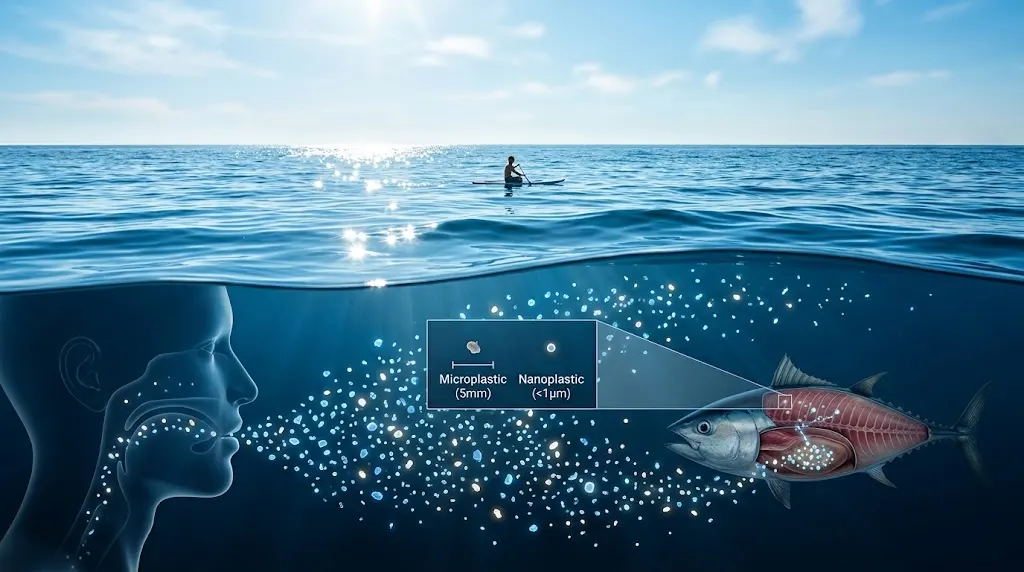
What made this even more shocking is the scale. Scientists now estimate that while trillions of plastic pieces float on the surface, quadrillions of nanoplastics may exist deeper in the ocean. In other words, the problem didn’t disappear, it just became invisible.
From Ocean Depths to Your Plate
Meanwhile, these tiny particles are entering the marine food chain in ways we’re only beginning to understand.
At the bottom of the food chain, tiny organisms mistake nanoplastics for food. Small fish eat those organisms. Bigger fish eat the smaller ones. Step by step, plastic moves upward a process similar to a snowball rolling downhill, getting bigger as it goes.
What makes this even more concerning is that nanoplastics don’t just stay in a fish’s stomach. They can move into the flesh, the part we actually eat. So when seafood is on your plate, plastic might be there too, just invisible.
Some foods carry higher risk than others. Shellfish like mussels and oysters are considered “high exposure” foods because they filter huge amounts of water daily. Shrimp and small fish like sardines also rank high because they are often eaten whole.
Plastic in the Air ? Yes, Really
On the other side of the story, the ocean isn’t just keeping plastic, it’s sending it back into the air.
When waves crash and bubbles burst, they release tiny droplets into the atmosphere. Along with those droplets come nanoplastics. This process creates what scientists now call “plastic rain” particles that travel through the air and fall back to Earth.
That means even if you don’t eat seafood, you’re still exposed. These particles can be breathed into the lungs, carried by wind, and deposited on crops and water supplies.
It’s a cycle: from land to ocean and back again.
Why This Matters for Your Health
Beyond the environment, this issue is now personal. Recent studies have found microscopic plastic particles in human blood and arteries, a discovery that is shifting this from an environmental issue to a health concern.
In some cases, people with plastic particles in their arteries were found to have a much higher risk of heart problems, including heart attacks and strokes. Scientists believe this happens because the body treats plastic like an unwanted intruder, triggering chronic inflammation.
Even more concerning, nanoplastics can act like tiny “carriers,” bringing harmful chemicals deeper into the body. It’s a bit like a Trojan horse small, hidden, and potentially damaging.
Small Changes That Make a Difference
At this point, avoiding nanoplastics completely isn’t realistic. But reducing exposure? That’s something we can do.
Start simple. Avoid heating food in plastic containers, as heat can release more particles. Choose filtered tap water over bottled water when possible. At home, regular dusting can help reduce airborne particles from synthetic fabrics.
When it comes to seafood, small steps help too. Opt for larger fish fillets instead of whole small fish, and properly clean shrimp before cooking. Even rinsing seafood briefly can reduce surface particles.
A Problem We Can Still Turn Around
It’s easy to feel overwhelmed by all this. After all, how do you fight something you can’t even see?
But here’s the hopeful part: awareness is growing, and change is already underway.
Global discussions, including efforts toward a plastic treaty, aim to reduce plastic production and waste at its source.
The story of nanoplastics is a reminder of something bigger. The ocean isn’t separate from us, it’s connected to our food, our air, and our bodies.
And that means every small action we take today can help shape a cleaner, safer world tomorrow.