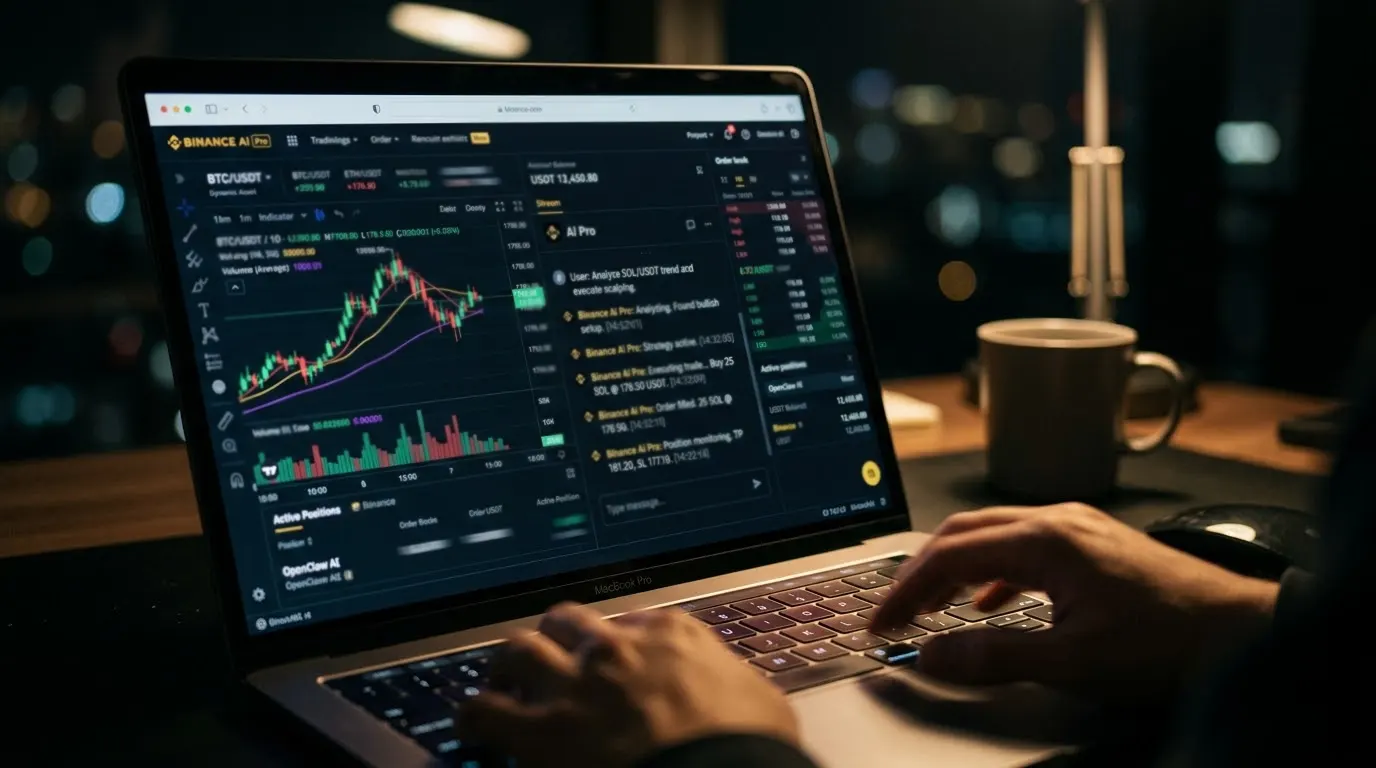
For years, crypto trading tools have promised to make markets easier to navigate. Most of them ended up as smarter dashboards or chatbots that explain what’s happening.
Now, Binance is trying something different.
With the launch of Binance AI Pro, the company is handing over something far more powerful: the ability for AI to actually execute trades on your behalf. Not suggest.
Not guide. Execute.
That shift from advice to action is what makes this moment stand out.
From Chatbot to “Agent”: The AI That Has Hands
Until now, most trading AIs behaved like assistants. You could ask questions, get analysis, maybe even generate a strategy. But you still had to click the buttons yourself.
Binance AI Pro changes that by introducing what’s known as “agentic AI.” In simple terms, that means the AI doesn’t just think, it acts.
Instead of stopping at “you should buy,” the system can place the order, manage the position, and adjust strategy in real time.
Under the hood, it runs on something called the OpenClaw ecosystem. You don’t need to understand the technical details, but the key idea is this:
the AI is connected directly to trading tools, giving it the ability to carry out tasks like a human trader would.
That’s a big leap. And it raises an obvious question: how much control are users actually giving up?
A “Brain Swap” for Your Trading Strategy
One unusual feature is that you’re not locked into a single AI system.
Binance AI Pro lets users choose between multiple large language models basically different “brains” for the AI. These include tools from OpenAI (ChatGPT), Anthropic (Claude), and Alibaba (Qwen), among others.
Each model has its own strengths. Some are better at reasoning. Others are faster or cheaper to run.
The idea is simple: you can match the AI’s “thinking style” to your trading strategy.
But there’s a catch. These models run on a credit system. Users get 5 million usage credits per month, and more advanced models consume more credits per request.
Once those credits run out, the system automatically switches to simpler models.
In practice, that means your AI trader can quietly downgrade itself mid strategy something most users may not immediately notice.
The “Sandbox” That Keeps Your Money (Mostly) Safe
Letting an AI trade your money raises obvious concerns. What happens if it makes a mistake? Or worse, sends funds somewhere it shouldn’t?
Binance’s answer is a “sandbox” system.
When you activate AI Pro, it creates a separate sub account. You manually transfer funds into it, and the AI can only access that pool.
Most importantly:
the AI cannot withdraw or transfer funds out of the account.
It can trade. It can open and close positions. But it cannot move your money elsewhere.
This design is meant to prevent worst case scenarios, like an AI glitch sending funds to a random crypto wallet.
Still, it doesn’t eliminate risk entirely. The AI can still lose money through bad trades, it just can’t steal it.
Turning Plain English Into Trading Strategies
Using the system is surprisingly simple.
Instead of navigating charts and indicators, you can just type instructions in plain language. For example:
- “Analyze the top trending tokens”
- “Create a short term trading strategy”
- “Execute it with 500 USDT”
The AI handles the rest.
Behind the scenes, it uses something called “skills”, pre built tools that let it perform specific actions. These include placing trades, analyzing blockchain data, and managing leveraged positions.
What used to require coding, technical analysis, and experience can now be done with a sentence.
That simplicity is part of the appeal. But it’s also what makes the tool potentially disruptive.
The Quiet Arrival of Retail High Frequency Trading
In traditional finance, high frequency trading (HFT) refers to using powerful algorithms to execute trades at high speed. It’s usually the domain of hedge funds and specialized firms.
Binance AI Pro doesn’t fully replicate that world but it moves in that direction.
By combining automation, real time data, and fast execution, it gives everyday users access to strategies that were once limited to professionals.
For example, a user can ask the AI to run a “scalping” strategy quick trades designed to capture small price movements with built in risk controls like stop loss limits.
This is what some are calling the “democratization of advanced trading.”
But democratization cuts both ways. Easier access can also mean more people taking risks they don’t fully understand.
Why This Launch Matters Beyond Crypto
At first glance, this might look like just another crypto feature rollout. It’s not.
What Binance is testing here is a broader idea:
What happens when AI systems are allowed to act directly in financial markets?
That question goes beyond crypto.
If tools like this become mainstream, they could reshape how people invest not just in digital assets, but across stocks, commodities, and beyond.
It also raises deeper concerns:
- How much should users trust automated decision making?
- What happens when thousands of AI agents react to markets at the same time?
- And who is responsible when things go wrong?
These are questions regulators and users are only beginning to grapple with.
The Real Shift: From Tools to Delegation
In the end, Binance AI Pro is not just another feature. It represents a shift in how people interact with technology.
We are moving from using tools to delegating decisions.
That’s convenient. It’s powerful. And it’s a little unsettling.
Because once you let an AI trade for you, the hardest question isn’t how it works.
It’s whether you’re still the one in control.