You know how it is when you check your sleep tracker in the morning and see
a low sleep score and suddenly you feel more stressed than rested ? We’ve all been there.
For years, sleep technology mostly focused on tracking rings, watches, and apps collected data while we slept, then showed us charts the next morning. But in 2026, something big has changed.
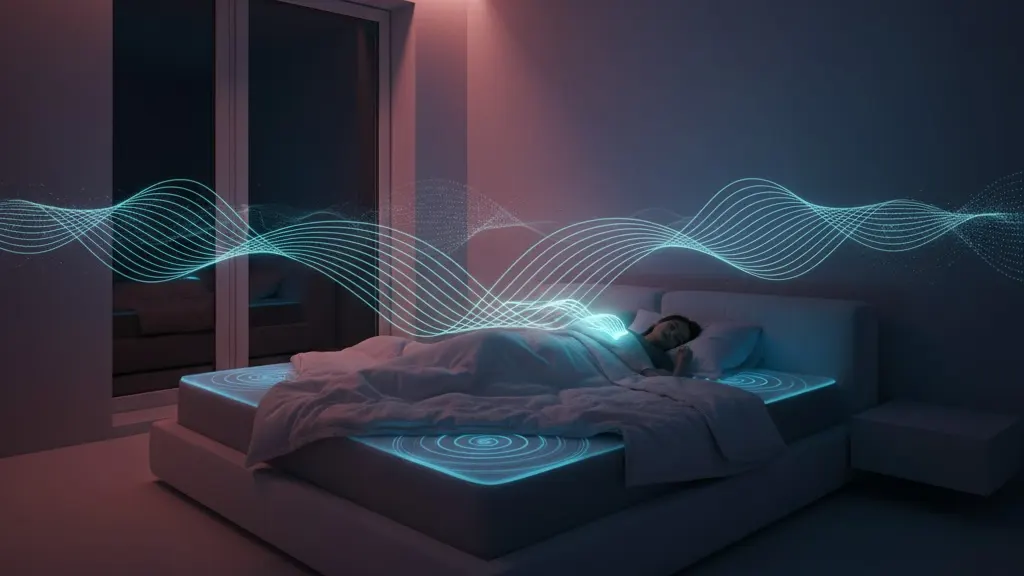
We’ve entered the era of “Rewired Wellness.” Instead of just measuring sleep,
technology is now actively helping improve it while you sleep.
In other words, your bedroom is quietly turning into what experts call
a “biological cockpit.”
Goodbye Wearables: The Rise of Invisible Sleep Sensors
For a long time, improving sleep meant wearing a ring, watch, or wristband to bed.
But the newest trend is surprisingly simple: no wearables at all.
Companies are developing “Spatial AI” systems that sit quietly in your room and monitor your body without touching you.
These systems use millimeter wave sensing, a type of low power radar technology that can detect subtle movements in your chest as you breathe.
Interestingly, this is often the same radar style sensing technology used in modern smart home motion detectors and gesture controlled devices, which helps explain how the system can monitor sleep without cameras or sensors on your body.
These small bedside hubs quietly track signals like:
- Breathing patterns
- Heart rate
- Body movement during sleep
The biggest benefit ? You simply go to bed like normal no rings, no watches, no gadgets.
And unlike older trackers, these devices don’t just observe your sleep. They help shape it.
When Your Bedroom Starts Adjusting Itself
Imagine drifting off while your bedroom quietly adjusts itself to support your body.
That’s exactly what modern AI powered sleep environments are beginning to do.
Instead of fixed settings like “lights out at 10 PM,” the room adapts in real time based on your biometrics.
Adaptive Lighting
Smart lighting now works with your body’s natural rhythm.
As bedtime approaches, lights gradually shift from warm white to deep red tones, which help your body release melatonin the hormone responsible for sleep.
Then, once the system detects deeper sleep stages, the lights switch off automatically to ensure total darkness.
Smart Temperature Control
Your body temperature naturally fluctuates throughout the night especially during REM sleep.
Smart mattresses like the Eight Sleep Pod 4 use something called a digital twin, which is essentially a virtual model of your body.
By analyzing heart rate, breathing, and temperature patterns, the system predicts when your body might heat up and cools the mattress a few degrees before that happens.
The result ?
Less tossing and turning and more uninterrupted sleep.
Noise Cancellation for Your Entire Room
If you’ve ever been woken by traffic, a car alarm, or even a snoring partner, you know
how easily sleep can be disrupted.
New smart home systems are tackling this problem using room scale active noise cancellation.
Here’s the basic idea:
- Microphones detect incoming noise
- Speakers create an opposite sound wave
- The waves cancel each other out
This process, called destructive interference, can significantly reduce sudden sounds before they wake you.
Think of it as noise canceling headphones but for your entire bedroom.
How Sleep Tech Has Changed: Passive vs. Active Sleep
To really understand the shift happening in sleep technology, it helps to visualize the difference between the old model and the new one.
The Old Way: Passive Sleep Tracking
Step 1: You fall asleep wearing a tracker.
Step 2: The device records your sleep data.
Step 3: You wake up and check your sleep score.
Step 4: You try to adjust your habits the next night.
Result:
You get helpful data but nothing actually helps you while you’re asleep.
The New Way: The Active Sleep Loop
Now the system works very differently.
Step 1: Sensors monitor breathing, heart rate, and movement.
Step 2: AI analyzes your sleep stage in real time.
Step 3: Your environment responds automatically.
For example, your room might:
- Dim lights to protect melatonin levels
- Cool the mattress during REM sleep
- Neutralize sudden outside noises
Result:
Your bedroom becomes a closed loop recovery system that actively protects your sleep.
The Breakthrough That Could Predict Your Health
One of the most fascinating developments in sleep science comes from Stanford researchers, who recently introduced an AI model called SleepFM.
Instead of simply measuring sleep quality, SleepFM analyzes how different systems in your body interact during sleep.
By studying one night of sleep data, the model can identify patterns linked to more than 130 health conditions, including:
- Parkinson’s disease
- Dementia
- Heart attacks
- Atrial fibrillation
- Chronic kidney disease
The idea is that sleep contains a hidden “biological language.”
Just like AI models learn patterns in written text, SleepFM learns patterns in brain waves, heart signals, breathing rhythms, and muscle activity.
But there’s an important distinction to remember.
SleepFM predicts risk, it does not diagnose illness.
Right now, it’s primarily a research tool used in sleep labs rather than consumer apps.
Still, it hints at a future where sleep data might help doctors detect health risks years earlier than before.
Brain Tech Sleep: The Rise of Digital “Sleep Pills”
For people looking to take sleep optimization even further, a new category of technology is emerging: consumer brain-computer interfaces.
Devices like the Muse S Athena headband monitor your brainwaves while you sleep.
But instead of simply tracking them, they respond.
The system uses a process called auditory gating.
Here’s how it works:
- Sensors detect your brainwave patterns in real time.
- If your brain struggles to stay in deep sleep, the system responds.
- Subtle rhythmic sounds guide your brain back into deeper sleep waves.
This technique, known as neural entrainment, helps the brain synchronize with calming rhythms.
In simple terms, these devices act like digital sleeping pills without medication.
Their goal is to:
- Reduce sleep latency (fall asleep faster)
- Prevent fragmented sleep
- Wake you during lighter sleep stages to reduce morning grogginess
The Hidden Downside: When Sleep Becomes Too Perfect
Of course, even helpful technology can create new pressures.
Sleep researchers have noticed a rising phenomenon called orthosomnia.
This happens when people become so focused on achieving perfect sleep metrics that the anxiety itself disrupts sleep.
You know the feeling.
You lie in bed thinking:
“I have to get eight perfect hours tonight.”
And suddenly… you can’t sleep.
It’s a reminder that while technology can guide us toward better rest, it shouldn’t become another source of stress.
The Big Picture: Your Bedroom as a Wellness Partner
When you step back and look at these technologies together, something remarkable appears.
Your bedroom is no longer just a place where you sleep.
It’s becoming a responsive wellness environment one that quietly supports your body while you rest.
The system works as a loop:
- Your body data guides the environment.
- The environment adjusts to protect your sleep.
- Better sleep supports long term health.
And the most impressive part ?
Most of it happens automatically, while you’re asleep.
A Future Where Sleep Works With You
All of this technology from invisible sensors to AI driven lighting has one simple goal:
Better rest.
Better mornings.
And better long term health.
Sleep is no longer just something we track the next morning.
It’s becoming something our homes actively help us improve.
And as these technologies evolve, your bedroom may quietly become the most advanced wellness space in your entire home.
So tonight, when you turn out the lights, remember:
Your bedroom might already be working behind the scenes helping you wake up feeling a little more like yourself again. 🌙